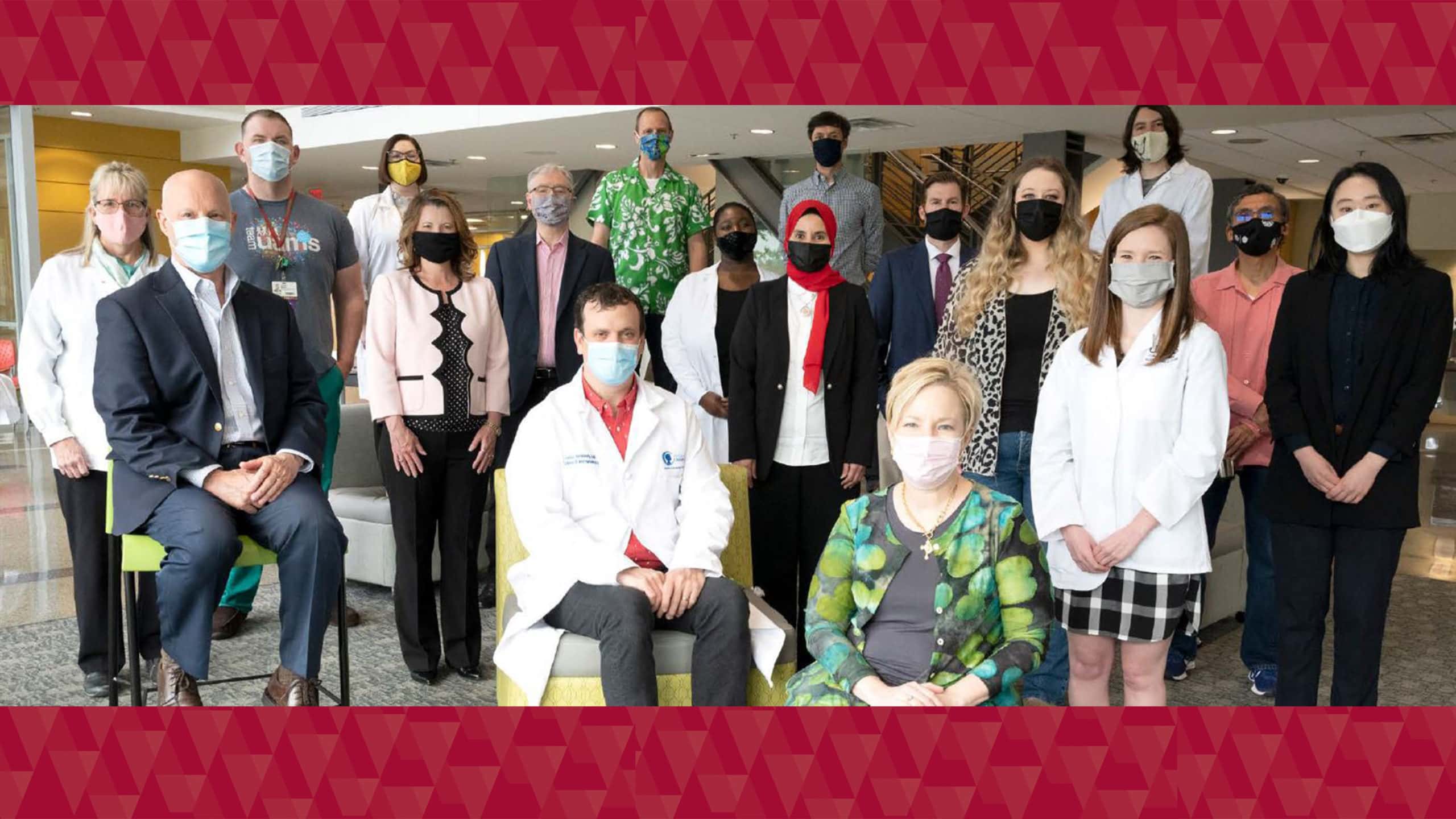
UAMS Releases Findings from Statewide COVID-19 Antibody Study
| LITTLE ROCK — A statewide COVID-19 antibody study led by UAMS found that by the end of 2020, 7.4% of Arkansans had antibodies to the virus. UAMS researchers released their findings this week to a public database, medRxiv (med archive).
The study included analysis of more than 7,500 blood samples from children and adults across the state. It was conducted in three waves from July to December 2020. The work was supported by $3.3 million in federal coronavirus aid that was then allocated by the Arkansas Coronavirus Aid, Relief and Economic Security Act Steering Committee created by Gov. Asa Hutchinson.
Unlike diagnostic tests, COVID-19 antibody testing looks back into the immune system’s history. A positive antibody test means the person was exposed to the virus and developed antibodies against SARS-CoV-2, the virus that causes the disease known as COVID-19.
The UAMS team collected blood samples from children and adults. The first wave (July/August 2020), revealed low rates for SARS-CoV-2 antibodies, averaging 2.6% in adults. However, by November/December, 7.4% of adult samples were positive.
Blood samples were collected from individuals seen at medical clinics for non-COVID reasons and who were not known to have had COVID-19 infection. The antibody positivity rates reflected cases of COVID-19 in the general population.
While the overall positivity rate in late December was relatively low, the findings are important because they indicate previously unrecognized COVID-19 infections, said UAMS’ Josh Kennedy, M.D., a pediatric allergist and immunologist who helped lead the study.
“Our findings underscore the need for everyone to get vaccinated as soon as they can,” Kennedy said. “Very few people in the state have immunity from a natural infection, so vaccination is key for getting Arkansas out the pandemic.”
The team found little difference in antibody rates between rural and urban residents, which surprised researchers who thought rural residents might be less exposed.
The antibody test was developed by UAMS’ Karl Boehme, Ph.D., Craig Forrest, Ph.D., and Kennedy. Boehme and Forrest are associate professors in the College of Medicine Department of Microbiology and Immunology.
The UAMS Fay W. Boozman College of Public Health helped identify study participants through their contact tracing call center. In addition, samples were obtained from UAMS Regional Program sites across Arkansas, the Arkansas Federation for Medical Care and the Arkansas Department of Health.
Faculty within the College of Public Health and College of Medicine participated in the epidemiologic and statistical evaluation of the data and included College of Public Health Dean Mark Williams, Ph.D., Benjamin Amick, Ph.D., and Wendy Nembhard, Ph.D., as well as Ruofei Du, Ph.D. and Jing Jin, MPH.
The study represents a major collaboration for UAMS, including the Translational Research Institute, Regional Programs, the Rural Research Network, the College of Public Health, the Department of Biostatistics in the College of Medicine, UAMS Northwest Regional Campus, Arkansas Children’s, the Arkansas Department of Health and Arkansas Foundation for Medical Care.
The Translational Research Institute is supported by grant TL1 TR003109 through the National Center for Advancing Translational Sciences of the National Institutes of Health (NIH).
UAMS is the state’s only health sciences university, with colleges of Medicine, Nursing, Pharmacy, Health Professions and Public Health; a graduate school; hospitals in Little Rock and Bryant; an orthopaedic hospital; a main campus in Little Rock; a Northwest Arkansas regional campus in Fayetteville; a statewide network of regional campuses; and seven institutes: the Winthrop P. Rockefeller Cancer Institute, Jackson T. Stephens Spine & Neurosciences Institute, Harvey & Bernice Jones Eye Institute, Psychiatric Research Institute, Donald W. Reynolds Institute on Aging, Translational Research Institute, and the Institute for Community Health Innovation. UAMS includes UAMS Health, a statewide health system that encompasses all of UAMS’ clinical enterprise, including partnering hospitals in Pine Bluff, Helena-West Helena, Mena, and Warren. UAMS is the only adult Level 1 trauma center in the state. UAMS has 3,813 students and 1,030 medical residents and fellows, and two dental residents. It is the state’s largest public employer with about 12,000 employees, including 1,200 physicians who provide care to patients at UAMS, its regional campuses, Arkansas Children’s, the VA Medical Center and Baptist Health. Visit www.uams.edu or uamshealth.com. Find us on Facebook, X (formerly Twitter), YouTube or Instagram.###