UAMS Faculty Learn Ways to Help Students Who are Struggling
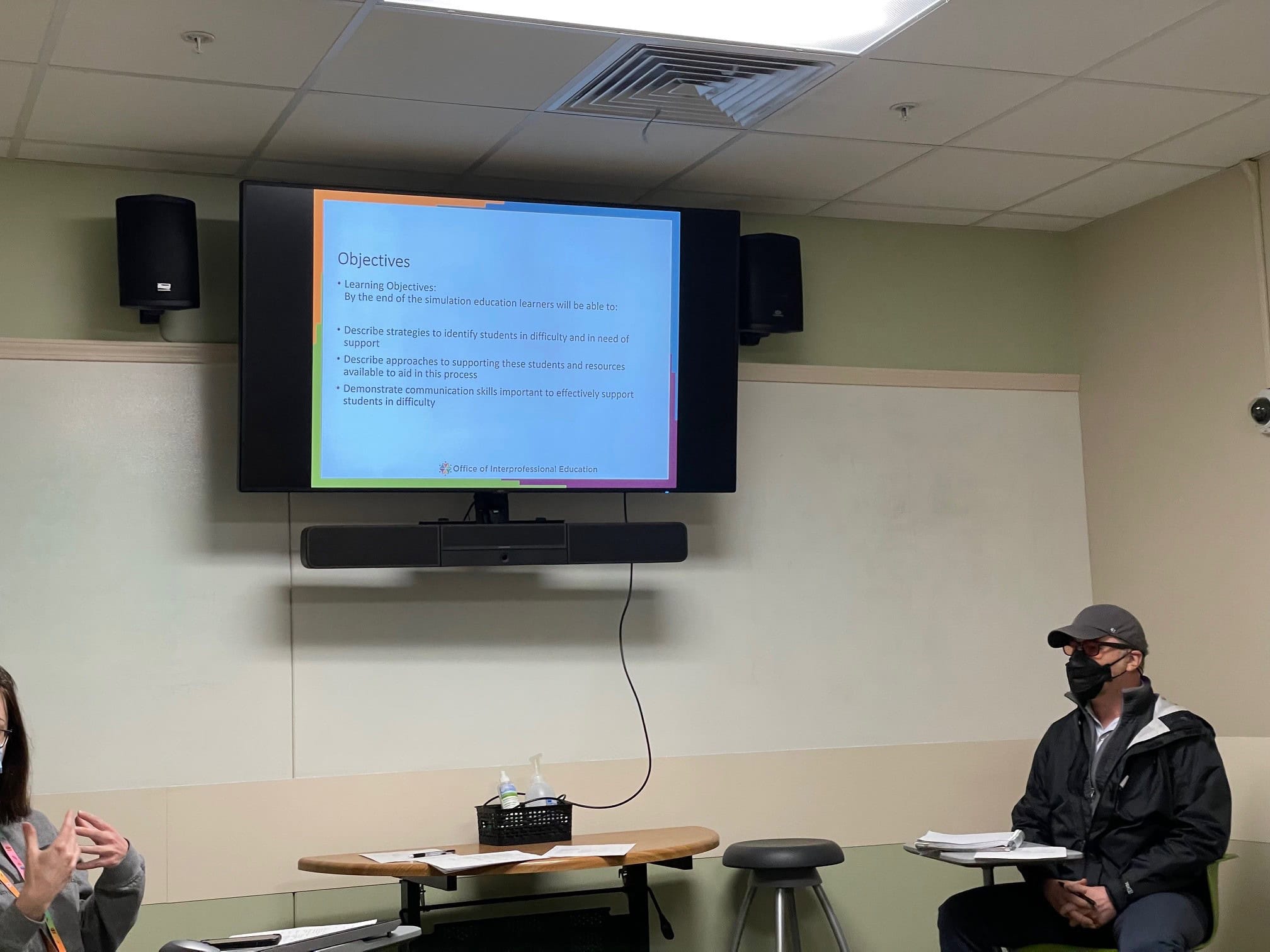
| Faculty members from various colleges gathered earlier this month in the University of Arkansas for Medical Sciences (UAMS) Simulation Center to learn effective ways of supporting students in difficulty, including how to steer them toward helpful resources.
It was the first in a series of educational sessions for faculty focusing on supporting students in difficulty. This education has been developed by a group of interprofessional faculty led by Karen Dickinson, M.D., an assistant professor in the College of Medicine Department of Surgery and director of Interprofessional Simulation and Clinical Skills Training at UAMS. The group brings subject matter experts on simulation education, student issues, counselling, suicide and Title IX, amongst other topics and, with Dickinson, includes Wendy Ward, Ph.D.; Kathryn Neill, Pharm.D.; Matthew Boone, LCSW; Rikki Turner, Ed.D.; Linda Larson-Prior, Ph.D.; and Michelle Zengulis.
Dickinson began the Feb. 12 session asking all faculty learners to describe their role in engaging with students, so the group could better understand everyone’s roles and responsibilities, enriching the discussion and learning.
Boone, an instructor in the College of Medicine’s Department of Psychiatry who is associate director of the Student Wellness Program, delivered education and advice to the learners before the simulation education began. He said he knows that faculty members often want to reach out to struggling students, but that “sometimes it’s not clear what to do.”
He assured them, “You probably already have most of the tools in your toolbox,” adding “the best tool in your toolbox is showing you care.”
Boone said 1 in 5 people have a psychiatric disorder every year, and that antidepressants are the most prescribed drugs in the United States for people between the ages of 20 and 59, so it’s not uncommon to encounter students who are in distress, even if they don’t readily reveal it.
“Usually, we are comparing our insides to other people’s outsides,” he said, explaining why many people feel alone when they are struggling.
Visible signs that students may be overwhelmed include falling behind academically, not showing up for class and displaying a sad, anxious or irritable demeanor, Boone said. He said that when questioned, struggling students may report difficulty keeping up with assignments or trouble sleeping or eating.
“It’s hard to be invested when your mind is elsewhere,” Boone said.
He encouraged faculty to make referrals to student resources at UAMS like the Student Success Center or the specific associate deans in every college who are available to help students.
He noted that students can always contact the Student Wellness Program by calling 501-686-8408 or sending a message to studentwellness@uams.edu. They can also seek help anonymously through the online Interactive Screening Program (ISP), which prompts a reply from someone in his office.
“I tell students this is the most accessible health care you are going to find in your entire life, and it’s free,” Boone said.
Boone encouraged faculty members to check back in with the student after making a referral. “It can mean a lot to a student if a faculty member later follows up, such as through an email, to see how things are going,” he added.
Following this education on resources and different approaches to support students in difficulty, the faculty learners participated in two simulation exercises. These gave the faculty members an opportunity to rehearse different scenarios while the rest of the group watched and listened, to provide structured and thoughtful feedback through templates created by the educational team.
Faculty learners interacted with a standardized participant who played the role of the student in difficulty. The scenarios were based on situations and challenges that students deal with every day. Following the simulation scenario, Dickinson led the debrief in which perspectives from the learners, the standardized participant and faculty facilitators provided rich discussion to prepare faculty to best support UAMS students.
Dickinson said that while this first part of the educational series sets the groundwork for supporting students in difficulty, the following parts focus on different types of struggles. For example, Part 2 addresses suicide and suicidality and Part 3 addresses issues around sexual assault, sexual harassment, pregnancy, breast feeding and lactation issues. She said the next two parts will be delivered in summer and fall 2025.
Other parts are also being developed, and the group is working on creating a similar course to support residents and fellows who are struggling. Dickinson and Neill also will be delivering a workshop to colleagues on the UAMS Northwest Regional Campus to educate on how to best deliver this simulation education at the NWA campus.
“The last few years have been challenging for everyone, with burnout and stress prevalent — through this educational series we hope to support both UAMS faculty and staff who support students, as well as the students themselves,” Dickinson said.