
Pharmacy Alumnus Encourages Growth, Innovation for Community-Based Pharmacy Residents
| Experiential education represents a significant milestone in a pharmacy student’s life, where they learn alongside pharmacists providing care for real patients. As they move from site to site, students begin to make decisions on how they want to specialize in their careers after graduation. Sometimes, it’s a homegrown touch that can have the most impact.
The College of Pharmacy’s postgraduate year one (PGY1) community-based pharmacy residency program aims to develop community-based pharmacists with diverse skills in patient care, leadership, research, and teaching skills. That can lead to devising innovative pharmacy practices and pursuing further training in a second postgraduate year residency training in advanced areas of pharmacy practice
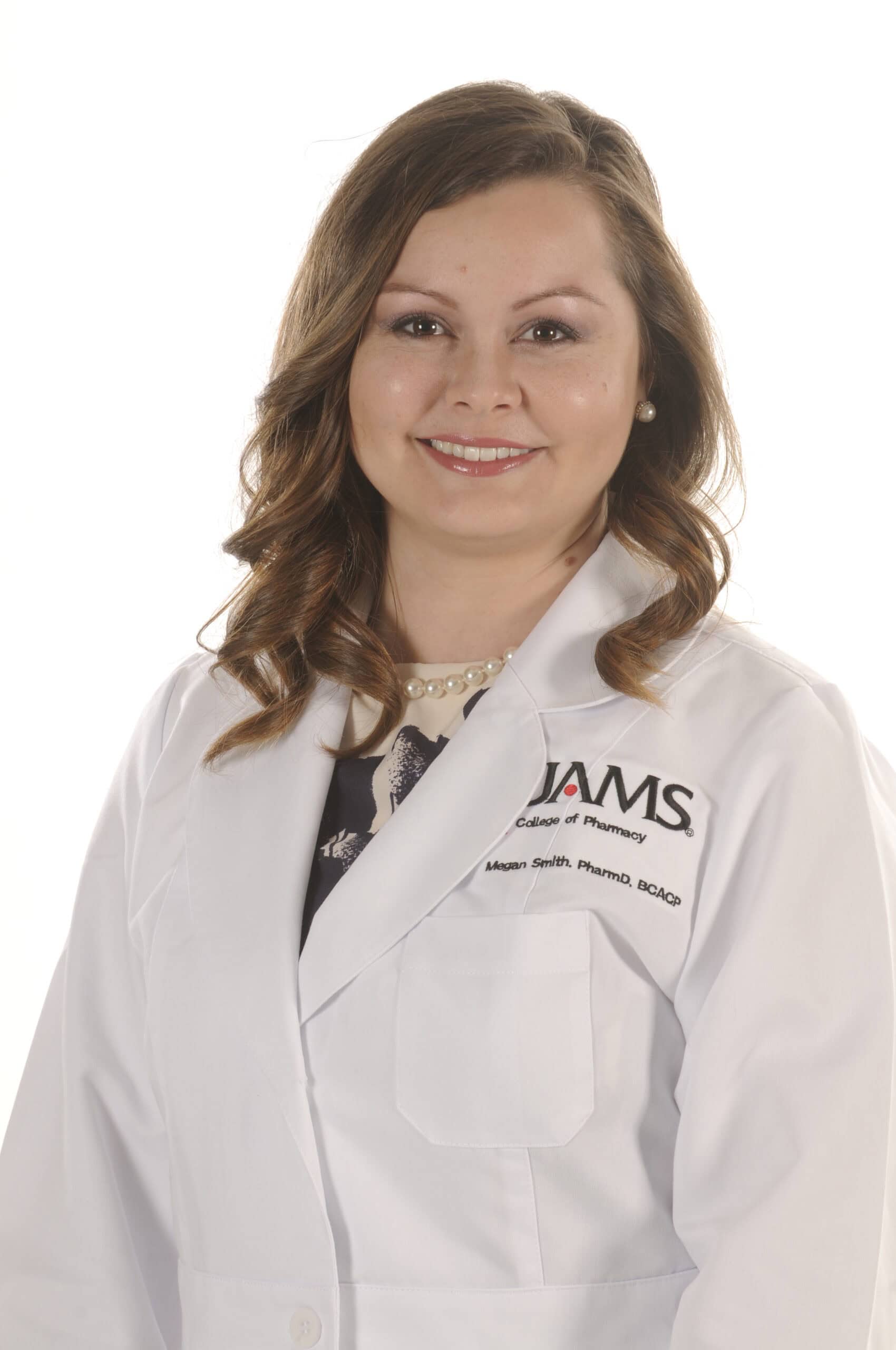
Megan Smith, Pharm.D., said Martin is a strong advocate for the program.
Ultimately, the goal is continuous development. UAMS’ multisite program provides shared curriculum and mentorship across all practice sites, and leads to each resident taking on increased responsibility and independence throughout the year, said Megan Smith, Pharm.D., residency program director and associate professor of pharmacy practice.
“Our residents are matched to a primary practice site, but the program operates as a unified cohort, with shared learning experiences along with consistent expectations and outcomes,” Smith said. “This model ensures depth, continuity, and professional growth over time.”
The PGY1 program has several sites across the state, including Walmart, Kroger, Harps, West Side Pharmacy and the UAMS Outpatient Pharmacy in Little Rock. Bryant Family Pharmacy holds a distinctive role within the program as the pioneering site to establish a residency at an independent pharmacy in the state, setting an early standard for leadership and innovation.
Jon Martin, Pharm.D., Class of 2010, owns Bryant Family Pharmacy and supervises its more than 50 employees, including eight staff pharmacists. He said he enjoys helping residents learn.
“I knew from the beginning of my fourth-year advanced pharmacy practice experiences (APPEs) that I wanted to be a preceptor when I could,” Martin said. “I knew from my experiences how important it was to allow students the opportunity to learn what it’s like to be a pharmacist while still having support from others.”
Martin founded the pharmacy in 2013 with two long-time pharmacy technicians. He joined the PGY1 community-based pharmacy residency program as a preceptor and site coordinator in 2017.
“Jon joined the PGY1 residency program around the time that I became director,” Smith said. “He is a strong advocate for our program and has helped to shape its infrastructure and partnerships into a truly multisite program.”
“As an owner and manager, I’m able to share so many of the experiences I’ve gained with residents,” Martin said. “I strive to allow them to get as much as they want out of my residency. I try to be an open book to them, answer questions, and give advice where I can.”
Bryant Family Pharmacy residents are charged with innovating and expanding the practice of pharmacy, Martin said. That includes not only gaining experience from the residency itself but being allowed to pursue a passion project, such as point-of-care testing, test-to-treat implementation, diabetes education classes, and drug-induced nutrient deficiency.
“We challenge them to try something new and different,” he said. “They get to develop, implement and evaluate the concept. Us being locally owned and operated allows residents to cut out some of the corporate red tape that can slow the implementation of novel ideas.”
Advanced pharmacy practice experiences can be intimidating for any student. There is pressure to quickly adapt their years of classroom instruction into real-world know-how. Knowing that same pressure from his time as a student, Martin said he wants his residents to understand that it’s okay to fail.
“I like to say [to residents] that the residency is their opportunity for an idea to fail, and that is really okay,” he said. “We take the successes and grow them and look at the ideas that didn’t work and see how we might could do things differently next time.”
Since 2017 the Bryant Family Pharmacy has welcomed six College of Pharmacy community-based pharmacy residents. Three now own their own pharmacies, with two serving as community pharmacists and one as an assistant professor of pharmacy practice. As the years go on, Martin said he looks forward to his role in helping shape the profession.
“I truly do enjoy getting the opportunity to develop relationships with the future of pharmacy,” Martin said. “I’ve always said that community pharmacy is constantly changing. There are always hurdles but we have overcome them every step of the way. I tend to believe that is the result of each generation shaping the next and being willing to adapt, change, and grow together.”