View Larger Image
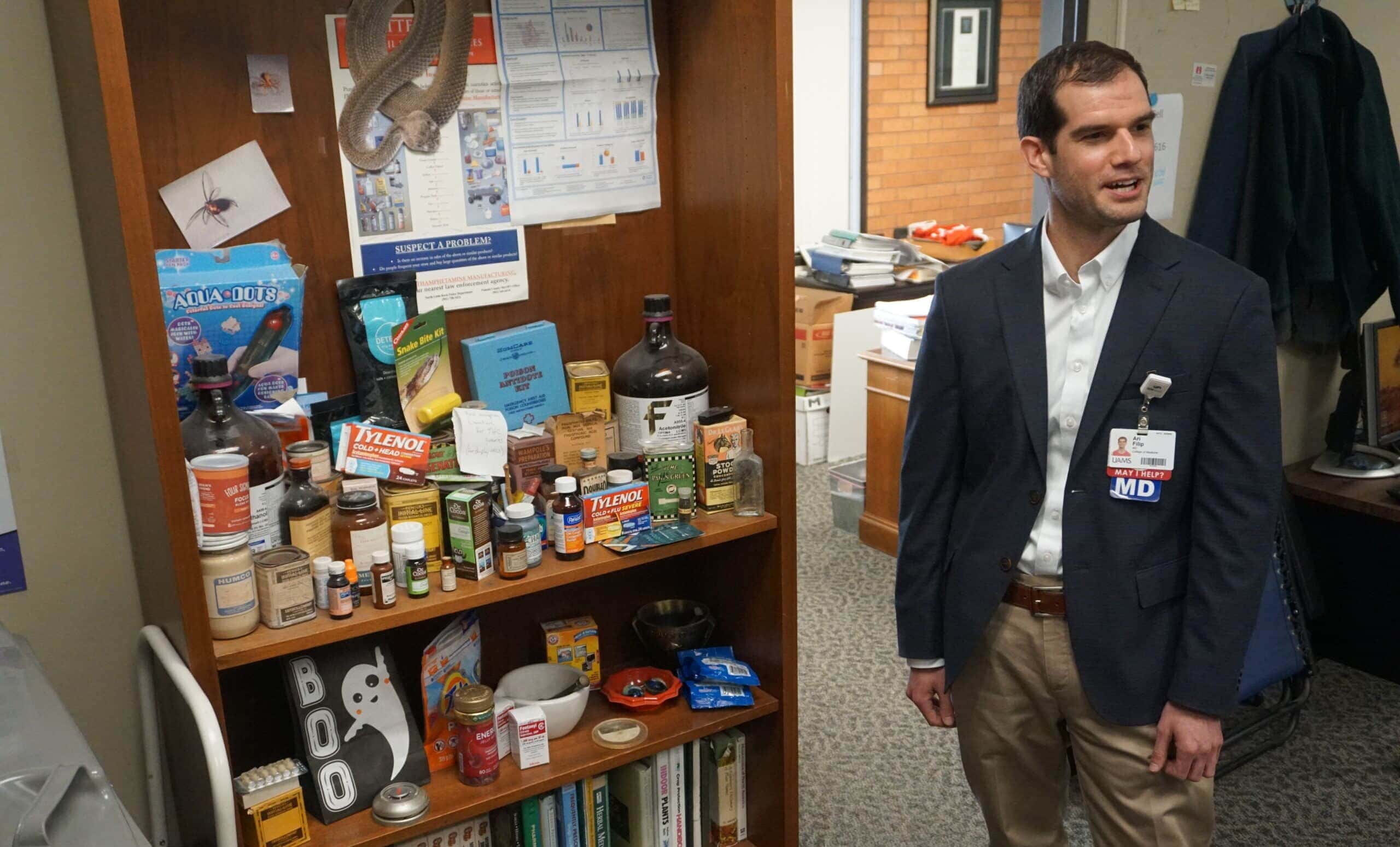
Ari Filip, M.D., the center's medical director, stands in front of a shelf containing items that can cause poisoning in this 2023 photo. Filip said the center's role in public health has continued to expand.
Image by Benjamin Waldrum
State Poison Center Still an Essential Resource for All Arkansans
| As the number and complexity of cases have changed over the years, the Arkansas Poison and Drug Information Center has continued to adapt and evolve its free, statewide service. In addition to its well-known role as a 24/7 call center, the center has also been a growing source of information for the state’s health care facilities.
This progress follows national trends. A recent study conducted by nonprofit RAND Corporation found that poison centers nationwide provide significant monetary and societal benefits as they take on an expanding role in public health.
It’s a role that has evolved even more following the COVID-19 pandemic, said Ari Filip, M.D., the center’s medical director.
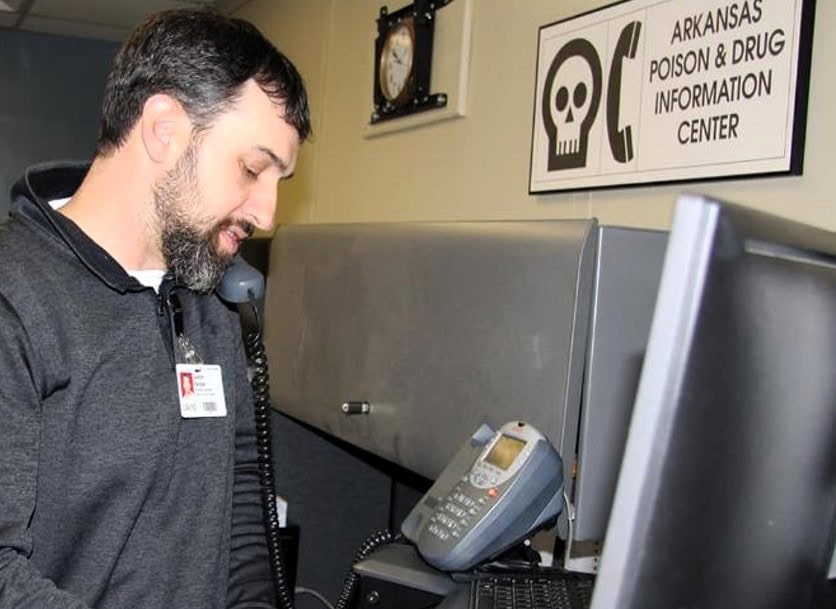
Justin Harper, Pharm.D., a pharmacy specialist at the center, handles a case in this undated photo.
“Our mission has always been to support those at home who have poison and drug-related questions, such as parents with young kids who accidentally get into their parents’ meds, eat something they shouldn’t, or people who have accidents with their medications or other toxic substances,” Filip said. “More recently, we have an increased role in supporting health care facilities as consultants on complex ingestions from intentional overdoses, which has been exacerbated by a large mental health crisis following the pandemic.”
“Since 2005, suicide cases have increased in patients 12 years of age or less,” added Howell Foster, Pharm.D., the center’s managing director.
Hospital-based calls have increased 75% since 2005, Filip said, with “almost double” the number of cases related to overdoses from attempted suicides. To meet this need, he said, the center now employs additional toxicologists along with the nurses and pharmacists already on staff.
“We had only two clinical toxicologists and one medical toxicologist until around 2020 or 2021,” Filip said. “Now we have three of each, with one clinical toxicologist joining last year.”
Additional staffing strains the center’s limited public funding; however, the additional staff is necessary to meet the number of increasing calls, Foster said. In 2021, the center logged approximately 20,000 human exposure cases. Last year, the center answered 29,000 drug and poison related questions and over 22,000 human exposure cases.
The RAND study found that despite their growing value, overall funding for poison centers nationwide has decreased by 8% from 2011 to 2024, as well as a decrease in subsidized support. Centers overall generate an estimated value of 16 times the amount of money spent on services. By reducing emergency room visits or shortening hospital stays, centers save up to $3.1 billion in health care costs each year.
“Our findings demonstrate that the economic and societal value of Poison Centers is significant. Poison Centers take strain off an already-burdened emergency health system, while saving lives and money,” said David Metz, lead author of the report and senior analyst at RAND.
The report confirms the essential role that poison centers play in strengthening national response to poisons and toxic emergencies while providing accessible, expert advice. The report’s release is timely, coming ahead of National Poison Prevention Week, which is recognized each year in the third week of March. Its goal is to teach about the risks of poisonings at any age and increase public involvement in poison prevention.
Founded in 1973 by the UAMS College of Pharmacy, the Arkansas Poison and Drug Information Center has been a free, statewide resource for more than 50 years. It is fully accredited by the America’s Poison Centers formally the American Association of Poison Centers.
Cases come in from each of Arkansas’ 75 counties every month, Filip said. A staff of 16 people handles around-the-clock requests from the state’s population of more than 3 million.
The center continues to innovate and adapt, Filip said, with some staff also performing consults at UAMS and Arkansas Children’s. The center also provides video consultations for snakebites to hospitals statewide thanks to digital health infrastructure provided by the UAMS Institute for Digital Health & Innovation.
Although the methods used to assist the public may have changed over the years, the center continues its mission of information, education, and prevention, Filip said.
“While the health care landscape has changed, our mission has stayed the same: helping prevent, manage, and advise on poison exposures in our state,” he said. “With the hope of ongoing support from the state, the center will continue serving Arkansas’s over 3 million residents, always free of charge. The poison center has been a true public health success throughout its history.”
The center’s poison information hotline is 1-800-222-1222, with a certified specialist in poison information available 24 hours a day, seven days a week.