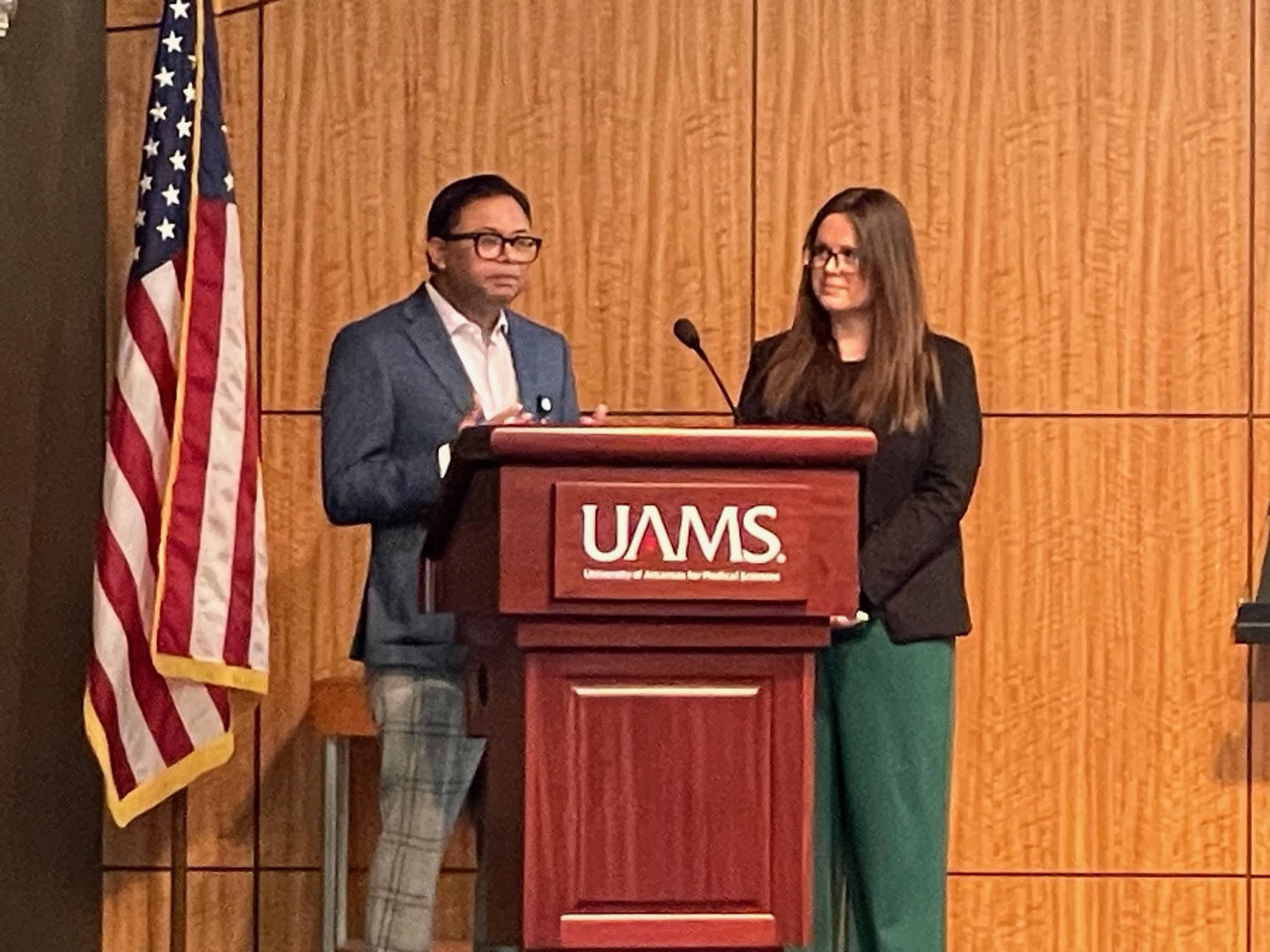
UAMS Hosts Second Multiple Sclerosis Symposium for Patients, Caregivers
| Patients, caregivers and health care professionals recently gathered at the University of Arkansas for Medical Sciences (UAMS) for the 2026 Multiple Sclerosis Symposium, a free, two-hour event focused on treatment options, the latest research, and available resources.
About 200 people, some participating virtually, attended the March 14 event, now in its second year, at the Jackson T. Stephens Spine & Neurosciences Institute on the Little Rock campus.
The symposium began with a participatory chair yoga session and went on to feature personal stories from the perspective of both a patient and her caretaker, as well as a panel discussion by local experts and a look at the impact of multiple sclerosis (MS) on cognition, as well as its lifetime progression.
Liz Adams, a 73-year-old MS patient, told the audience that she was diagnosed with the neurological disease 40 years earlier after she began experiencing “drop foot,” a condition that prevented her from lifting the front part of the foot, causing her to drag or scrape her toes while walking.
She said the diagnosis initially scared her school-age son, who worried that she was about to die, while her husband didn’t believe it because she “didn’t look sick.” Then she fell down the stairs on the job, and after applying for workers’ compensation benefits, lost her property management job.
Adams said her sister arranged a family meeting to figure out how all four siblings could work together to take care of her, but “I was 33 years old. I didn’t need anybody to take care of me, OK? I ended up leaving property management and going into financial services, and I did that for 36 years,” retiring at age 70.
While MS is “inconvenient” and “frustrating,” with fatigue and running out of stamina her biggest complaints, Adams said she has always stayed active and hasn’t let it slow her down much. She said she did have to wear an ankle foot orthosis (AFO) brace initially, and then gradually progressed to needing a walker, followed by surgery and now a wheelchair. But, she emphasized, “it took 40 years for me to get to this point.”
She joked that while some people treated her differently because she used a wheelchair, she became the “best friend” of her caretaker’s 3-year-old son, who loved to ride on the chair with her.
“Our motto is there’s nothing we can’t do together,” she said of Peggy Cromwell, her caretaker of 23 years, who is also her wife. “And we love to travel,” regularly taking river and ocean cruises and visiting major league baseball parks across the country.
While she has needed special accommodations at some hotels and airports, she said, “It’s pretty humorous. But you know what? I’d rather laugh than cry.”
Adams said she has been “blessed,” thanking her “wonderful team of doctors,” led by Robert L. “Lee” Archer, M.D., a longtime UAMS neurologist and former chair of the UAMS College of Medicine Department of Neurology.
The audience then heard from Cromwell, who said that when she met Adams, she was using a cane and driving. Eventually, Adams needed a power chair. Now, thanks to having hand controls installed in her vehicle, which Cromwell said was a relatively simple addition, Adams is still able to drive.
Still, “things are going to change as time goes on,” the caretaker said. “And generally, not for the better. That’s just the reality of the disease.”
She advised other caretakers in the audience to “pay attention all the time,” which can be “exhausting,” because “eventually small changes become big changes. Be prepared for those changes as much as you can. And please, please, please engage a support network of some kind, whether it’s your doctors, a counselor, a trusted friend, or a group of trusted friends.”
Cromwell also encouraged other caretakers to have a plan for taking a break when needed, like going away for the weekend, if they start harboring angry feelings at the patient, because otherwise it can be harmful to both people.
“When frustration becomes directed at the one you’re caring for, you need a break,” she said. “The mortality rate for caregivers is about 30% higher than it is for the people for whom they are caring, which is hard, because as a caregiver, you spend a lot of emotional time, a lot of physical time, a lot of mental time, caring. Don’t neglect your own health and well-being.”
Whitney Allen, Ph.D., a neuropsychology fellow at UAMS, discussed the implications of MS on cognition and offered tips for compensating.
“Our brain is made up of a ton of neurons,” she said. “And the idea is, we have this myelin sheath that wraps around all the connections in our brain. As part of the MS trajectory, it starts to attack these connections. Different areas of our brain have to communicate, and when attacks begin on this sheath, it can slow down our thinking, and that can lead to these cognitive changes that we sometime see in MS.”
Allen said some MS patients have trouble staying on task or losing their train of thought, but more frequently, the disease can affect what is broadly thought of as “executive functioning,” which includes problem solving, switching between tasks, managing a “to do” list, and experiencing disrupted thinking. She said patients often talk about losing “processing speed.”
“Research shows that about 50% of people with MS will sometimes experience some cognitive changes,” she said.
She said fatigue is common, and it, as well as pain, can influence cognitive functioning, which is why “the quality of our sleep is very important for our cognitive resources. I like to think of it as like we have cleaning people that go into our brain at night, and it cleans away the gunk of the day.”
Allen also recommended that MS patients regularly participate in social activity, such as having conversations with people, as “a really good way to stimulate your brain.”
She suggested having strategies in place to compensate when a potentially taxing situation is on the horizon, such as arranging matters of personal comfort before a planned period of focus, to keep from being distracted. She also suggested writing down the pros and cons of a situation to help decision-making.
“We don’t want this to become burdensome,” she said. “You can do this for maybe just the most important things on your to-do list, or if you’re at a very important appointment.”
Following a brief discussion about “MS across the lifespan” by Erin Willis, M.D., a neurologist at Arkansas Children’s Hospital, and Shitiz Sriwastava, M.D., a neurologist at UAMS, participants listened to a 30-minute Q&A session with six expert panelists, including Archer and Sriwastava.
“We have made tremendous progress,” Archer said. “It’s not a hopeless disease at all. I like to use the term ‘nuisance.’ It’s a nuisance, and you have to pay attention to it, and you have to treat it. But the vast majority of people we treat now are controlled.”
Sriwastava said the types of drugs available for treating MS have grown from two to 25, and that the average lifespan of an MS patient is generally no different than that of anybody else.