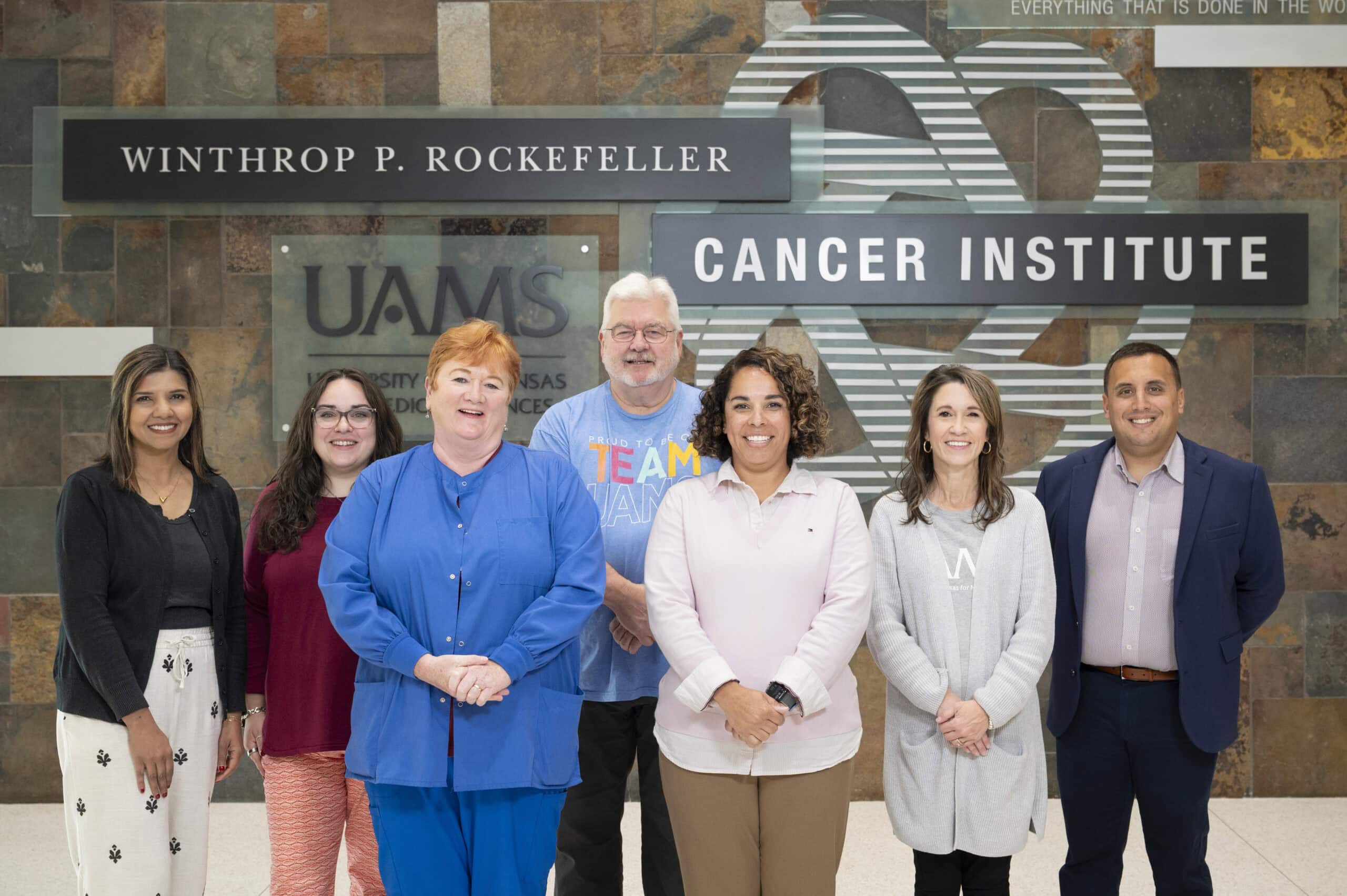
Cancer Institute’s Clinical Research Team Guides Myeloma Clinical Trials
| The Winthrop P. Rockefeller Cancer Institute at the University of Arkansas for Medical Sciences (UAMS) is the state’s leader in cancer clinical trials. Clinical trials are conducted for purposes such as studying new drugs or drug combinations, reviewing a new method of performing surgeries or using existing treatments, or researching ways to prevent diseases.
The Cancer Institute’s Clinical Trials Office has research teams assigned to clinical trials for specific conditions, including multiple myeloma.
“The Cancer Institute Clinical Trials Office supports a growing portfolio of myeloma clinical trials,” said Clinical Trials Office Director Matt Kovak. “Our myeloma team has been a part of many practice-changing clinical trials where UAMS was a top enrolling site, leading to Food and Drug Administration (FDA) approval of needed treatments.”
Susan Panozzo, the assistant director of clinical research operations, explains how the office is organized.
“Our office is comprised of several specialized teams,” she said. “Our regulatory team focuses on the preparation and submission of documentation to sponsors and regulatory agencies, including institutional review boards and the FDA. The finance team develops study budgets, facilitates the payment of participant stipends and reimbursements, and audits clinical trial charges for accuracy and compliance.
“On the operations side, we have research nurses, research coordinators and a laboratory team, all who are involved with the management of a clinical trial, collection of study data and the protection of research participants,” she added. “The research nurses are split based on disease, and two are dedicated to myeloma clinical trials. Coordinators are broken up in a similar way.”
Tia Prichett, manager of clinical research, notes the important role that coordinators play.
“We are the keepers of the protocols,” said Prichett, who has been with UAMS for more than 25 years, including 14 with the Clinical Trials Office. “We ensure that the physicians, nurses and everyone involved are following the procedures specified in the clinical trial. We also make sure patients are treated effectively and safely during the trial.”
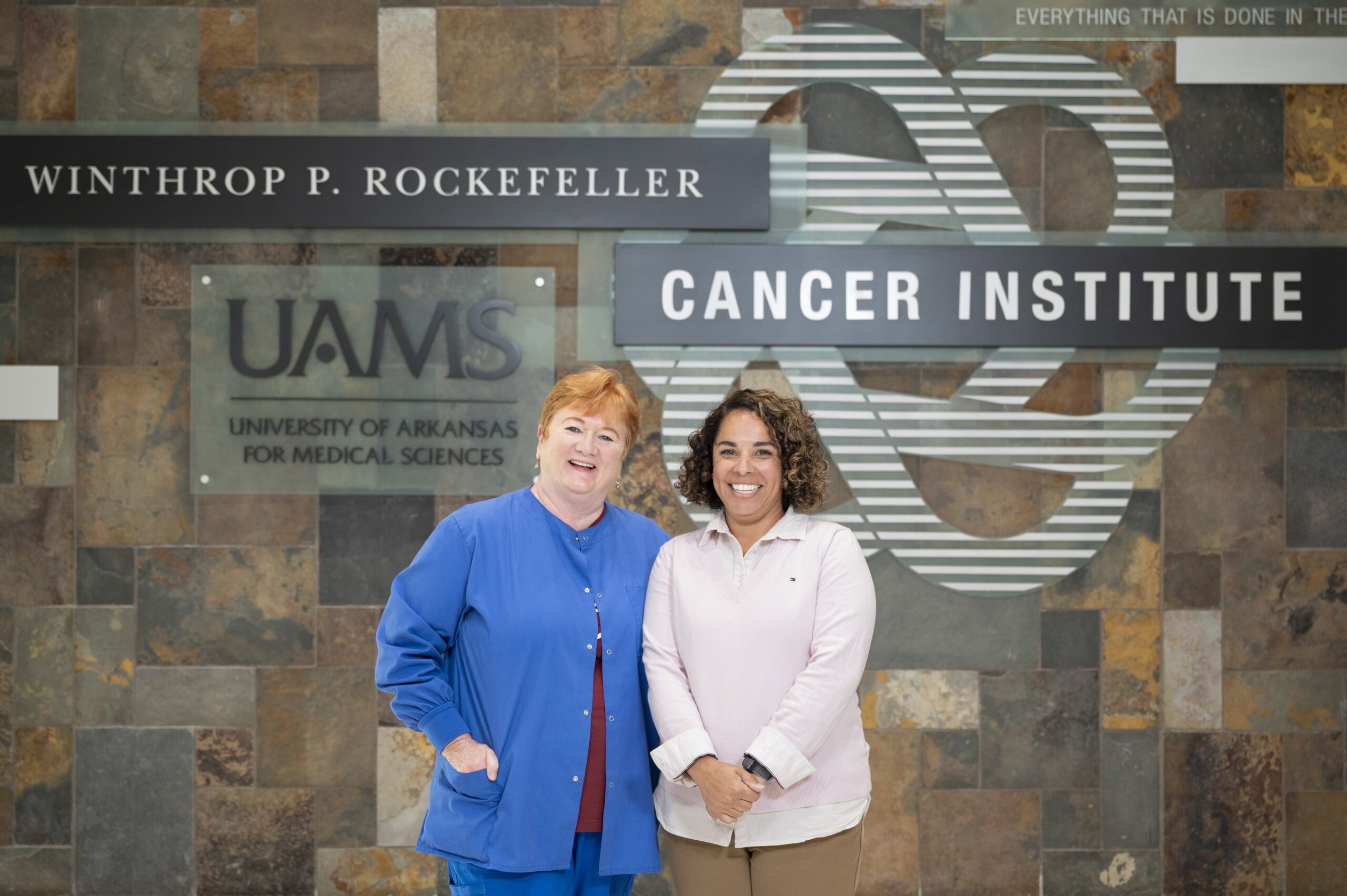
Clinical research nurse Vera Griffin, and manager of clinical research Tia Prichett.Image by Evan Lewis
Research nurses Vera Griffin and Mitchell Mosley bring their experience with direct patient care to the team.
“The clinic approaches us to see if a patient is a possible candidate for a clinical trial,” said Griffin, who spent more than 30 years treating myeloma patients before joining the clinical research team. “The patients must consent before they participate.”
“We do an initial screening of the patient to see if they meet certain criteria. After they consent, we’ll do more testing,” she continued. “For example, in myeloma patients their protein must be at a certain level. There’s also blood work, positron emission topography (PET) scans and MRIs. Once we have all the information, it is sent to the sponsor to determine whether the patient will be accepted into the trial.”
It is vital that patients understand what they are signing up for.
“We discuss with the patient everything involved in a clinical trial,” said Mosley, who has worked in various nursing roles at UAMS since 2016. “We go over the treatments, the possible side effects and other aspects of the trial. Once they feel that they are informed enough to sign the document, we have them sign the consent.”
Data entry is a key point in documenting progress in clinical trials.
“High-quality data entry and participant care is a focus for our team, which is not unnoticed by our patients,” Kovak said.
“The myeloma studies usually require a lot of data entry for very complex clinical trials, so we have multiple coordinators working on them,” said Panozzo.
“About half of what we do is data collection,” Mosley added. “We’re primarily documenting adverse events. It could be something as simple as a headache or itching, or a scenario where a participant needed to be hospitalized. It’s crucial that we get accurate data to submit to the sponsor, which is then subsequently submitted to the FDA.”
Another important aspect of clinical trials the research team must monitor are the activities of trial participants when they’re away from UAMS.
“We have to remember that patients aren’t only seen here, they’re seen everywhere,” Prichett said. “We need a full medical picture of what’s happened since the last time they were at UAMS. There are times where we’ll need to inform an outside facility that a patient is in a clinical trial and the restrictions they’re under. We usually give the patient documentation to keep with them in case they need to go to an emergency room or other location for treatment.”
Monitoring trial participants doesn’t necessarily stop when a trial ends.
“Depending upon the sponsor, we may follow patients for five years or more and continue to collect data,” Griffin said.
The Myeloma Center plays a vital role in the Cancer Institute’ clinical trials program, Panozzo said.
“The Myeloma Center sees patients from all over the world. We can enroll many patients in clinical trials because of the ingrained culture of research and having trials appropriate for the patient population,” she said.