View Larger Image
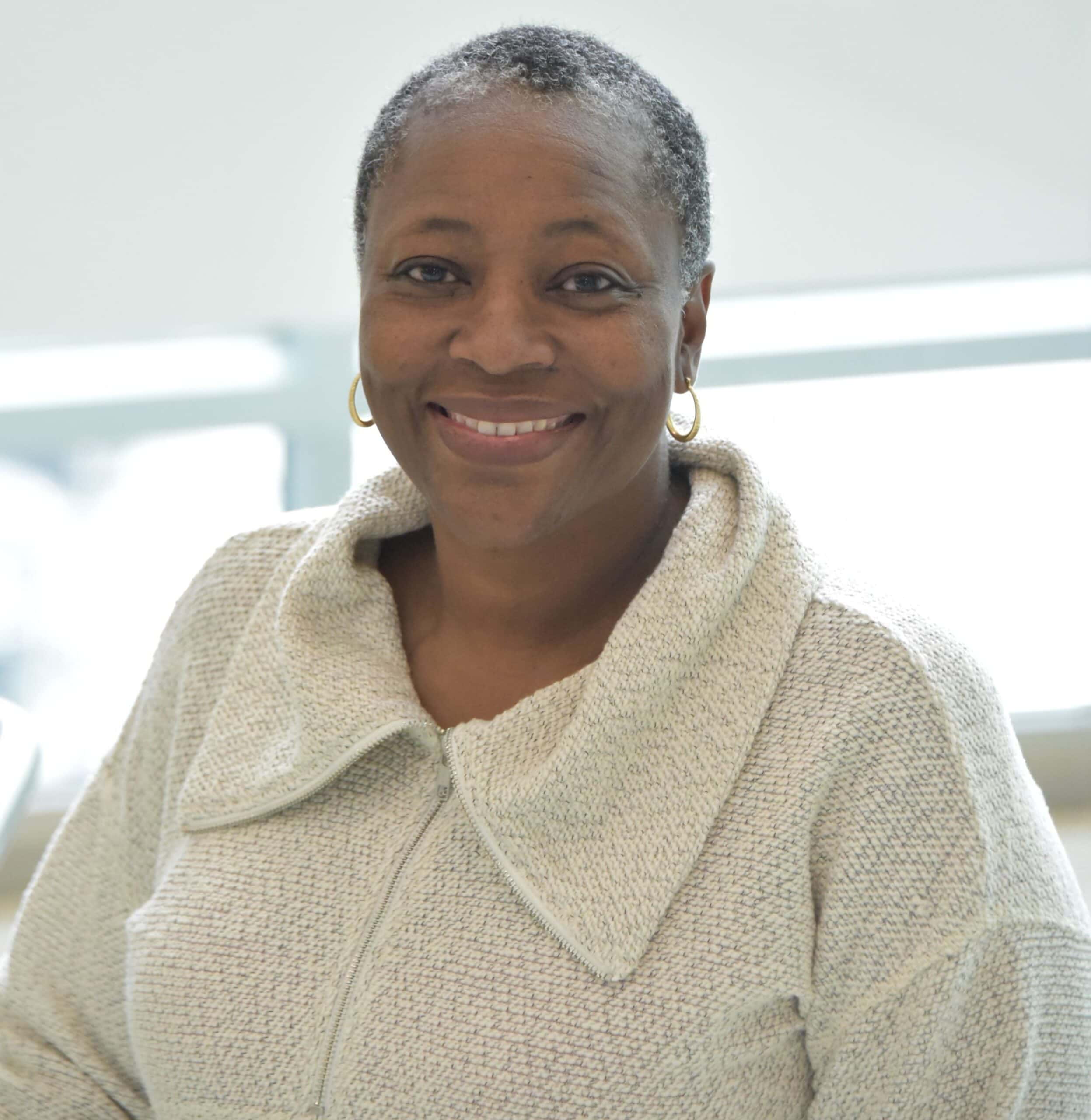
Angelia Hood began her treatment at the UAMS Myeloma Center in October 2021.
Image by Nathan Tidwell
Persistence Leads Myeloma Patient to UAMS
| Angelia Hood didn’t let her initial multiple myeloma diagnosis and treatment keep her from looking for other ways to battle this disease.
“Get a second opinion and continue to do your research,” she said.
That determination to remain in control of her care led Hood to the Winthrop P. Rockefeller Cancer Institute’s Myeloma Center at the University of Arkansas for Medical Sciences (UAMS).
Hood resides in Duncanville, Alabama, a community about 12 miles south of Tuscaloosa and around 60 miles south of Birmingham. A retired speech language pathologist and special education coordinator, her myeloma experience began with back pain in July 2017.
“I thought I had strained or pulled a muscle,” she said. “Not only was my back aching, but I also began to feel pain in my legs. I had X-rays taken, and a local doctor said they looked a little concerning. After consultation with a radiologist, it was found that I had lesions on my back and on my legs and was told it was multiple myeloma.”
It was disconcerting news.
“I was devastated,” said Hood. “I had never heard of multiple myeloma. After hearing what the disease was, it wasn’t reassuring at all.”
Her initial treatment included one autologous stem cell transplant. However, she continued to explore additional methods to deal with her condition.
“One day I was online and saw a local support group. I contacted them and was invited to a meeting,” said Hood. “Everyone in the group was being treated at UAMS, and they recommended I go there for a second opinion.”
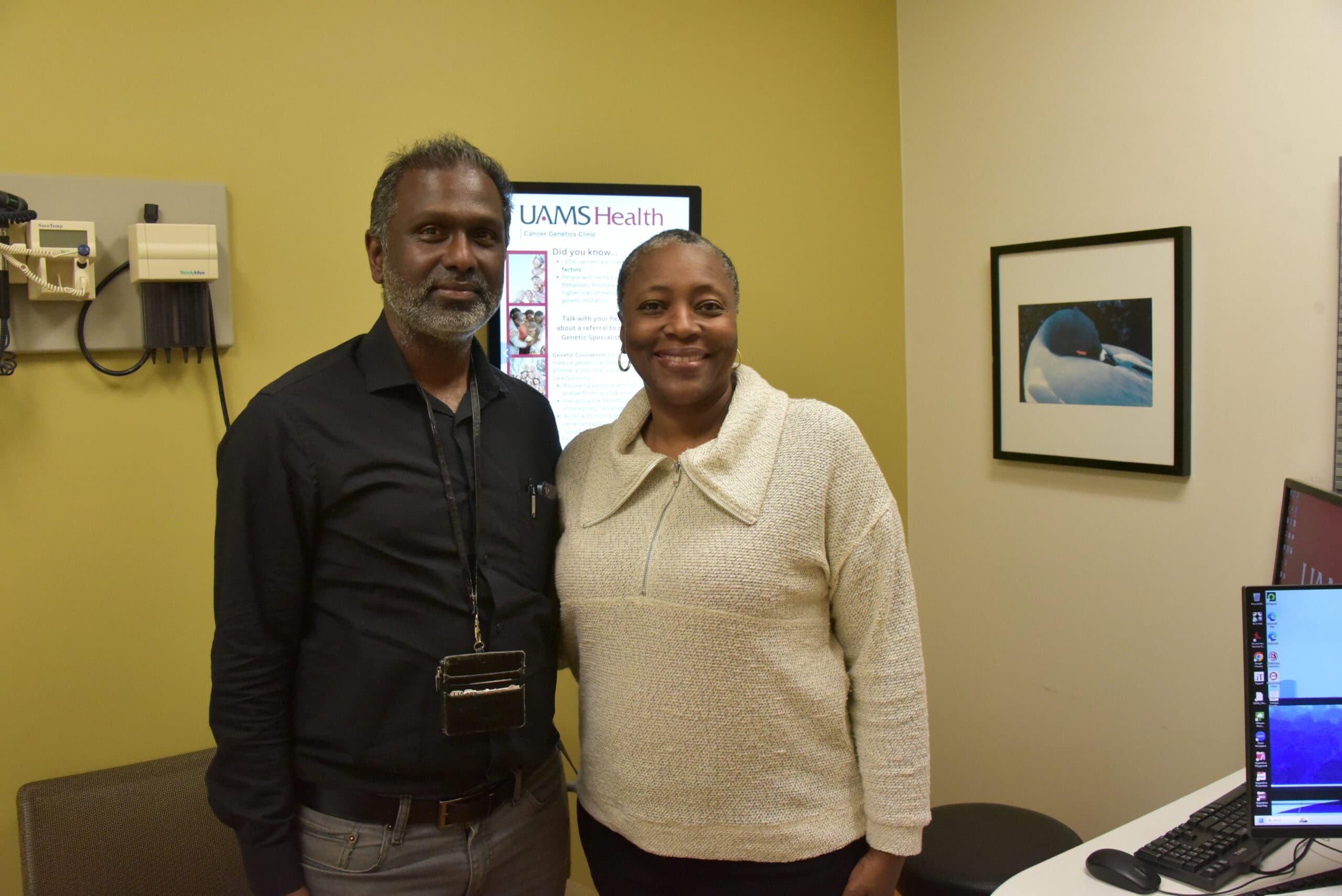
Myeloma Center physician Sharmilan Thanendrarajan, M.D., Ph.D., and Angelia Hood.Image by Nathan Tidwell
She contacted the Myeloma Center and had her first appointment in October 2021. The Myeloma Center’s well-known reputation for getting patients in quickly made a great first impression.
“It was a very quick turnaround — less than two weeks from when I first called,” Hood said.
The extensive care available at UAMS was also a benefit.
“I had a problem with my shoulder, had X-rays taken, and an orthopaedic doctor came to see me. It was great,” she said.
Myeloma Center physician Sharmilan Thanendrarajan, M.D., Ph.D., oversees her treatment.
“He explained to me that my first appointment would be the longest. He went through all my records thoroughly — no stone was left unturned,” said Hood.
“She’s received various therapies, including chimeric antigen receptor (CAR) T-cell treatment,” Thanendrarajan said. “She is now considered in stringent complete remission.”
Hood has undergone two treatment protocols with UAMS.
“Initially I was prescribed daratumumab, cytoxan, kyprolis and dexamethasone,” she said. “I was on that regimen until the fall of 2024. I had a relapse, so Dr. Thanendrarajan recommended CAR T-cell therapy.
“I had that treatment in January 2025 and was at UAMS for about five weeks,” she continued. “I’ve responded very well.”
Hood noted the improvement in her quality of life since receiving CAR T-cell therapy.
“I’m not as tired, I’m able to do more. I can go to more places and do more things. I don’t have to take pain medicine as often. I think my quality of life is much better,” she added.
Her treatment protocol now includes virtual appointments and in-person visits to UAMS to assess how she’s doing.
Hood offers this message to other patients.
“Always get a second opinion. No one had ever really told me that you’re entitled to a second opinion. Also, join a support group. You can learn a lot from other patients. I’m still learning things about multiple myeloma.”
She offered glowing comments about UAMS.
“I’m glad that I decided to come to UAMS, and I’m pleased with the treatment I’ve received,” said Hood. “Everyone there is great, and I haven’t had a negative experience. I’m excited about the future — I have three sons, and I’m looking forward to enjoying life with them.”