View Larger Image
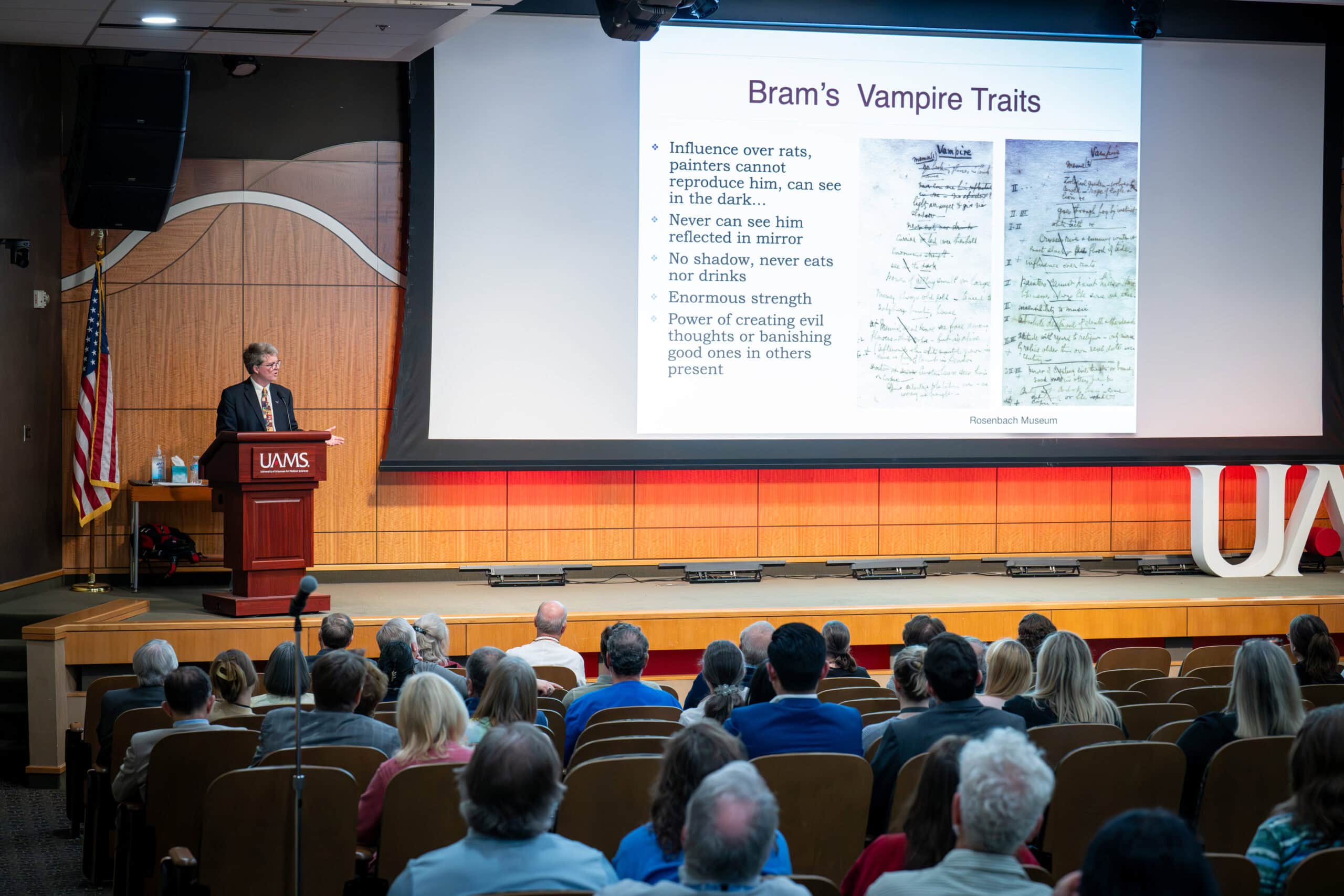
Dacre Stoker shows the audience how his great granduncle incorporated ideas from medicine, science and literature into the character of Dracula.
Image by Bryan Clifton
Dacre Stoker Tells UAMS Audience About Medical Influences that Shaped ‘Dracula’
| Back in the 1890s when Bram Stoker was writing “Dracula,” he didn’t rely solely on his own imagination to come up with a storyline that would intrigue generations of readers and filmmakers to this day.
His great-grandnephew, Dacre Stoker, a native Canadian who lives in Aiken, South Carolina, recently spoke to a large audience at the University of Arkansas for Medical Sciences (UAMS) to highlight the enormous influence of medical, scientific, and other research that inspired the saga, which would become one of literature’s most iconic works.
Published in 1897 after seven years of research and writing, the fictional novel borrowed heavily from the ideas, fears, and practices of the day, such as misconceptions about cholera and the plague, and early medicinal practices such as bloodletting. Those themes, backed by the author’s meticulously researched descriptions of actual places and their surrounding geography, and work he did as a clerk in the local court system, gave it a weightiness that resonated with readers and created a lasting template for nearly all vampire portrayals to come.
“Bram Stoker was a very complex individual that got his ideas from many different sources,” said Dacre Stoker, a historian who describes himself as a literary forensic detective. “Bram delivered Dracula as a story with all sorts of veiled messages, and the state of medicine was one of the main ones, because not just his older brother was a doctor, but his two younger brothers were as well. My great-grandfather was one of them.”
Stoker’s presentation marked the fourth installment of the annual History of Medicine and Science Lecture Series, hosted by the UAMS Department of Neurosurgery and the Jackson T. Stephens Spine & Neurosciences Institute. Drawing on historical documents and photographs, Stoker outlined his interpretation of how the storyline developed for an audience of more than 300, including attendees at the Fred Smith Auditorium and viewers joining virtually and via PBS broadcasts in countries such as Italy, Sweden, and England.
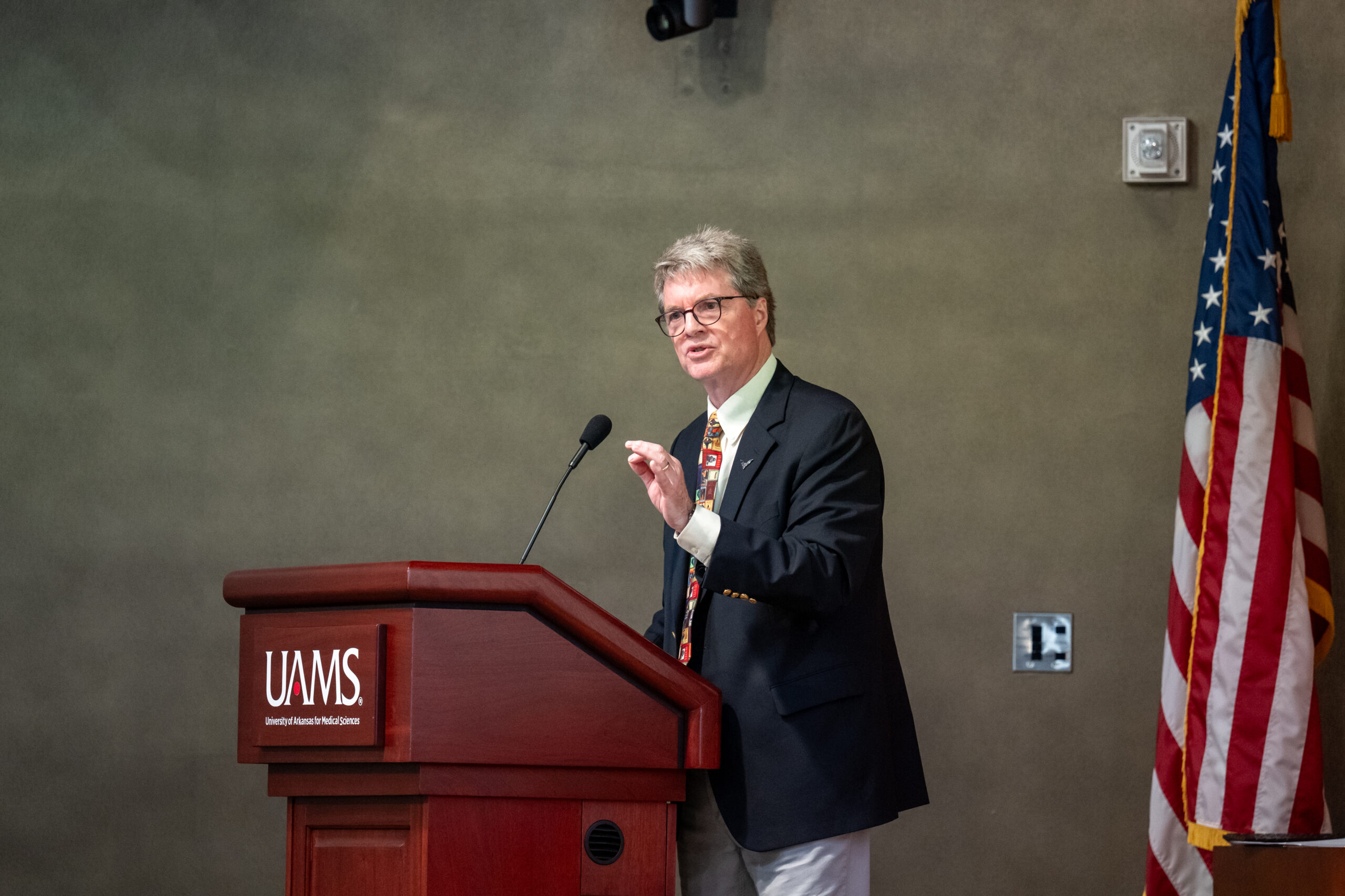
Dacre Stoker explains how his research showed the character Dracula was created.Bryan Clifton
Among the items Stoker shared were snippets of his great-granduncle’s handwritten notes that were discovered in 2018 in the margins of several books he used for research at the London Library, a handwritten journal found in the attic of Stoker’s cousins’ home on the Isle of Wight off the coast of England, papers that the family sold to Trinity College in Dublin, and 110 pages of material that didn’t make it into the book and are stored at the Rosenbach Museum in Philadelphia.
Stoker also showed the audience old maps found in the London Library that depicted routes like those used by characters in the novel, and words or phrases created by other authors that his uncle had circled or highlighted in books and magazine articles.
Stoker said he believes that ideas from Herbert Mayo (1796-1852), a professor of anatomy and surgery at the Royal College of Surgeons, may have helped shape the characters his great-granduncle developed in Dracula.
Mayo, he said, “attempted to explain supernatural beliefs through science and psychology, arguing that many ghost stories and other phenomena arose from misunderstood natural causes.” Stoker noted that Mayo explored topics including apparitions, hallucinations, mesmerism, vampirism, and religious visions.
Stoker also pointed to other possible influences on the novel’s key characters, including the Rev. Frederick George Lee, a clergyman who studied surgery, ghosts, and psychic phenomena. Lee was known to have opened graves to examine the bodies of suspected vampires, reporting “shrouds around the face” and what appeared to be blood and fluid at the mouth after death. He also cited Henry Charles Lea, whose writings — including work on natural and geological phenomena — may have influenced Stoker’s descriptions of the landscape surrounding Dracula’s home.
“You see how this is all coming together for Bram,” Stoker said. “He’s finding all the right components for the home of the devil. He’s got the superstitions, he’s got the volcanoes, and he’s got the maps to prove it.”
William “Thornley” Stoker, who was Bram Stoker’s older brother and one of Ireland’s leading physicians at the time, performed some of the first brain surgeries in Ireland, Dacre Stoker told the audience, calling him “the key guy who actually gave Bram, because of his association with brain surgery, credibility.”
Stoker said Thornley Stoker “actually wrote four pages of notes about brain surgery he performed on a person,” and that description was used, “almost word for word,” to describe how brain surgery was performed in the novel.
Stoker cited “all the medical issues that were floating around” while his relative was writing the book, naming “anesthesia, germ theory, antiseptic surgery, early brain surgery, neurology, blood transfusion, experiments in hematology. It was all cutting-edge.”
“He needed all these details to make the story seem real,” Stoker said. “The medical things make it seem real and real horrifying, because this was something people were wrestling with.”
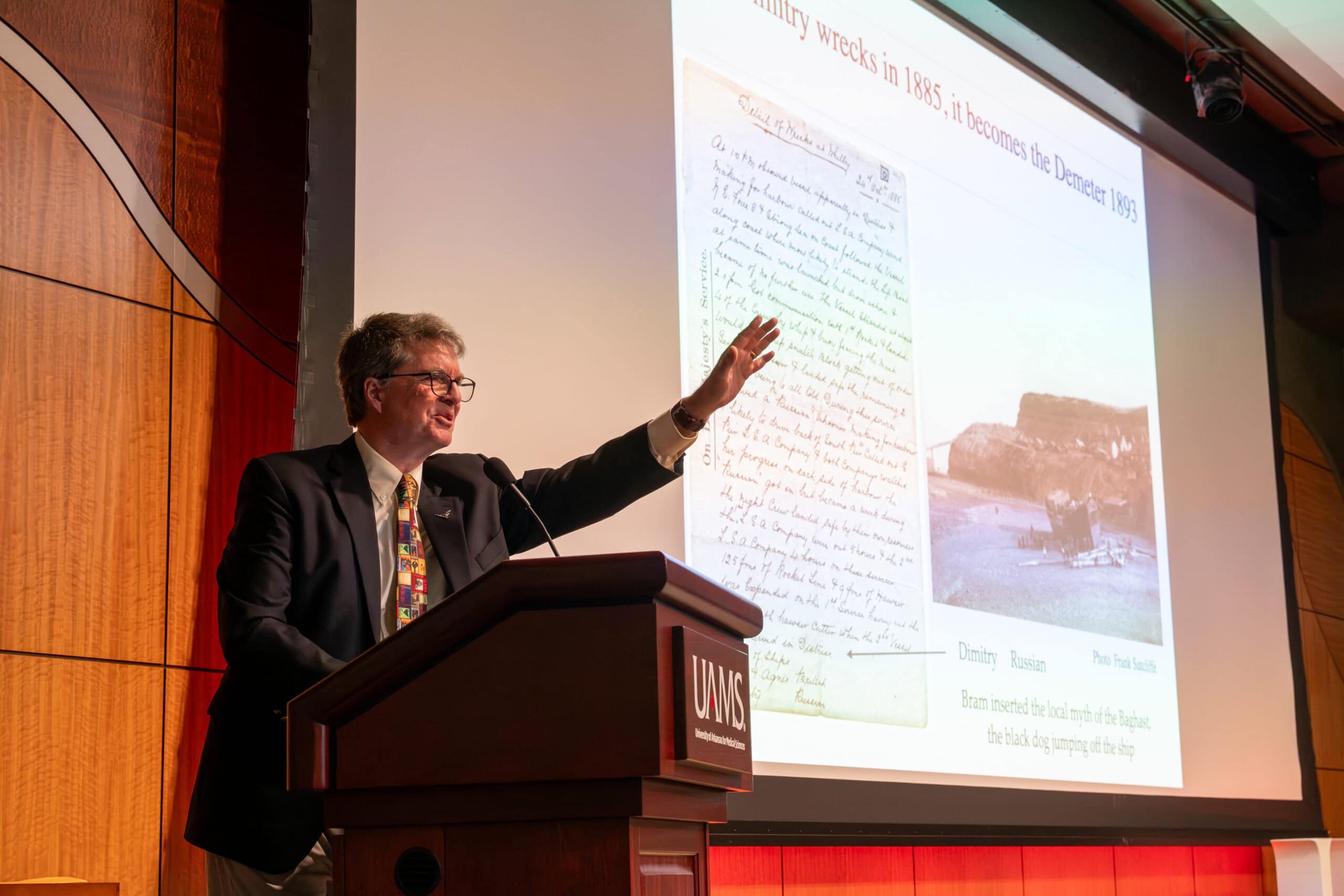
Dacre Stoker displays handwritten notes of his great granduncle to show how he developed the Dracula storyline.Bryan Clifton
The reason Bram Stoker used the personas and viewpoints of physicians and scientists of the day to create characters in the book, Dacre Stoker said, is because “their presence grounded the novel in real 19th century medical issues — the topics that fascinated Victorian society. But Bram did it in a special way. He didn’t just cite these guys. He actually absorbed them into the story.”
Dacre Stoker theorized that his great-granduncle also relied on his own experiences with a mysterious illness that afflicted him for the first seven years of his life, as well as stories his mother told him.
“In the 19th century, Gothic fictional novels charted the rise of modern medicine, from Mary Shelley’s ‘Frankenstein’ with its bold dream of creating life, to Robert Louis Stevenson’s ‘Strange Case of Dr. Jekyll and Mr. Hyde,’ which explores the attempt to control the human mind, and then culminating in Bram Stoker’s ‘Dracula,’ where medical science confronts the unknown and discovers it may not be enough on its own,” Dacre Stoker said. “Bram recognizes that modern technology must respect and pay attention to Old World traditions and superstitions to most effectively contribute to society.”
“My conclusion, ladies and gentlemen, is that Dracula is a medically informed Gothic novel. Bram’s meticulous research, specific medical details and actual locations provide a sense of horrifying reality rooted in late Victorian psychiatry and neurology that neither science nor faith alone is enough,” Stoker said. “Together, they can triumph over evil. Bram leaves us with a powerful reminder: Medicine is never finished.”