View Larger Image
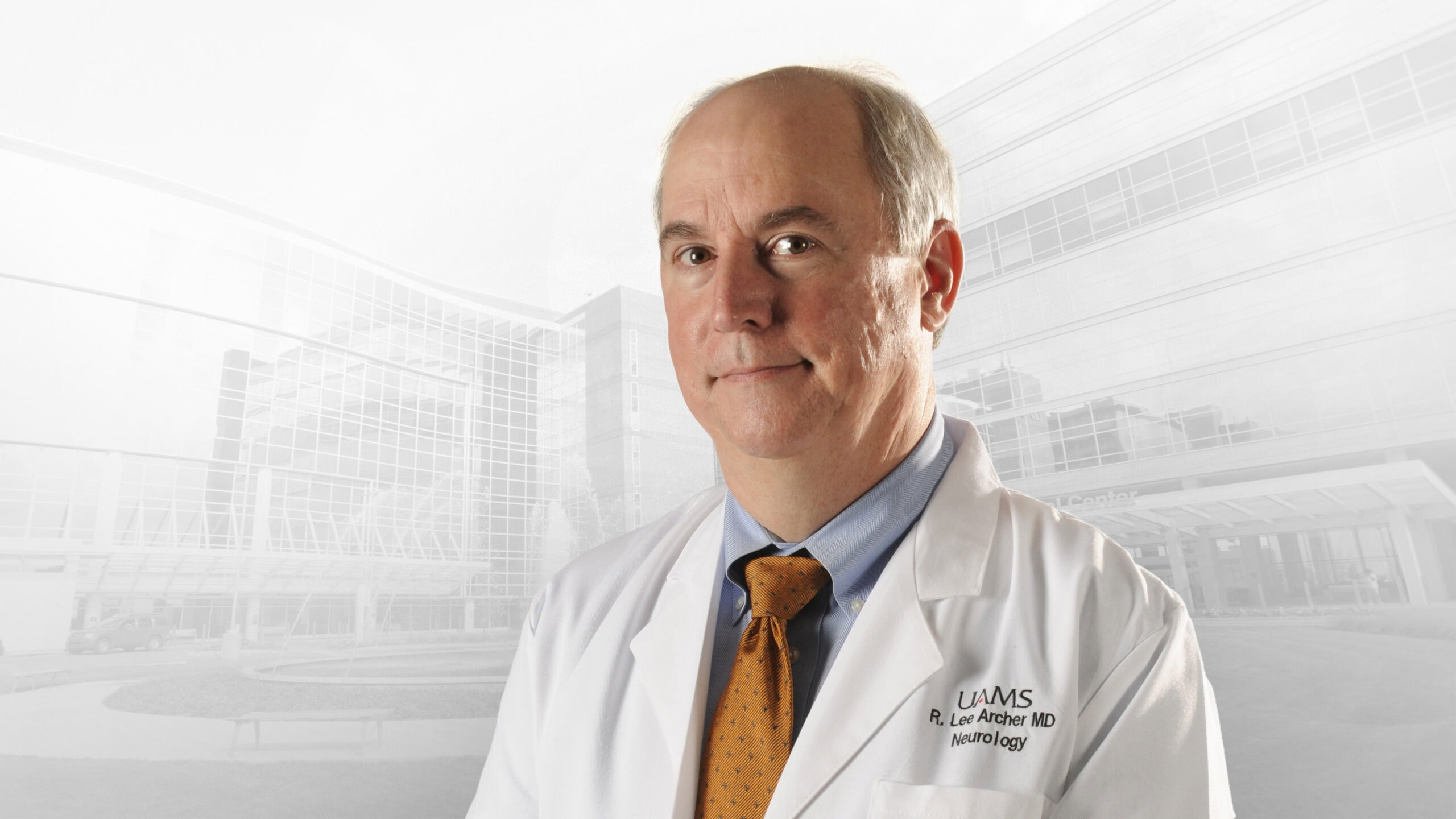
Lee Archer, M.D.
UAMS Neurologist Lee Archer, M.D., Honored for 40 Years of Care and Research
| Veteran neurologist Lee Archer, M.D., was honored for his contributions over 40 years to neurological research, clinical care, and patient access to care in a ceremony at the University of Arkansas for Medical Sciences (UAMS) that also highlighted an endowed research fund established in his and his late wife’s names.
“Tonight, we’re gathering to honor a remarkable legacy of service, leadership, and compassion, and to celebrate a future built on that foundation,” said Rohit Dhall, M.D., who became chair of the UAMS Department of Neurology in 2023 after Archer, who held the position for seven years, stepped down to focus more on his patients.
A professor and leader in the field of neurology in Arkansas who has been on faculty at UAMS for 40 years, Archer announced at the May 4 event in the Fred Smith Auditorium that he plans to retire next year.
“Dr. Lee Archer is a distinguished leader, clinician, educator, advocate, mentor — I could go on — whose career has profoundly shaped medicine in Arkansas,” Dhall said. “Lee has been an exemplar of UAMS’ mission, providing world-class clinical care to patients with multiple sclerosis while developing generations of physicians and advancing neurological care and delivery, and research and education, right here.”
An Arkansas native who attended medical school and completed his residency at UAMS, Archer founded the UAMS Multiple Sclerosis (MS) Service in 1987. Later designated a Center for Comprehensive MS Care by the National Multiple Sclerosis Society, it provides state-of-the-art care for patients across the state and beyond.
Archer has served in numerous leadership roles within UAMS and across the state, including being president of the Arkansas Medical Society. Among his many awards are the UAMS Dean’s Distinguished Award, the Pulaski County Medical Society’s President Award, and the Arkansas Medical Society’s Lifetime Achievement Award, all of which Dhall described as “honors reflecting both his achievement and the deep regard from his peers, not only for clinical excellence but for compassion, integrity and humanity.”
“He and Mrs. Archer were pivotal in recruiting me to Arkansas,” Dhall told the audience, which included Archer’s brother and sister, UAMS employees, and members of the community, including several of Archer’s patients.
Archer’s wife, Nancy, a retired schoolteacher, died Jan. 18. The couple was married 48 years, five months and five days.
Dhall said the Nancy and Lee Archer Endowed Research Fund honors Lee Archer’s legacy and “Mrs. Archer’s steadfast support of both our department and neurological research at UAMS,” and provides vital seed funding for neurology subspecialties, including MS research.
The fund was established with a $100,000 gift from Patti Bailey of Little Rock, whose two daughters have MS and are patients of Archer’s. Bailey established the fund when Archer, then the department chair, told her about the need to fund research until larger NIH grants can be secured.
Most large grants for neurological research come from the National Institutes of Health (NIH), which requires preliminary research to justify a larger grant. Preliminary research is usually funded internally by a seed grant — such as the typical $30,000 grants that the department chair gives each year to three of its nine subspecialties.
On Dec. 10, 2024, Bailey spoke about the impact that the MS care team at UAMS has had on her daughters, saying, “Dr. Archer and team gave my girls their lives back.”
She and one of her daughters were among four people who recorded video testimonials that were shown to the audience or spoke onstage on May 4 to illustrate the impactful personal care that Archer has provided his patients.
Dhall said the fund has so far received 73 gifts totaling $1.27 million, including $372,523 cash gifts in hand, and that another donor has committed to providing a matching gift of up to $250,000, to help the fund reach its $2.2 million goal.
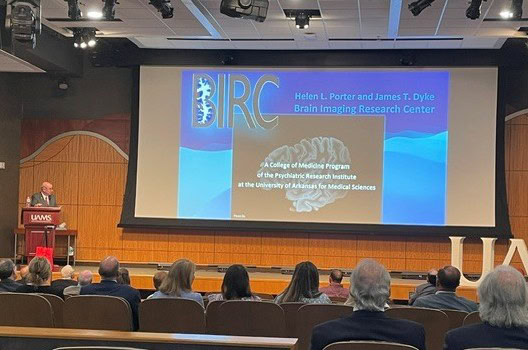
Lee Archer, M.D., shares ongoing neurological research projects with the audience.
One of the planned gifts included in the total is from Lee and Nancy Archer, who committed an estate gift of $900,000 to ensure that critical resources needed to advance import neurological research at UAMS are available in the future. Other philanthropic gifts include a generous contribution from Robert C. East and family, a longtime friend who has supported UAMS since 1998.
The goal of the fund, Archer told the audience, is “to be able to fund seed money for research, and if it’s an endowed fund, then it goes on forever. And that’s what we want. As Nancy and I talked about what I can leave, what we could leave as a legacy, I said I’d like for our estate, at least part of it, to go to this fund, because this will allow the department to expand research.”
“It’s a proven way to increase research funding,” he added, “and so this is what I wanted my legacy to be, is to endow this fund for all of the future.” He said that when he retires, “the cupboard is not going to be bare for MS. We’re going to be in good shape going forward.”
Archer reminisced about his wife from the lectern, calling her “fun” while “keeping the books” at home, being the family vacation planner, and helping him recruit top talent to UAMS. He said she always made sure that the children of faculty members had a present for the holidays, trained a therapy dog and took her to visit veterans, participated in an Alzheimer’s respite program at church, and was a master gardener, among other things.
He remembered that when he was trying to recruit Dhall to Arkansas, “she made sure he had cookies to take back to his kids and help seal the deal.”
Archer called himself “blessed” to have the job, co-workers, and patients he has had over the last 40 years, adding, “A lot of people think it’s a one-way street” with his patients, “but it’s not. It’s very much a two-way street. I see so much love between families, and it inspires me. I see courage, and that inspires me. I see determination.”
The audience also heard from Andrew James, Ph.D., a professor of psychiatry and neurology who directs the Helen L. Porter and James T. Dyke Brain Imaging Research Center at UAMS, and listened to a video recorded by Tatiana Wolfe, Ph.D., an assistant professor of psychiatry at UAMS who works in the research center, about the kinds of research being done at the center.