View Larger Image
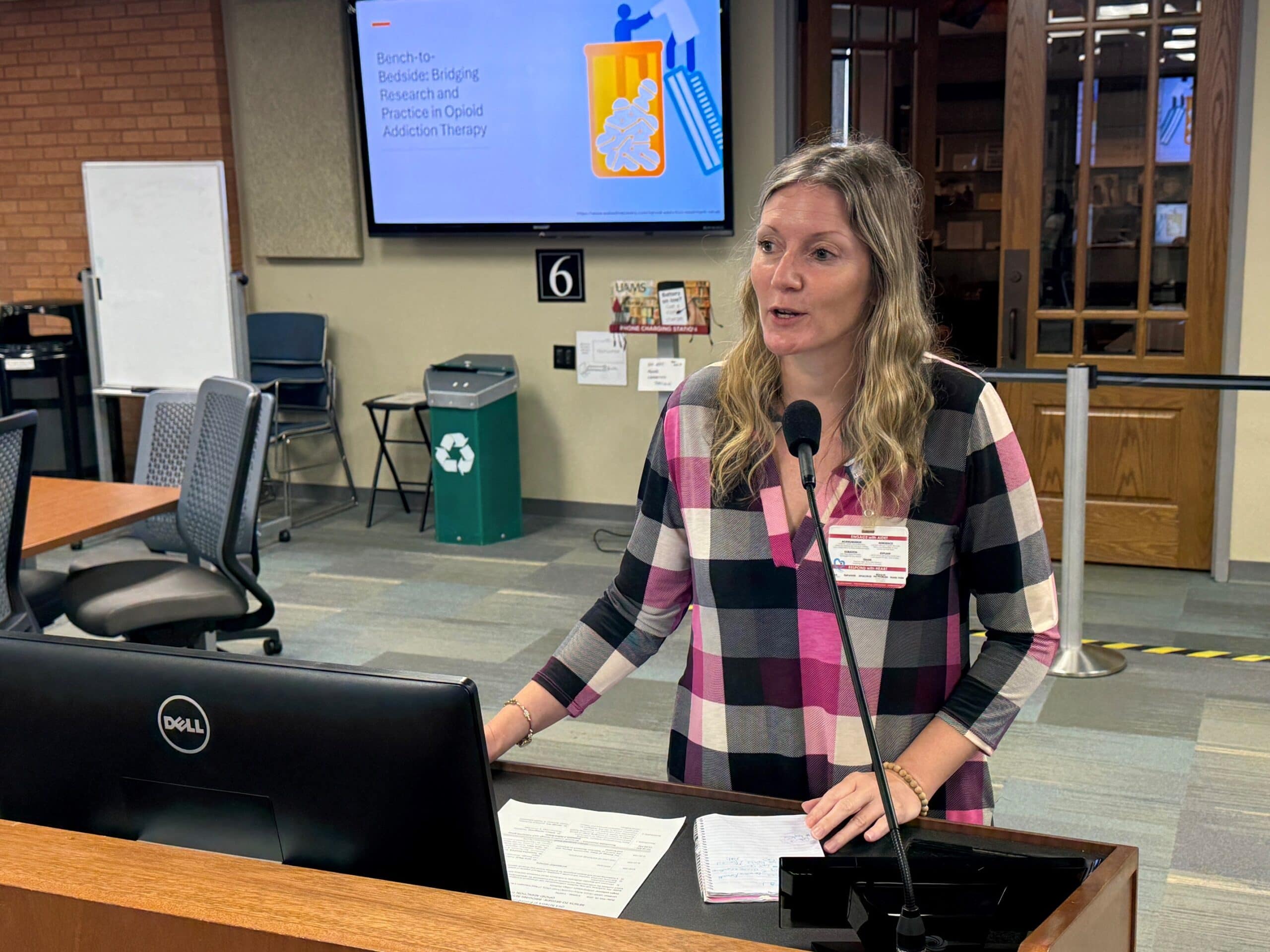
Samantha Kendrick, Ph.D., gives an overview of the workshop and its goals to the students and faculty in attendance.
Image by Tim Taylor
College Students Gain Understanding of Substance Use Through INBRE Workshop
| Thirty college students from across the country recently gathered at the University of Arkansas for Medical Sciences to learn about one of medicine’s most pressing challenges, the opioid crisis.
The “Bench-to-Bedside” workshop, hosted by UAMS’ IDeA Network of Biomedical Research Excellence (INBRE) program, gave the students a firsthand look at the science behind addiction and the treatments researchers are developing to fight it.
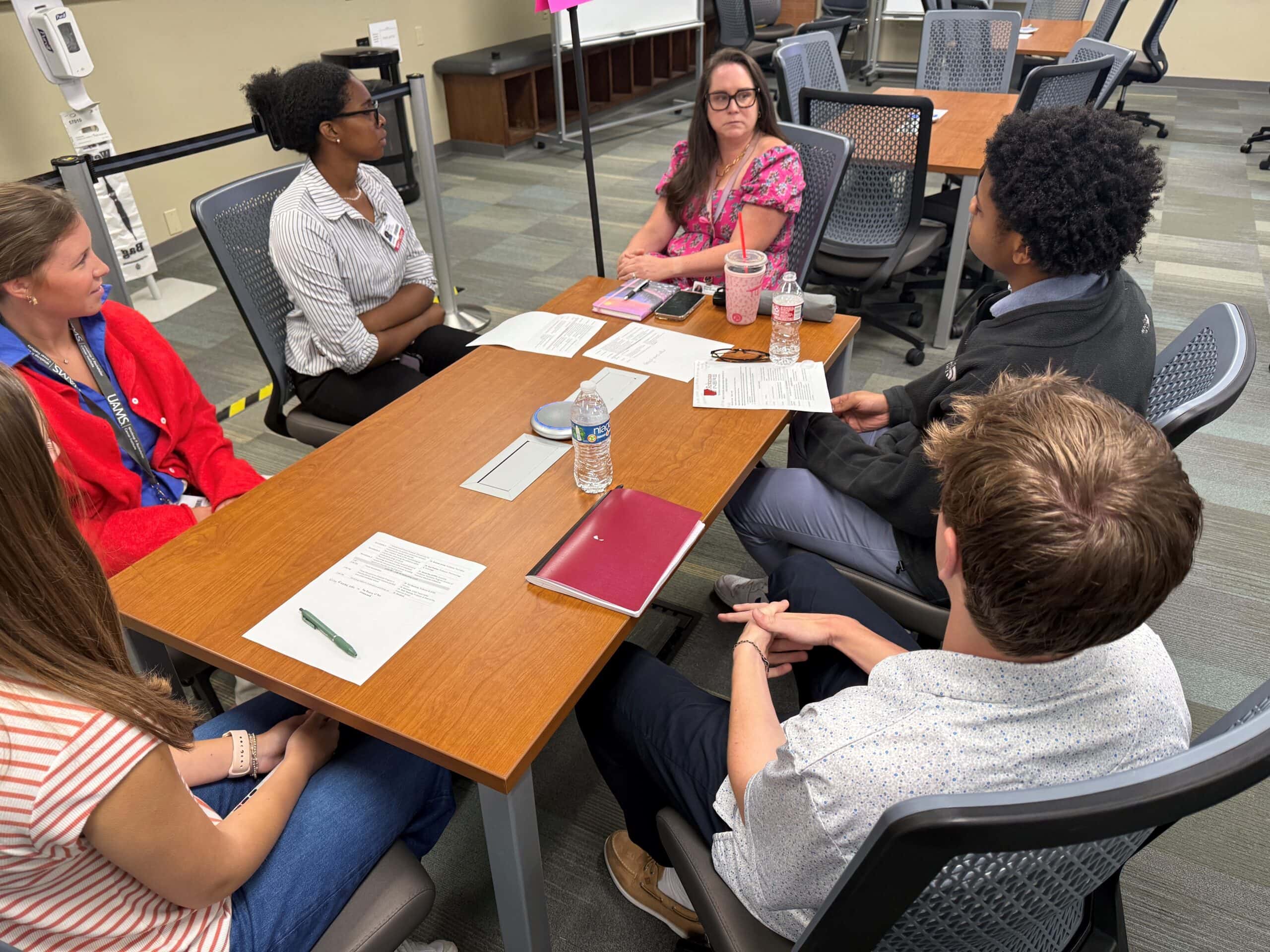
Shona Ray-Griffith, M.D., (center) discusses her work with women with substance use disorders during a roundtable.
The day-long workshop, held May 28 in the UAMS Library’s Active Learning Center, brought together undergraduate students from institutions like the University of Hawaii and the University of South Carolina as well as several Arkansas colleges. Led by UAMS clinicians and translational scientists, the students explored emerging research and treatment approaches for substance use disorders.
The workshop also marked the launch of INBRE’s 10-week summer research program, in which select undergraduates collaborate with UAMS faculty on biomedical research projects. The program is designed for STEM students considering careers in biomedical research.
“The goal of translational research is to improve patient outcomes, in whatever disease or disorder area a scientist is studying, and here, at the workshop, we provide real-world examples to the students of how their research can lead to changes in the clinic,” said Samantha Kendrick, Ph.D., INBRE’s faculty liaison and a professor in the Department of Biochemistry and Molecular Biology.
Last month’s workshop included a keynote speech from Alicia Allen, Ph.D., director of the National Center for Opioid Research and Clinical Effectiveness (NCOR), slated to open next year on the campus of the Arkansas Children’s Hospital Research Institute. A series of roundtable discussions with physicians and researchers discussing their work in substance use disorders with the students was followed by a panel discussion on UAMS’ Graduate Program in Interdisciplinary Biomedical Sciences (GPIBS) program in the UAMS Graduate School.
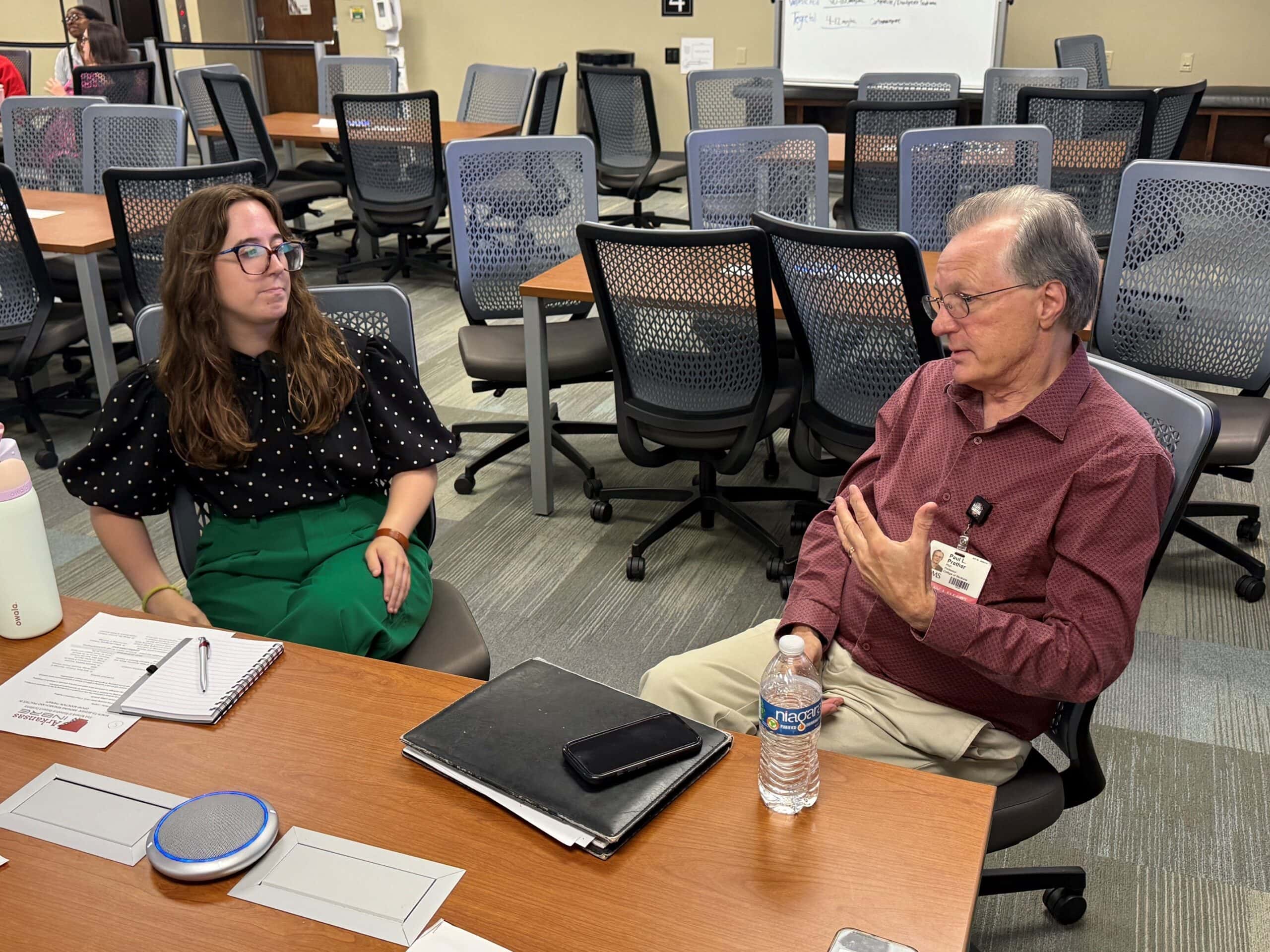
Paul Prather, Ph.D., (right) talks to Murphy Hernandez of Harding University about the addictive states caused by drug abuse.
“I think the workshop was very productive in accomplishing our goal of giving the students an understanding of opioid use disorder and the research and therapies that are being implemented,” said Kendrick, adding that she observed the undergraduates sharing similar concerns and questions throughout the day. “They were sort of building a community, which was great to see.”
Andrew James, Ph.D., director of UAMS’ Brain Imaging Research Center, talked to the students about how clinical trials can help those receiving treatment for opioid use disorder (OUD).
“My research involves brain imaging of patients in treatment for OUD, and more recently, developing a smartphone app to improve OUD treatment outcomes,” said James. “The students asked lots of questions about smartphone and neuroimaging technologies, but also addiction in general.”
Shona Ray-Griffith, M.D., an associate professor in the Department of Psychiatry and program director of her department’s Addiction Medicine Fellowship, led a roundtable discussion on research aimed at helping women dealing with illnesses like opioid use disorder during pregnancy.
“It’s always a pleasure to see the energy of the next generation of scientists and physician-scientists,” said Ray-Griffith. “I was asked to participate due to my expertise in addiction medicine and previous research experience in this area, specifically perinatal women with opioid use disorder. I was the only M.D. present so that was unique for the students as roughly half of each group had an interest in medical school.”
“I was surprised by the breadth of students we brought to UAMS this year. They came from all over the country with a huge range of interests including clinical medicine, pharmacy practice, analytical chemistry, environmental toxicology, and every kind of biomedical science imaginable,” said William Fantegrossi, Ph.D., a professor in the Department of Pharmacology and Toxicology, whose roundtable dealt with applying behavioral pharmacology in order to gain an understanding of the biological actions of illicit drugs. “All of them were extremely engaged and curious and definitely seemed excited to take advantage of all of the opportunities this program will provide for them this summer.”
Mohammed Naif, a sophomore biology major at the University of Arkansas at Little Rock, said the workshop gave him “a different point of view. It was an interactive learning experience, not just a lecture.”
Murphy Hernandez, a junior molecular and cellular biology major at Harding University, said the workshop provided her with insight into the world of medical research. “This helped me see if it’s something I want to pursue, it was really a great way to learn about the process in depth,” she said.
James encouraged other faculty to take part in the INBRE program, which is funded by the National Institutes of Health’ s National Institute of General Medical Sciences (NIGMS) and was recently renewed for another five years.
“UAMS is a pioneer for ‘bench-to-bedside’ translational research aiming to improve patients’ lives — not just for opioid addiction but for many, many disorders,” he said. “Hopefully, sharing our work and experiences with the students might encourage them to pursue careers in medicine and research. The INBRE is a phenomenal program for providing these experiences to Arkansas students.”