View Larger Image
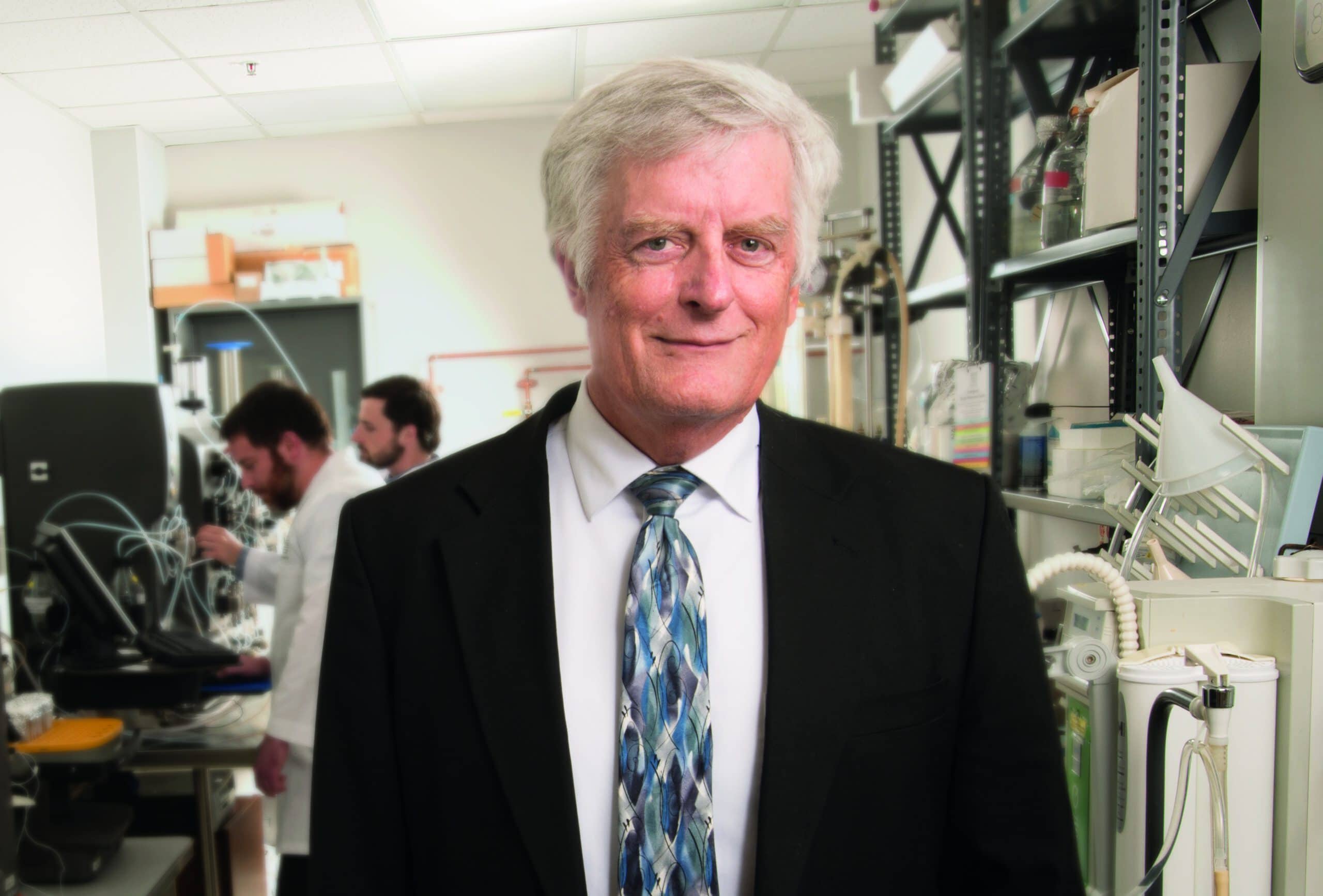
Lawrence Cornett, Ph.D., director of the Arkansas INBRE program.
Funding Renewed for UAMS-led Biomedical Research Program, Bringing INBRE’s 30-Year-Total to More Than $107 Million
| LITTLE ROCK — A federal grant that funds Arkansas INBRE, a statewide biomedical research program led by the University of Arkansas for Medical Sciences (UAMS), has been extended for another five years, providing 30 years of continuous funding totaling more than $107 million.
The latest grant from the National Institute of General Medical Sciences, which is part of the National Institutes of Health, is for $19.6 million. It will be distributed over five years, bringing the total amount of NIH funding for the research program to $107.7 million between Sept. 30, 2001, and April 30, 2031.
INBRE — the IDeA Networks of Biomedical Research Excellence — is an NIH-funded program that builds biomedical research capacity in states that historically receive lower levels of federal funding. It provides grants, mentoring, and research opportunities for undergraduates, graduate students, and faculty members, and connects universities, colleges, and research institutions within each state to share resources, facilities, and expertise.
IDeA refers to the Institutional Developmental Award (IDeA) program, which was established to distribute NIH funding for biomedical and behavioral research. IDeA grants, including INBRE awards, are awarded to institutions in 23 states and Puerto Rico.
“Sustained funding is critically important for impactful development of biomedical research capacity,” said Lawrence Cornett, Ph.D., a distinguished professor of physiology and cell biology at UAMS and director of the Arkansas INBRE program. “The grant allows us to continue to provide students and faculty with research opportunities, strengthen scientific infrastructure, and develop the next generation of researchers and innovators.”
According to the National Institute of General Medical Sciences, “INBRE grants are intended to enhance the caliber of scientific faculty at research institutions and undergraduate schools who can attract more talented students to augment the science and technology knowledge of the state’s workforce.”
“Our two biggest activities are 1) to provide funding to faculty at the primarily undergraduate institutions in our network so that they can establish research programs that engage their students in research and 2) to provide opportunities for undergraduate students to participate in research,” Cornett said.
The Arkansas INBRE is composed of the lead institutions, UAMS and the University of Arkansas at Fayetteville (UA), joined by a network of 16 colleges and universities spanning all four congressional districts. Of the many programs offered to build biomedical capacity in the state, one of the long-standing programs is an intensive mentored summer research experience. Students spend 10 weeks working with scientists at UAMS and the UA gaining research experience and career development skills. Since 2001, 342 students have participated in the summer program, and more than half of them have gone on to obtain advanced degrees after obtaining their baccalaureate degrees.
Jerry Ware, Ph.D., a professor in the UAMS College of Medicine Department of Physiology and Cell Biology and the co-primary investigator for the program with Cornett, said the research varies widely in scope but must fit within the NIH mission to enhance health, lengthen life, and reduce illness and disability. He said collaborative projects between various undergraduate institutions and UAMS have led to the development of anticancer therapies, novel antiparasitic compounds, novel antibacterial compounds and insights into DNA replication.
For many students, the program provides their first chance to conduct research, work in a laboratory, and present their findings with posters and presentations.
“The continued investment in the Arkansas INBRE not only advances scientific discovery but also creates long-term economic and health benefits for communities throughout Arkansas as well as the nation,” Cornett said.
He added, “We find the students who are introduced to hands-on science early on go on to be better students when we see them again as medical students, pharmacy students, and graduate students at UAMS.”
Research mentioned in this release is supported by the National Institute of General Medical Sciences of the National Institutes of Health under Award Number P20GM103429. The content is solely the responsibility of the authors and does not necessarily represent the official views of the National Institutes of Health.
UAMS is the state’s only health sciences university, with colleges of Medicine, Nursing, Pharmacy, Health Professions and Public Health; a graduate school; a hospital; a main campus in Little Rock; a Northwest Arkansas regional campus in Fayetteville; a statewide network of regional campuses; and seven institutes: the Winthrop P. Rockefeller Cancer Institute, Jackson T. Stephens Spine & Neurosciences Institute, Harvey & Bernice Jones Eye Institute, Psychiatric Research Institute, Donald W. Reynolds Institute on Aging, Translational Research Institute, and the Institute for Community Health Innovation. UAMS includes UAMS Health, a statewide health system that encompasses all of UAMS’ clinical enterprise. UAMS is the only adult Level 1 trauma center in the state. UAMS has 3,553 students and 1,030 medical residents and fellows, and two dental residents. It is the state’s largest public employer with about 12,000 employees, including 1,200 physicians who provide care to patients at UAMS, its regional campuses, Arkansas Children’s, the VA Medical Center and Baptist Health. Visit www.uams.edu or uamshealth.com. Find us on Facebook, X (formerly Twitter), YouTube or Instagram.
###