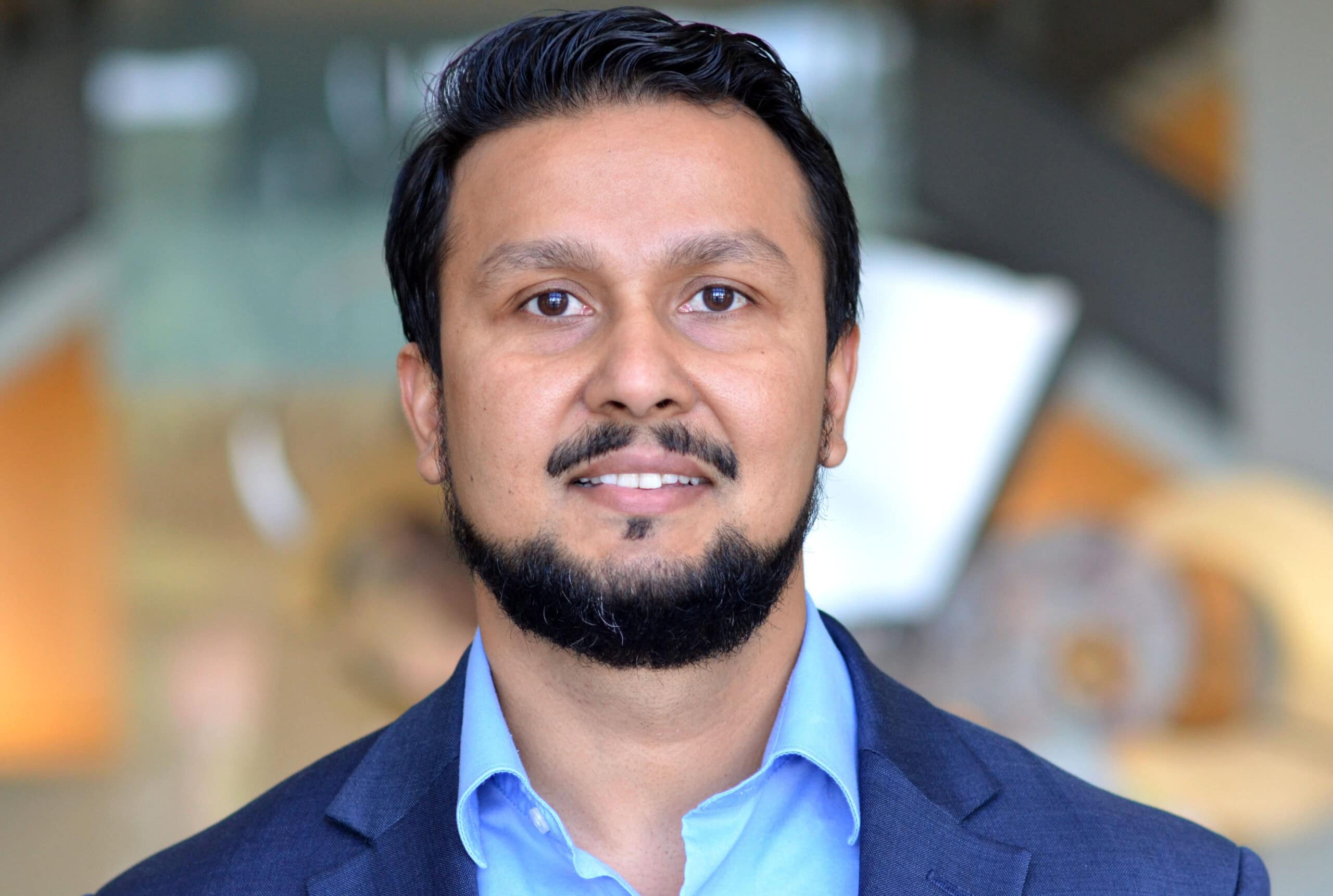
From Nepal to Arkansas: Associate Professor’s Journey to UAMS Department of Biostatistics
| For Milan Bimali, Ph.D., the long path he trod to the University of Arkansas for Medical Sciences (UAMS) influences his approach to being an educator, researcher, and family man.
Bimali, an associate professor in the UAMS Department of Biostatistics, part of the Fay W. Boozman College of Public Health and the College of Medicine, is a native of Nepal, a nation located between China and India in the Himalayan Mountains. Bimali’s hometown of Biratnagar is an industrial hub of over 250,000 residents that lies in Nepal’s southern plains near the India border.
Due to Biratnagar’s location and immense job opportunities, there are a variety of ethnic groups residing in the city. Thus, at a young age Bimali learned how to engage with people of various credos.
“Living in the United States and being in my line of work, you must interact with people of different cultures,” he said. “My upbringing helps me with being comfortable around people from cultures that are different than mine.”
Growing up in a working-class household also helps him empathize with people, he added.
“I was in a family, and grew up with people, who had limited resources,” he said. “That lived experience helps me connect with society. That’s important being an employee of a health center that works with so many people from underserved populations.”
The desire to someday have an easier life motivated Bimali academically as he excelled in high school, specializing in science and mathematical science. He graduated in the top 10% of his class.
Bimali then attended Tribhuvan University in Nepal for three years before moving to the United States in 2008. That’s when he relocated to Lawton, Oklahoma, where he attended Cameron University. In the process, Bimali completed the classes, first at Cameron University and then at Collin College, in Dallas-Fort Worth area, as he needed to earn enough credit hours for a U.S.-equivalent bachelor’s degree.
He then decided to move to Idaho.
Finding His Way
In August 2009, Bimali began working towards a master’s degree in mathematics from Idaho State University. He persevered, completing the program in December 2011.
“Pocatello, Idaho, was primarily a college town,” Bimali said. “Life was quite different there from what I’d previously experienced.”
“The education was intense,” he said. “I didn’t have much of a social life. I just wanted to get through school. The courses were tough, but they prepared me for the Ph.D. program I’d enter.”
After earning his master’s, Bimali worked at the university as a lecturer teaching undergraduate classes. This was his first foray into being a full-time educator. It proved to be an invaluable opportunity.
“Most of the students were from Idaho and the surrounding states,” Bimali said. “I struggled initially because of my language barrier and the fact that I was multilingual (I speak three other languages besides English). But in general, I feel that I did a great job. I ended up getting good reviews, including one student who said they enjoyed my class ‘even though it was math’. I had a good relationship with my students.
“Regarding my current communication skills, in terms of presenting to a large audience of people — that lecturer position in Idaho really helped me a lot.”
In 2012 he moved to Kansas City, Missouri, to pursue a doctorate in biostatistics from the KU Medical Center. Though Bimali enjoyed the location of the school, which basically straddles the Kansas-Missouri border, and the eclectic neighborhood in which it lies, he focused on academics, spending most of his time studying in the biostatistics department.
Bimali’s focus produced the desired result as he earned the doctorate in December 2015. Not long afterward, he went to Connecticut as a post-graduate associate at Yale University. Bimali spent a year at Yale before relocating to Wichita, Kansas, to work as a biostatistician in the KU Medical Center Wichita branch — Office of Research. Throughout his time in Wichita, Bimali was the only doctorate-level biostatistician on campus. Though he appreciated the opportunity, Bimali realized that he wanted more for himself professionally.
“I simply felt the need to move to a bigger department that would allow me to flourish and develop my skills around other biostatisticians,” he said.
During his quest for better career options, he eventually met the administrators in the UAMS Department of Biostatistics and decided to come to Arkansas.
“By that point I’d been in the U.S. for several years and most of that time I had lived in the Midwest or the South,” he said. “I’d grown a liking to the lifestyles of the two regions. I wanted to build a career in one of those places.
“I was impressed by the leadership of the department and how the staff members were very welcoming. The collegiality of the department stood out for me. Plus, I could collaborate and especially teach — which I didn’t want to give up doing.”
Happy in Arkansas
Bimali joined UAMS in 2018. Among his primary duties are working with UAMS investigators, teaching biostatistics classes, and serving on various campus committees. He also specializes in answering health sciences and biomedical sciences research questions.
“As a biostatistician, I take pride in being an integral part of a team that works on projects rooted in science that can eventually benefit society,” he said. “Whenever I’m out in public as a panelist, or if I’m speaking at an event, I get a sense of pride that my work is making a difference.
“It’s the seeing of the impact you can make that gives me a sense of pride and happiness.”
Bimali enjoys research and collective problem solving, but he also loves to teach. Knowing that he’s educating the next group of biostatisticians excites him. He also appreciates how teaching makes him a better orator.
“The more I teach, it hones my communication skills, and it helps me also as a collaborator,” he said. “Teaching supports my collaborative work. Also, when I collaborate, the real-world experience I get, I can take the info to my students and teach them about it. There’s a bi-directional benefit.”
Regarding professional collaborations and networking, Bimali uses his career to make a positive impact in Nepal.
He’s a member of the Association of Nepalese Mathematicians in America. Through his affiliation with the organization, he has participated in 12 webinars on statistics, three workshops on statistical computing, internships and scholarships for undergraduate and graduate students, and an international conference.
Bimali also takes pride in the work he’s done with the American Statistical Association Biometrics Section’s Strategic Initiatives Grant. The organization champions innovative outreach projects that focus on enhancing awareness of biostatistics for American students.
Outside of work, Bimali is a devoted husband and father of two young children. His wife, also a native of Nepal, is a nurse at UAMS. The couple makes it a point to assure that their kids have knowledge of their roots in Nepal.
“Our kids can speak more than one language,” he said. “My son understands the language we speak back home, and he communicates with us in English. We appreciate how our kids understand and embrace the culture of Nepal while living in America and knowing that they were born here.”
When reflecting on his journey, Bimali joyfully marvels at his current life status.
“It’s important to be emotionally and spiritually happy,” he said. “That will keep you going in the long run. I greatly value that.”