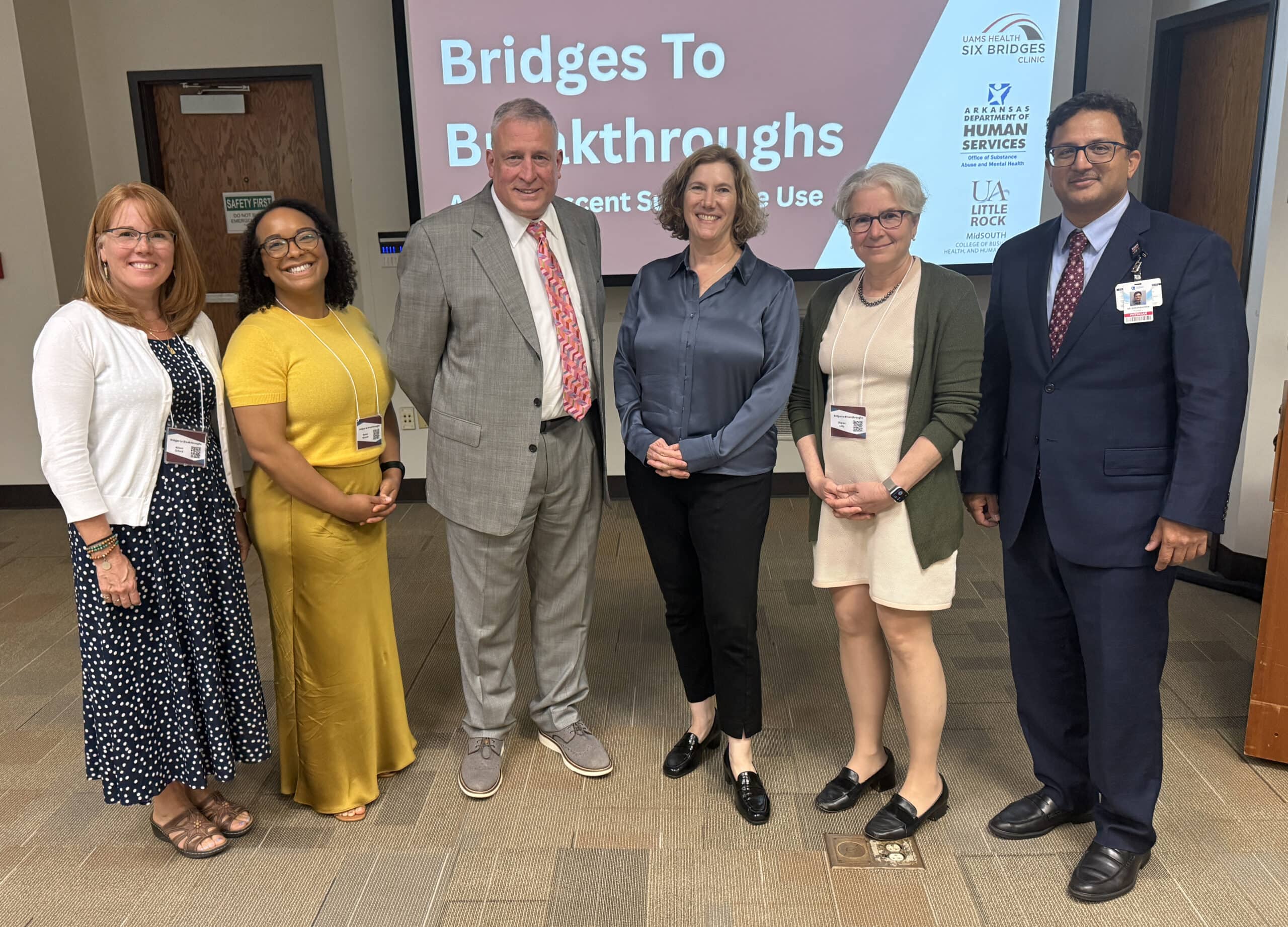
Summit Builds ‘Bridges’ Between Groups Seeking to Help Youth with Substance Use
| Michael Mancino had a short but noteworthy message for those in the crowded room about substance use.
“Don’t ignore it. Don’t stick your head in the sand; it’s not going to get better on its own.”
That blunt warning from Mancino, director of the University of Arkansas for Medical Sciences’ Center for Addiction Services and Treatment, set the tone for the Bridges to Breakthroughs summit, held June 25-26 at the University of Arkansas at Little Rock.
Speaking to more than 140 counselors, social workers, medical professionals, and law enforcement representatives, Mancino addressed the issue of prescription drug abuse by youth, a problem he said has increased dramatically with the introduction of synthetic opioids like fentanyl.
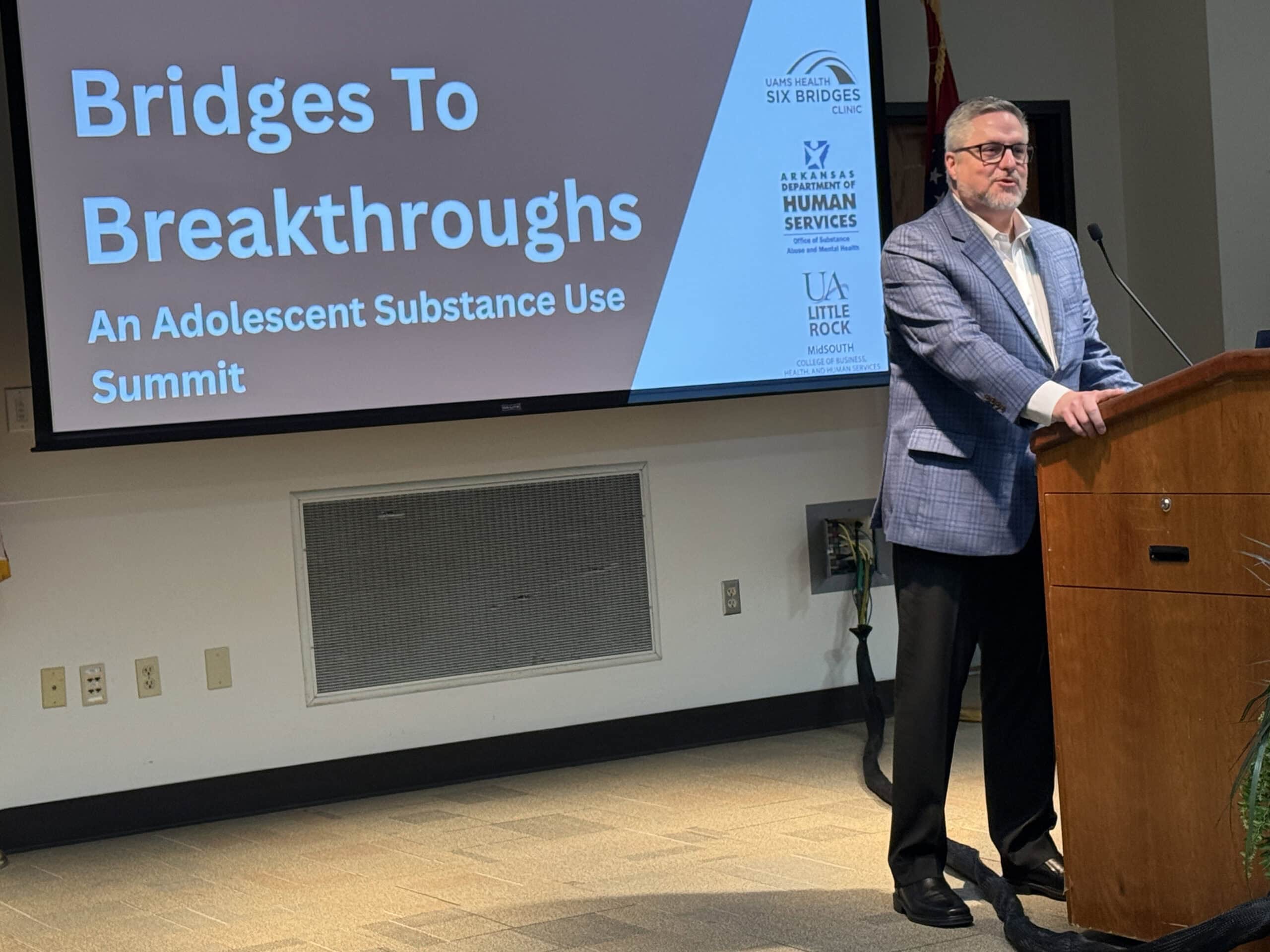
Jason Williams, Psy.D., MS.Ed., thanks the organizers and attendees of the summit for their belief in Arkansas’ young people.
“A lot of these drugs are taken together, and it’s a combination of the drugs that leads to overdosing,” said Mancino, pointing out that 76,282 overdose deaths in this country in 2023 were attributed to fentanyl. “It’s one plus one equals three, not one plus one equals two, when you combine these drugs.
“When we talk about fentanyl, we’re talking about an extremely potent drug, a drug that’s 100 times more potent than heroin,” he added, showing the audience a slide with a penny that appeared massive next to a minute sample of fentanyl. “And those little crystals are 2 milligrams of fentanyl. And in most people, that’s enough to kill you, that tiny amount.
“Interestingly, patients that use fentanyl (prescribed to manage acute or chronic pain) who have an opioid use disorder, that’s usually the lowest dose that they use over 24 hours. When we dose fentanyl medically in a hospital setting, we dose it in micrograms and they’re using milligrams.”
Mancino was one of several experts in substance use to speak at the youth-oriented conference, a collaboration between UAMS’ Six Bridges Clinic, the UAMS Psychiatric Research Institute, the Blue & You Foundation for a Healthier Arkansas, the Arkansas Department of Human Services’ Office of Substance Abuse and Mental Health, and UALR’s MidSOUTH, the community service unit of the College of Business, Health and Human Services.
Jason Williams, Psy.D., MS.Ed., the division chief of Child and Adolescent Psychiatry at UAMS and section chief of Pediatric Psychology in UAMS’ Department of Pediatrics, said he loved the theme of the summit because it reinforced the idea that breakthroughs rarely happen in isolation.
“Breakthroughs happen when people come together, when researchers and clinicians collaborate, when schools and healthcare systems work together, when communities and families are connected to resources, when prevention and treatment become part of a continuum rather than separate conversation,” said Williams. “In other words, breakthroughs happen when we build bridges. Bridges between science and practice, bridges between systems, bridges between disciplines, bridges between organizations, and, most importantly, bridges between where a young person is today and where they have the potential to be tomorrow.”
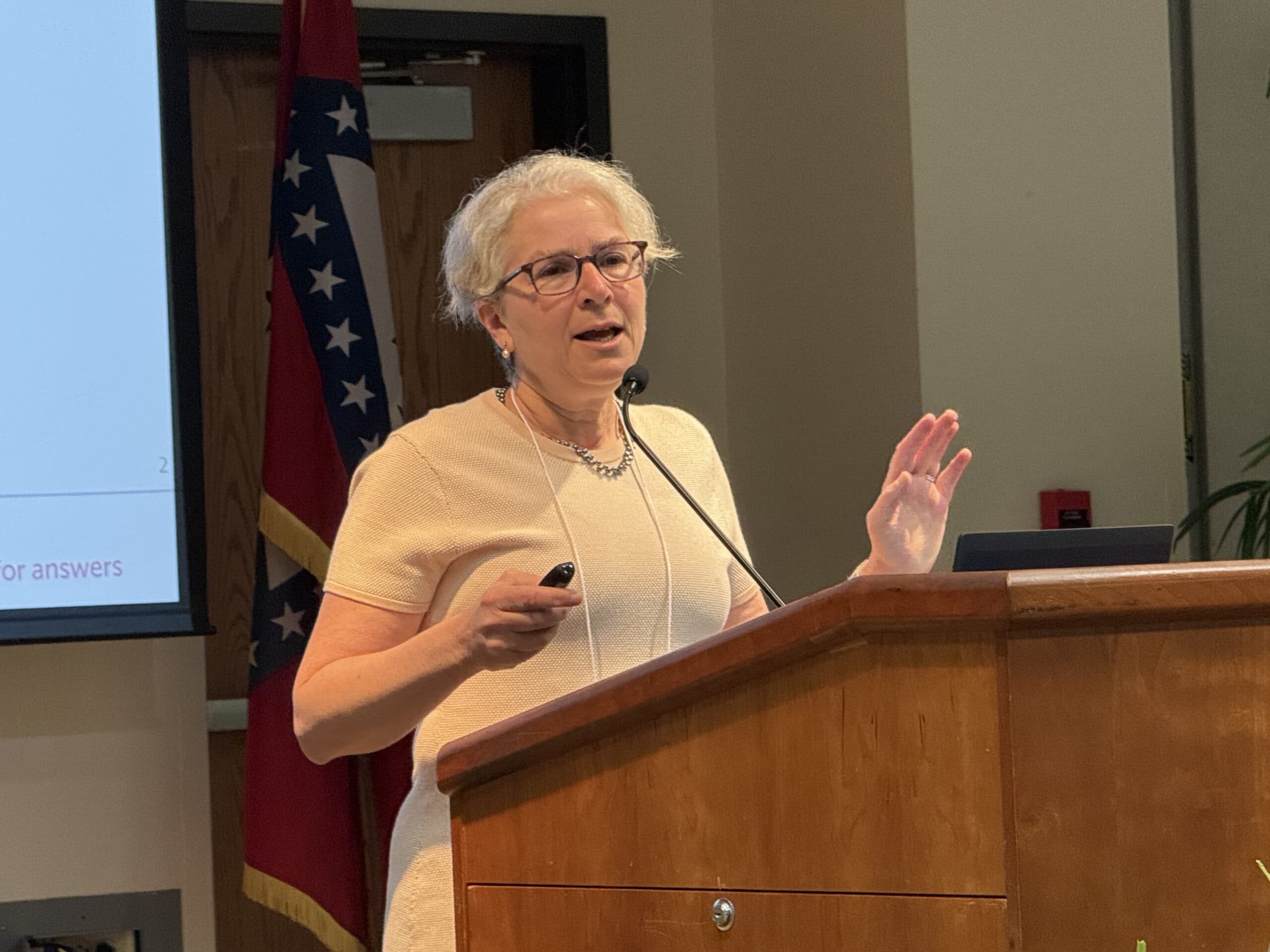
Sharon Levy, M.D., MPH, speaks about the impact of substance use on adolescents and their developing brains.
Sharon Levy, M.D., MPH, chief of the Division of Addiction Medicine at Boston Children’s Hospital and a professor of Pediatrics at Harvard Medical School, provided the audience with an overview of adolescent neurodevelopment and its relationship to substance use vulnerability.
“Most substance use starts before the age of 21, most alcohol and cannabis use starts before the age of 18. Not only are adolescents curious, they are developmentally vulnerable to develop substance use disorders,” said Levy, who called nicotine, alcohol, and cannabis “the big three, because these are the substances that are most frequently used by adolescents and that has been true for hundreds of years.
“All substances have some different impacts on the brain, but they all have the same final, common pathway,” she added. “And they are all triggering dopamine directly in that reward center in the brain. So naturally this is going to be of high interest to adolescents. It’s a very unhealthy, unnatural way to do it, but it is going to satisfy this developmental drive to look for things that are highly illogically rewarded.”
Srinivasa Gokarakonda, M.D., the medical director of the Six Bridges Clinic, made a case for using evidence-based screening tools to help identify youth with substance use disorders and provide effective methods of treatment.
The screening tools, clinical questionnaires designed as an early intervention, are short and have proven to be very effective, said Gokarakonda.
Of the more than 1.6 million adolescents in the U.S. who were identified as having a substance use disorder, “only 2% actually sought treatment,” he said. “There’s a lot of work to be done and we have to identify them and provide them with the treatment that they need.”
PreVenture, an early-intervention program developed to promote mental health and delay substance use among youths, was the center of a presentation by Alison Orford, MSW, RSW, a social worker at ACTive Minds Therapy & Consulting of Ontario, Canada.
“It’s not about changing what they are, it’s about helping them become what they want to be,” said Orford, who has seen PreVenture expand globally with a network of over 3,000 trained facilitators.
The first day of the conference concluded with a presentation by Renée Watson, M.A., LAC, a clinical therapist at the Child and Adolescent Behavioral Health Center on the impact of technology on the family system and a question-and-answer session led by Laura Dunn, M.D., chair of the UAMS Department of Psychiatry and director of the Psychiatric Research Institute.
“What struck me is how many people from across Arkansas showed up because they care about our kids and their families,” said Dunn. “Substance use touches every corner of this state, and no single clinic or system can address it alone. We have strong evidence-based prevention strategies and effective treatments, but they only work when the people closest to young people — teachers, school counselors, pediatricians, mental health professionals — know how to use them. That’s exactly why we’re investing in training through our Six Bridges program. Getting these tools into the hands of the people who see kids every day is how we make a real difference for Arkansas families.”
The second day was devoted to a day-long presentation on the ethics of substance use disorder treatment by Carrie Ann Carr, M.A., of Hope Enrichment Center, a private psychotherapy practice with locations in Illinois, Mississippi and Tennessee.