View Larger Image
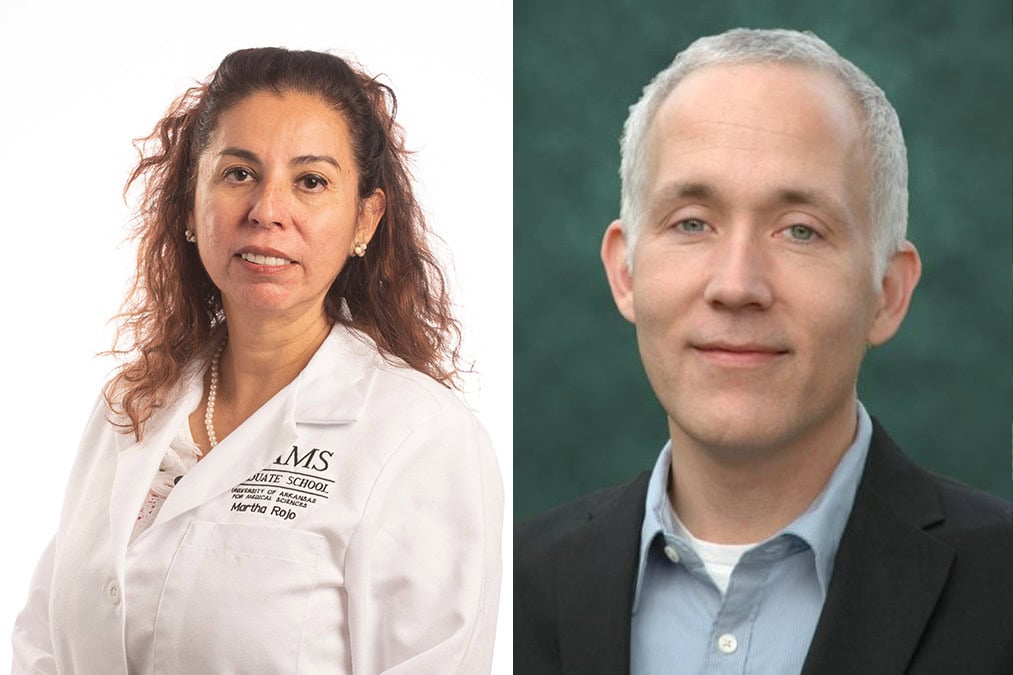
Martha Rojo, Ph.D.; Corey Nagel, Ph.D.
Graduate School’s Ph.D. in Nursing Program Stands Alone in Arkansas
| The University of Arkansas for Medical Sciences (UAMS) Graduate School is home to the only program in the state offering a doctoral degree in nursing. The Doctor of Philosophy in Nursing program gives candidates the opportunity to progress into advanced roles in nursing.
“We’re thrilled to offer this exceptional opportunity here at UAMS,” said Graduate School Dean Sean Taverna, Ph.D. “Students in our Nursing Ph.D. program can take advantage of training experiences across a wide range of disciplines.”
Candidates with the following degrees may apply for the program:
- Bachelor of Science in Nursing
- Master of Nursing Science
- Doctor of Nursing Practice
Martha Rojo, Ph.D., assistant professor in the College of Nursing and the program’s director, discussed her roles.
“My job is to identify and recruit students, then mentor and guide them once they’re admitted,” she said. “It’s a long admission process, and the program takes a minimum of five years.”
Rojo noted the rarity and the size of a doctoral nursing program.
“There are only 134 Ph.D. nursing programs in the United States, and only 1% of nursing professionals seek a doctoral degree,” said Rojo. “Our program is smaller than others, but the fact that we’re small is a good thing. Students get individualized attention from faculty — not only in their academic careers but also in regard to their health and well-being.”
Corey Nagel, Ph.D., associate professor in the College of Nursing, emphasizes the program’s collaborative aspect.
“One of the strong benefits of our Nursing Ph.D. program is that it’s situated in the Graduate School where there are faculty from all of the UAMS colleges,” he said. “That creates an environment where the students get the benefit of studying alongside and collaborating with people from nursing as well as from other areas of study.”
UAMS’ combination of clinical care, education, and research presents itself well for nursing doctoral candidates.
“This is the perfect place to be as a researcher,” Rojo said. “In the nursing program we prepare students to be generators of new knowledge so the clinicians can use any of the information the Ph.D.’s in nursing science generate. At the same time there are questions in the clinical realm that require answers. The marriage between clinicians and researchers is vital. That’s what nursing can do — looking at the individual holistically.”
“For the nursing students, healthcare is a team sport,” Nagel added. “Interprofessional collaboration is a critical aspect of healthcare practice in general. Every project I’ve worked on was a team composed of people from multiple disciplines — nurses, physicians, epidemiologists, statisticians, economists. The benefit in being trained in that kind of environment prepares students for what the work is actually like.”
Rojo noted the future benefits of the nursing doctoral program.
“We’re developing people who can teach the next generation of nursing scientists,” she said.
For additional information regarding admissions or questions about the process email graduateadmissions@uams.edu, call (501) 686-5454, or visit the College of Nursing Ph.D. in Nursing program page.