UAMS Winthrop P. Rockefeller Cancer Institute’s Investment in Research Connections Leads to $3.1 Million NIH Grant
| LITTLE ROCK — A five-year National Institutes of Health grant for more than $3.1 million will fund University of Arkansas for Medical Sciences (UAMS) researchers studying a new method aimed at enhancing the immune system’s ability to fight tumor growth in head and neck cancers.
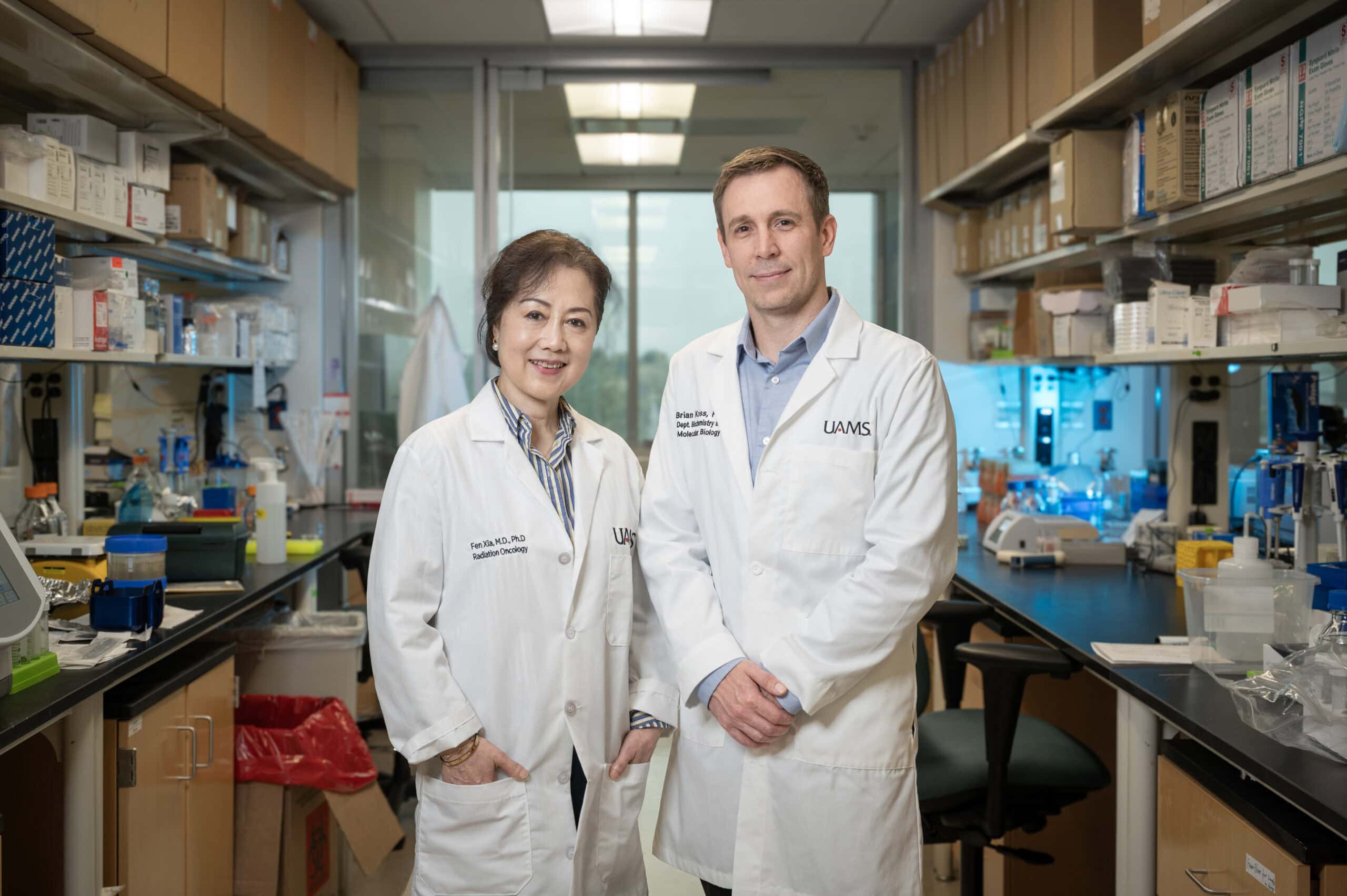
Fen Xia, MD, Ph.D., a radiation oncologist and professor in the College of Medicine Department of Radiation Oncology, will serve as co-principal investigator on this study with Brian Koss, Ph.D., an assistant professor in the College of Medicine Department of Biochemistry & Molecular Biology. Both Xia and Koss are members of the UAMS Winthrop P. Rockefeller Cancer Institute. Xia’s work studies DNA damage response, while Koss focuses on the immune control of cancer.
“The Winthrop P. Rockefeller Cancer Institute brings together scientists and clinicians from across disciplines and provides the resources needed to pursue innovative cancer research,” said Michael Birrer, M.D., Ph.D., vice chancellor of UAMS and director of the Cancer Institute. “This study demonstrates how these connections and institutional support can lead to promising new discoveries.”
“This project is a perfect example of intramural support leading to collaborative success,” said Koss.
Xia and Koss’s collaboration grew out of the Cancer Institute’s annual retreat, which brings together researchers and scientists to connect and share insights, facilitating the groundwork for this study and ultimately leading to the NIH grant award for the two researchers. Following the retreat, the two submitted for and were awarded a Cancer Institute Team Science Award that supported the preliminary data utilized in the application for this grant award.
With this new award, the team will study the use of DNA repair to improve the performance of T cells, which are a critical part of the immune system’s defense against tumor growth.
Many cancer researchers are exploring the use of inhibitors of DNA repair proteins to weaken cancer cells and make them more sensitive to traditional therapies such as radiation or chemotherapy. Xia and Koss are taking a novel approach with their study.
“Our project is fundamentally different in that we are working to enhance DNA repair to protect therapeutic T cells in solid tumors and hopefully improve immune response,” said Koss.
Research will focus on the GSK3ß-53BP1 axis, which Xia and Koss recently identified as an important regulator for how cells repair damage and respond to treatment. According to Xia, emerging evidence along with their previous findings suggest that targeting this axis may enhance the body’s immune response to tumor growth.
Ultimately, this work could lead to improved treatment outcomes for head and neck cancers.
This study is supported by the Winthrop P. Rockefeller Cancer Institute and the National Institutes of Health award 1R01CA299654.
UAMS is the state’s only health sciences university, with colleges of Medicine, Nursing, Pharmacy, Health Professions and Public Health; a graduate school; hospitals in Little Rock and Bryant; an orthopaedic hospital; a main campus in Little Rock; a Northwest Arkansas regional campus in Fayetteville; a statewide network of regional campuses; and seven institutes: the Winthrop P. Rockefeller Cancer Institute, Jackson T. Stephens Spine & Neurosciences Institute, Harvey & Bernice Jones Eye Institute, Psychiatric Research Institute, Donald W. Reynolds Institute on Aging, Translational Research Institute, and the Institute for Community Health Innovation. UAMS includes UAMS Health, a statewide health system that encompasses all of UAMS’ clinical enterprise, including partnering hospitals in Pine Bluff, Helena-West Helena, Mena, and Warren. UAMS is the only adult Level 1 trauma center in the state. UAMS has 3,813 students and 1,030 medical residents and fellows, and two dental residents. It is the state’s largest public employer with about 12,000 employees, including 1,200 physicians who provide care to patients at UAMS, its regional campuses, Arkansas Children’s, the VA Medical Center and Baptist Health. Visit www.uams.edu or uamshealth.com. Find us on Facebook, X (formerly Twitter), YouTube or Instagram.###