View Larger Image
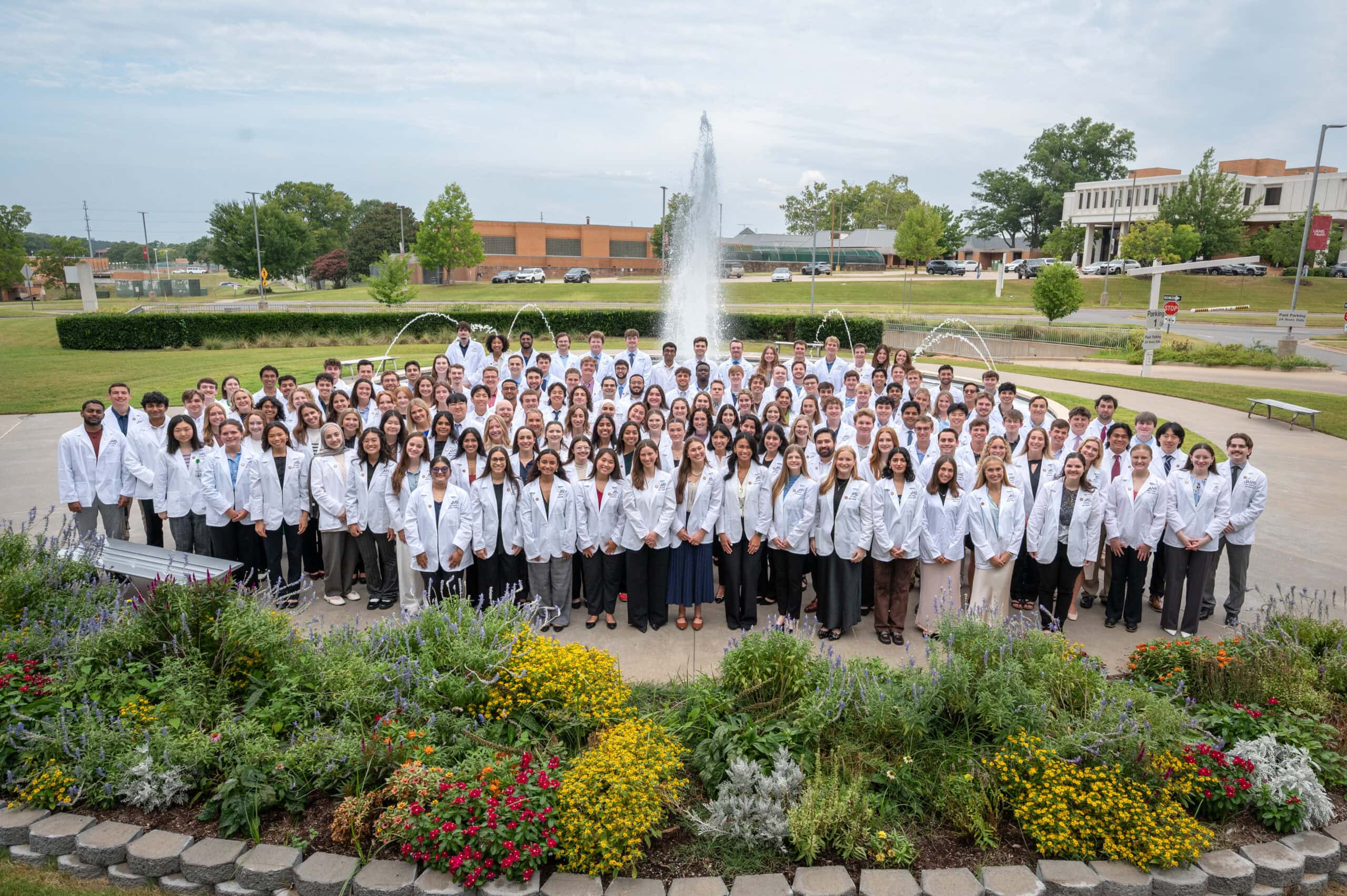
The College of Medicine Class of 2026 in their white coats
Image by Evan Lewis
UAMS College of Medicine Welcomes 172-Member Class of 2030 with White Coats
| In ceremonies held Aug. 7 in Little Rock and Fayetteville, the University of Arkansas for Medical Sciences (UAMS) College of Medicine extended a warm welcome to 172 new medical students comprising the Class of 2030.
The incoming classmates gathered at the Robinson Center Performing Hall in Little Rock and the University of Arkansas Don Tyson Center in Fayetteville to hear from UAMS leaders before jointly reciting the Medical Student Oath and donning their first white coats onstage.
Members of the Class of 2030 recite the Medical Student Oath before donning their white coats.Bryan Clifton
The short white coats symbolize their commitment to medicine and the privileges and responsibilities that go with it as they begin their studies. Upon graduation in four years, they will recite the Hippocratic Oath and receive longer white coats signifying their transition to medical doctors before beginning additional training in their designated specialties in the form of three- to seven-year residencies.
The white coat ceremonies capped Welcome Week activities such as tours and orientation on both campuses before classes began Aug. 10.
The class is 51% male and 49% female, with ages ranging from 20 to 38. Nineteen members of the class will be studying at the UAMS Northwest Regional Campus in Fayetteville, while the rest will be at the main campus in Little Rock.
Tom G. South, assistant dean of medical student admissions, said that about 10% of the class is married, including at least two couples in which both spouses are medical students. He said two class members in Fayetteville and one in Little Rock are participating in an accelerated three-year track to a medical degree.
At the ceremony in Little Rock, students heard welcoming remarks from UAMS Chancellor C. Lowry Barnes, M.D., and Becky Latch, M.D., associate dean of student affairs, before turning their attention to Ron Robertson, M.D., a UAMS graduate and veteran trauma and general surgeon who was named dean of the college this summer.
Robertson told the incoming class members that they represent just 5% of 3,339 applicants for their spots.
“So, congratulations!” he said, flashing a large smile from the stage, where students faced him from several rows in the center of the auditorium. Behind and around them, supporters including family members and friends filled seats on the floor and in upper balconies, many of them snapping photos with cell phones.

College of Medicine Dean Ron Robertson, M.D., welcomes the new medical students in a cavernous auditorium.Bryan Clifton
“You worked very hard to get here,” Robertson told the giddy yet attentive crowd. “I understand you know your commitment. You’ve shown us that you have the ability to succeed in medical school and the desire to improve lives and communities through the practice of medicine. You were selected to be here as a member of this class because we believe you will help us carry out our mission, which is to improve the health and well-being of Arkansans and others in the region.”
More than 11,900 physicians have graduated from the UAMS College of Medicine since its establishment in 1879, Robertson said.
But the goal isn’t just to confer medical degrees, he said. Instead, “Our obligation is to truly make you great physicians. That means someone who is knowledgeable and skilled, who is compassionate and humble, who upholds the highest ethical and professional standards, and who always, always, puts their patients first.”
“The next four years are going to be very demanding,” Robertson said. “The years and the decades that follow will likely be just as challenging. So, as you work through these challenges and tough times, try to remember the profound impact that you will have on your patients and families. And remember, we’re here to support you throughout this very special journey.”
Naveen Patil, M.D., president of the Arkansas Medical Society, addressed the audience next, followed by keynote speaker Lindsey Sward, M.D., an associate professor of obstetrics and gynecology.
Patil shared a quote he learned when he began medical school 36 years earlier: “What we learn with pleasure, we never forget.”
He encouraged the students to see every patient as a teacher, and to listen carefully, as “their stories often reveal the diagnosis before any test does. Pay attention during every physical exam: the murmurs and the crackles, the masses and the rashes, the reflexes and the signs. Each is a clue waiting to be recognized.”
He added, “Remember this truth: what the brain does not know, the eyes cannot see, the ears cannot hear, the nose cannot smell, and the hands cannot feel. Knowledge sharpens observations, and observations save lives. Medicine is both a science and an art.”
One of many white coats given out at the ceremony.Bryan Clifton
Sward, a 2009 College of Medicine graduate, said that the white coat, however difficult to keep clean, has come to represent four overarching principles: expertise, empathy, selflessness, and integrity.
“Having a kind smile, a listening ear, and a compassionate touch often go further than any remedy we have to offer,” she told the students. “Patients much more often remember the empathy and compassion of their doctors than they do the exact medical treatment they received.”
She urged the students to “take time to make sure that you are well nourished and well rested, both physically and emotionally, so that you can provide the best care to your patients. But while you’re on the clock, your patients should come first, no matter how hard or inconvenient it may be. Going the extra mile for your patient, not taking the easy way out, is always the right thing to do, and something that, in the long run, I promise you won’t regret.
“As a medical student,” she continued, “selflessness will sometimes look like doing tasks that might otherwise be deemed beneath you, and for which you may not get any recognition. In those moments, I want you to remember that you are putting the needs of others above your own, and that’s how a truly great doctor is made.”
Students paused for photos with loved ones from the stage after being helped into their white coats.Bryan Clifton
After a short presentation of awards to medical students beginning their second, third, and fourth years, John Spollen, M.D., the college’s executive associate dean, led the first-year students in a recitation of the Medical Student Oath.
The solemn occasion took a celebratory turn as each student then walked across the stage and, with the help of family, friends or academic advisers, put on their white coat for the first time, then stopped to pose for a photograph and applause.