View Larger Image
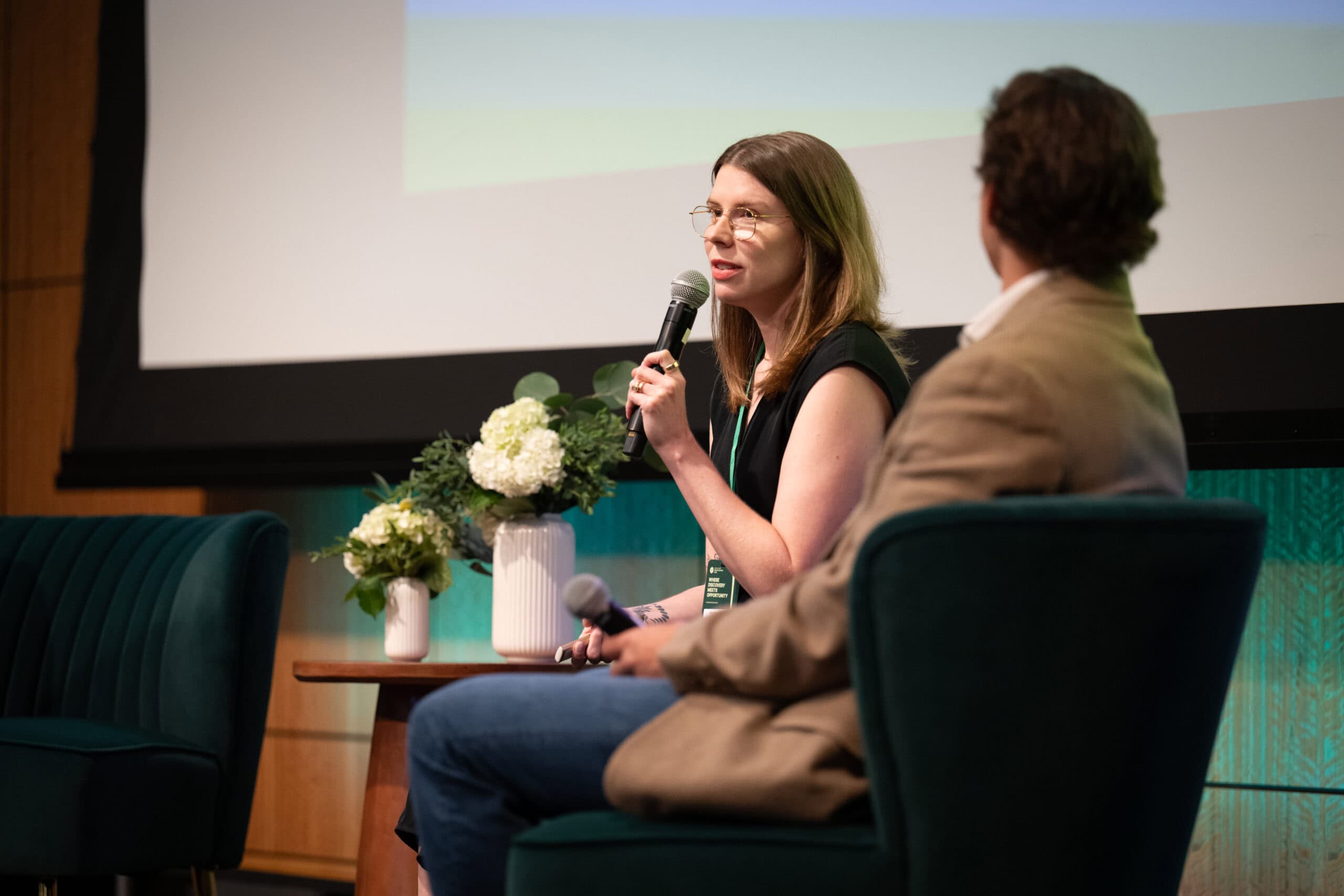
Amy Hopper Swan (center) speaks during a panel with Chris Baldwin (right) during Innovation Day 2026.
Image by Bryan Clifton
‘From Idea to Practicality:’ BioVentures Innovation Day Touts Possibilities
| The University of Arkansas for Medical Sciences (UAMS) recently celebrated researchers and their discoveries at BioVentures Innovation Day, which showed that innovation can take many forms, and celebrated the teams of experts that help make it all possible.
BioVentures, founded in 1994, is the technology transfer and commercialization office at UAMS, supporting researchers and innovators in protecting intellectual property, advancing biomedical discoveries, developing startup companies, and connecting innovations with industry and the marketplace.
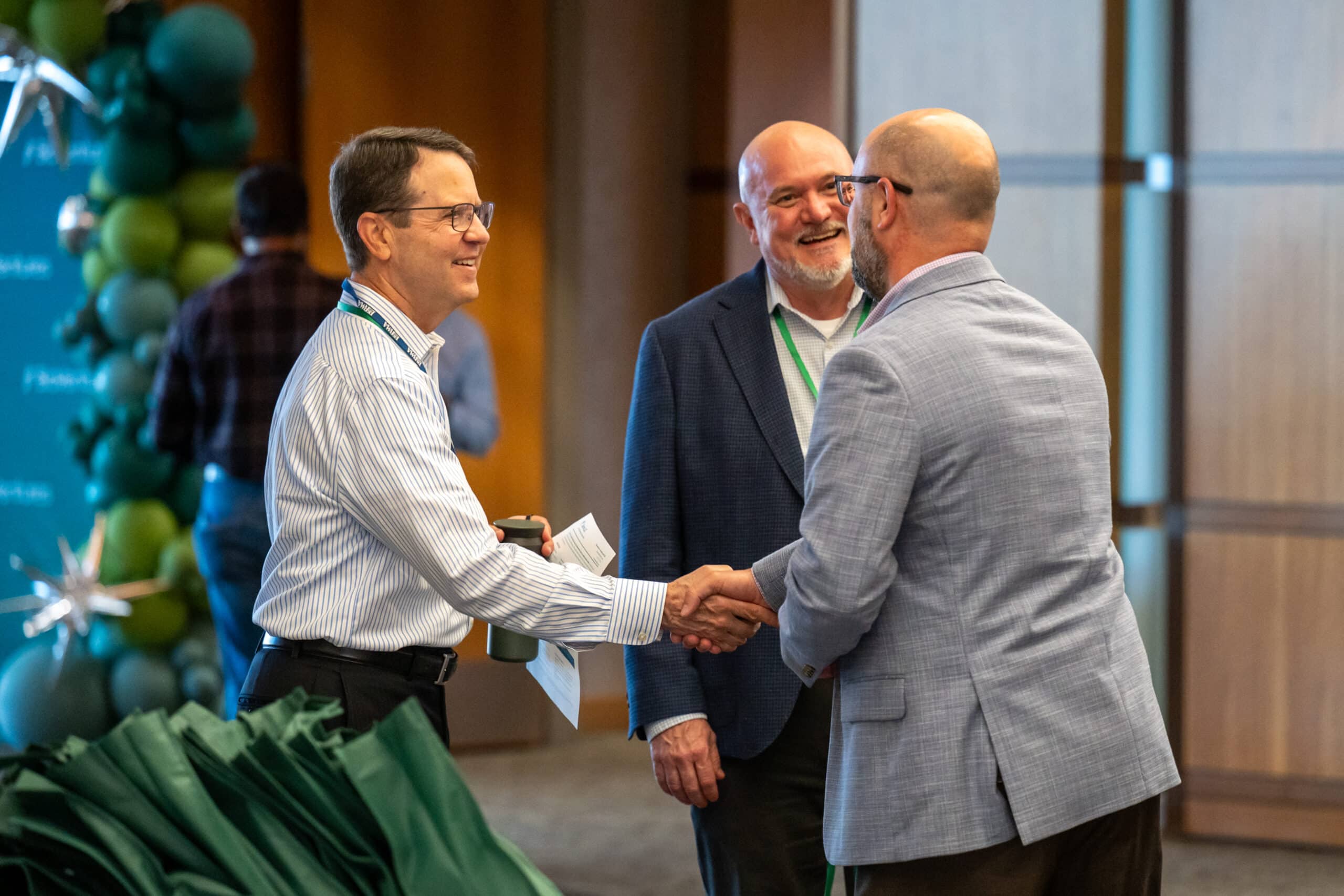
Jay Gandy, Ph.D., professor emeritus (left) and BioVentures President Eric Peterson, Ph.D. (center) greet Dan Voth, Ph.D., UAMS vice chancellor for research (foreground) during Innovation Day.Bryan Clifton
The Aug. 19 event drew more than 100 people to the 12th floor of the Jackson T. Stephens Spine & Neurosciences Institute, where attendees made new connections and learned how to make their ideas a reality.
“Innovation is so important to our institution and life in general,” said UAMS Chancellor C. Lowry Barnes, M.D., as he kicked off the day’s events.
Barnes has developed medical innovations for hip and knee surgeries over his career as an orthopaedic surgeon and owns multiple patents. He encouraged attendees to think ahead to next steps and commercialization, so that today’s ideas can help tomorrow’s patients.
“Challenge each other, because that’s what leads to innovation,” Barnes added. “Our research is very important, but it’s about how we apply it and how we use it to make Arkansans, Americans, and those around the world better.”
The connection between technology transfer offices and universities helps transfer ideas out into the real world, said BioVentures President Eric Peterson, Ph.D. He shared a few of UAMS’ medical innovations over the years, including cancer marker antibodies, fetal monitoring systems, amino acid blends, and a fall risk assessment scale that became a national model.
In 2025, BioVentures helped file 42 patent applications, Peterson said, with an additional eight patents granted. In total, the office handled nearly 300 individual patents over the last year, which brought in approximately $1.18 million in licensing and equity revenue. The office also assisted in founding three startup businesses and obtaining more than three dozen licenses.
“Innovation begins when someone says, ‘There has to be a better way,’” Peterson said. “Every patent represents a patient, and every invention disclosure begins with a patient problem.”
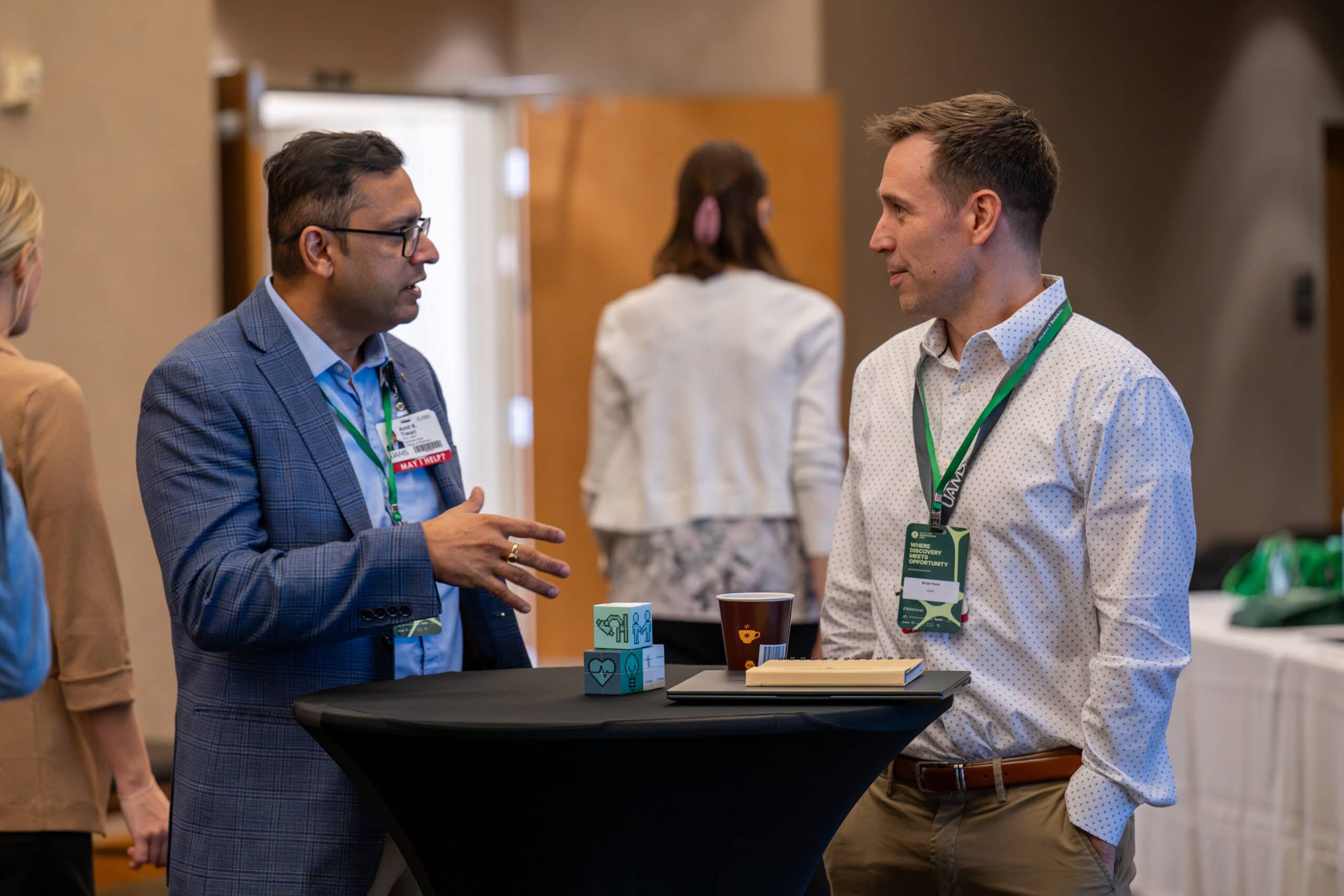
Amit Tiwari, Ph.D., (left) UAMS College of Pharmacy associate dean of research and graduate studies, and Brian Koss, Ph.D., assistant professor of biochemistry and molecular biology, chat during a break.Bryan Clifton
Current trends in medical innovation are focusing on digital health, precision medicine, cell and gene therapy, biomedical informatics, and artificial intelligence (AI), which Peterson called “the elephant in the room.” Above all, a renewed focus on Arkansas entrepreneurship will drive those innovations, he said.
“The goal is not patents or startups, but the impact — lives changed,” Peterson said.
Allison Thompson, M.Ed., a program manager with BioVentures, said it’s never too early to reach out to the office for long-term support. Along with consultation and support, the office has multiple programs available, including the Arkansas Health Ventures Accelerator for drugs and therapeutics, the NIH R25-funded CADET (Cancer and Developing Entrepreneurial Technologies) training program for cancer researchers, the MIEHT (Medical Innovation and Entrepreneurship Honors Track) honors program for medical students, the Founder’s Forum for UAMS faculty startup leaders, and the soon-to-launch Research Innovation Ambassadors program, which will engage UAMS faculty as departmental connectors for research innovation and commercialization resources.
A pair of panels generated plenty of discussion and audience questions.
Megan Reed, Ph.D., MBA, senior licensing associate, moderated a conversation with local entrepreneurs Chris Baldwin and Amy Hopper Swan about the state of innovation and capital investments in Arkansas. Baldwin, who founded Synapse Communications Consulting, touted Gov. Sarah Huckabee Sanders’ involvement in promoting investment in homegrown innovations and said it’s easier to make connections in a smaller state. Swan, the founder of Swan Impact Strategies and a strategy consultant with BioVentures, said that although healthcare venture capital investment in Arkansas is much lower than in neighboring states, there is also less market saturation, which translates to greater opportunities to grow something locally.
“People may not think there is tech here [in Arkansas], but we know that there is,” she said. “We are hungry to show what we can do.”
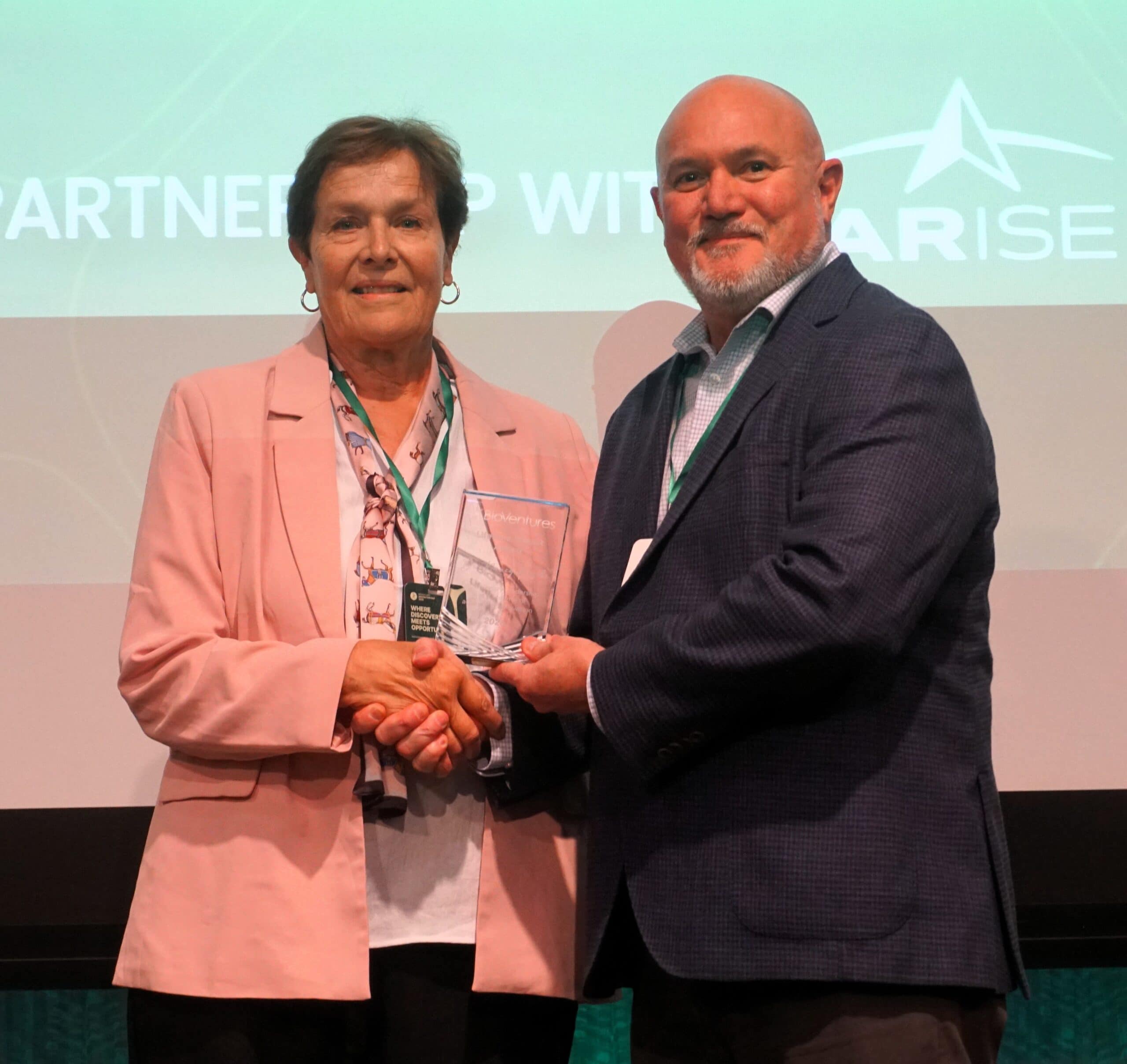
Nancy Rusch, Ph.D. (left) accepted the BioVentures Lifetime Impact Award for her decades of service to UAMS and the healthcare community.Benjamin Waldrum
Luna Acosta, MBA, director of technology transfer at Arkansas State University, spoke with four local patent attorneys about protecting intellectual property rights for innovators. The influence of AI dominated most of the discussion, prompting several audience questions on how its use affects intellectual property and ownership of ideas.
The panel advised inventors to use closed-circuit AI programs when brainstorming, as public-use AI programs will simply absorb any information and potentially share it with other users.
“If you’re not specifically checking the confidentiality safeguards [in AI], and you’ve put in what you think is a new antibody or nucleic acid sequence, you’ve just fed [that program] what potentially could have been a new sequence,” said Tolga Gulman, Ph.D., a patent attorney with Quarles & Brady law firm. He added that, depending on the country, this could start the one-year grace period between publicly declaring an idea and being able to file a patent.
Other events of the day included discussions on industry partnerships, common pitfalls while navigating regulatory pathways, and tips for founding a startup business.
An awards ceremony closed Innovation Day. Winners included:
- Patent Achievement Recognition
- Jia Liu, Ph.D., U.S. Patent No. 12,428,626
- Arny Ferrando, Ph.D., and Robert Wolfe, Ph.D., Japanese Patent No. 7716119
- Philip Breen, Ph.D., U.S. Patent No. 12,516,035
- Srinivas Ayyadevara, Ph.D., Peter Crooks, Ph.D., and Robert Reis, Ph.D., U.S. Patent No. 12,552,763
- Subi Al’Aref, M.D., and Kedar Jambhekar, M.D., U.S. Patent No. 12,582,374
- Mohamed Abdeldayem, M.D., Ph.D., and Erika Petersen, M.D., U.S. Patent No. 12,370,338
- Therapeutic Innovation of the Year — William Lu, Ph.D., for developing FBX039-specific T-cell receptors, a new approach to T-cell therapy for difficult-to-treat solid cancers, including breast cancer and glioblastoma.
- Student Innovator of the Year — Rodrigo Meade, a College of Medicine student, for showing initiative in developing ideas and having an entrepreneurial mindset.
- Innovation Champion of the Year — Grover Miller, Ph.D., for his role with the UAMS Patent and Copyright Committee and continued support of innovative research.
- Lead Woman Inventor of the Year — Erica Malone, Ph.D., for developing a high-fidelity nerve block simulation model to help train clinicians through simulation.
- Medical Device of the Year — Erica Malone, Ph.D., Michael Luna, M.D., Beau Aguilar, Anthony Gunderman, Ph.D., and Alex Gilman, M.D., for developing a high-fidelity perfused cadaveric simulator for coronary artery bypass graft, which creates a more realistic environment for multidisciplinary teams to practice complex procedures.
- Research Innovation Ambassadors — Samuel Atcherson, Ph.D.; Craig Forrest, Ph.D.; Abdel Fouda, Ph.D.; Robert Griffin, Ph.D.; Andy James, Ph.D.; Grover Miller, Ph.D.; Konrad Rajab, M.D.; Analiz Rodriguez, M.D., Ph.D.; Ankita Shukla, M.D.; Amanda Stolarz, Pharm.D., Ph.D.; Ben Stronach, M.D.; Sami Uwaydat, M.D.; Chris Wardell, Ph.D.; Yong Zhu, Ph.D.
Allison Streepey, a business manager with the UAMS Centers on Aging, attended the event and came away with a greater knowledge of the patent process from start to finish.
“I knew only a little about BioVentures, but this conference showed me how they establish contacts and resources to help protect inventors completely through the process, from the idea to practicality,” she said. “My favorite part was seeing the scientist researchers being recognized with awards for making a difference in the world through their work.”
Peterson also presented Nancy Rusch, Ph.D., distinguished professor and chair of the Department of Pharmacology and Toxicology, with the BioVentures Lifetime Impact Award for her decades of service to UAMS and the healthcare community. Rusch, who led an NIH-funded cardiovascular lab for 30 years and held numerous leadership positions at UAMS, also co-founded a startup company through BioVentures and serves on its advisory board.
“If you want to be successful and have a fun career, just step out of your comfort zone,” Rusch said. “Everything I’ve done related to entrepreneurship has not been in my comfort zone. I think, whether at 25, 35, 50, or 72 – it’s never too late to be an entrepreneur.”