UAMS Cancer Institute Researchers Publish Groundbreaking Findings in Prestigious Scientific Journal
| LITTLE ROCK — A research team at the University of Arkansas for Medical Sciences (UAMS) Winthrop P. Rockefeller Cancer Institute was recently published in Cell, one of the world’s leading scientific journals, for a promising discovery that may lead to more effective cancer immunotherapies.
Cell is one of the most prestigious scientific journals, recognized for publishing high-impact research across the fields of biochemistry, molecular biology, and cell biology.
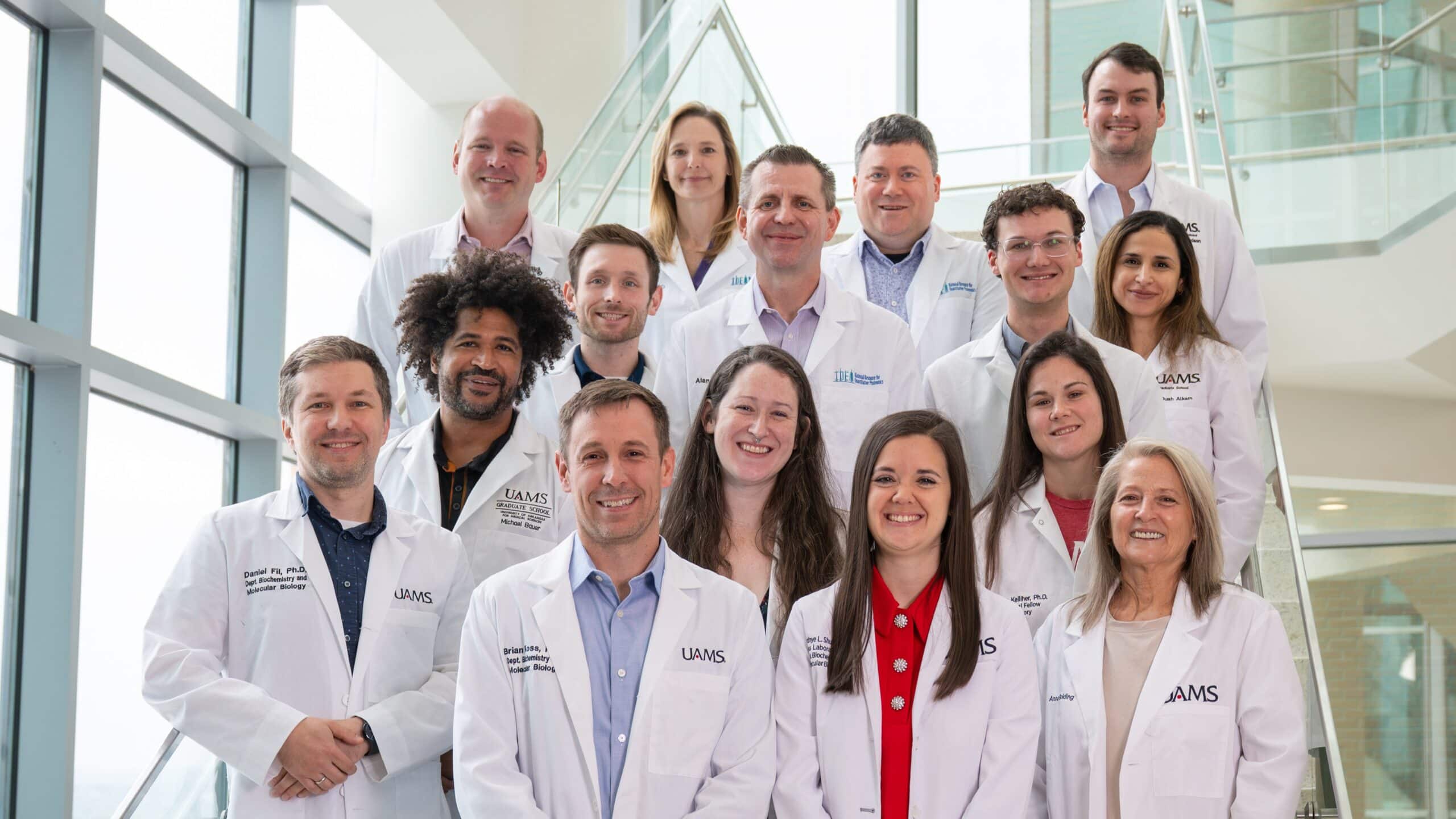
Brian Koss, Ph.D., an assistant professor in the College of Medicine Department of Biochemistry & Molecular Biology and co-leader of the Cancer Institute’s Cancer Therapeutics research program, is the senior author of the published manuscript. The study was led by Sydnye Shuttleworth, an M.D./Ph.D. student and Cancer Institute member who is mentored by Koss. Together, Koss and Shuttleworth study how the immune system controls cancer progression, with a particular emphasis on making CAR T-cell therapies more effective in solid tumors.
T cells play a critical role in the immune system, helping our bodies fight infection. CAR T-cell therapy is a form of immunotherapy that genetically modifies a patient’s T cells to enable them to seek and destroy cancer cells. This is an effective treatment for many blood cancers, but in solid tumors, T cells become exhausted and lose their ability to kill cancer cells.
“Dr. Koss and his team are leading work that could impact how the immune system fights cancer and create opportunities to develop more effective immunotherapies,” said Michael Birrer, M.D., Ph.D., UAMS vice chancellor and director of the Winthrop P. Rockefeller Cancer Institute. “Having this research published in Cell reflects the significance of this discovery and the caliber of research taking place at the Cancer Institute.”
The paper titled, “Proteomic Atlas of T-Cell Exhaustion Defines Proteostatic Collapse,” details the team’s efforts to better understand the underlying molecular changes that occur within T cells that lead to exhaustion when fighting solid tumors. Shuttleworth found widespread changes in cellular metabolism, DNA repair, and proteostasis — the biological process that controls protein maintenance and regulation — noting the collapse of proteostasis as a central driver in T-cell exhaustion.
“One of the most exciting aspects of this study is that it provides a new way to understand what happens inside T cells as they become exhausted,” said Shuttleworth. “By looking beyond gene expression to understand how proteins are regulated, we uncovered changes that would otherwise have been missed. We hope this work will provide a foundation for researchers across the field to make new discoveries that ultimately lead to better cancer treatments.”
“This study represents nearly six years of hard work and collaboration among many talented researchers,” said Koss. “I’m incredibly grateful to the members of our team and our close collaboration with the NIH National Resource for Quantitative Proteomics at UAMS. It’s exciting to see our collective efforts result in a resource that can benefit researchers across the field.”
Koss recently received a National Cancer Institute (NCI) NIH award to further research the effectiveness of RNF166, an enzyme identified in this study that showed promise for preventing T-cell exhaustion. Shuttleworth also received a prestigious NCI fellowship from the NIH in support of her training and pursuit of this promising research.
UAMS is the state’s only health sciences university, with colleges of Medicine, Nursing, Pharmacy, Health Professions and Public Health; a graduate school; hospitals in Little Rock and Bryant; an orthopaedic hospital; a main campus in Little Rock; a Northwest Arkansas regional campus in Fayetteville; a statewide network of regional campuses; and seven institutes: the Winthrop P. Rockefeller Cancer Institute, Jackson T. Stephens Spine & Neurosciences Institute, Harvey & Bernice Jones Eye Institute, Psychiatric Research Institute, Donald W. Reynolds Institute on Aging, Translational Research Institute, and the Institute for Community Health Innovation. UAMS includes UAMS Health, a statewide health system that encompasses all of UAMS’ clinical enterprise, including partnering hospitals in Pine Bluff, Helena-West Helena, Mena, and Warren. UAMS is the only adult Level 1 trauma center in the state. UAMS has 3,813 students and 1,030 medical residents and fellows, and two dental residents. It is the state’s largest public employer with about 12,000 employees, including 1,200 physicians who provide care to patients at UAMS, its regional campuses, Arkansas Children’s, the VA Medical Center and Baptist Health. Visit www.uams.edu or uamshealth.com. Find us on Facebook, X (formerly Twitter), YouTube or Instagram.###