UAMS’ Arkansas Center for Women and Infants’ Health Making Inroads, Pushing Forward
| | A lot has happened in the world of maternal and infant health in Arkansas since early 2025, when the Arkansas Center for Women and Infants’ Health at the University of Arkansas for Medical Sciences (UAMS) began implementing plans to reduce the state’s high rates of maternal and infant mortality.
The center was created with a $5 million Congressional appropriation, received in late July 2024, that was championed by U.S. Sen. John Boozman in response to national reports about the abysmal statistics. It recently received an additional $8 million from a $40 million appropriation, also championed by Boozman, that was set aside in February for a variety of programs at UAMS.
“This second $8 million investment allows us to build on the foundation we have created over the past two years,” said Nirvana Manning, M.D., professor and chair of the UAMS Department of Obstetrics and Gynecology, and director of the center. “Our first federal investment gave us the opportunity to bring people together, build partnerships across the state, and begin developing new ways to support Arkansas mothers and babies. Now we have the opportunity to take that work further and build a truly statewide system of postpartum support.”
Since its inception, the center has focused on three initiatives:
- Distributing mother and infant supply kits to every postpartum woman as she is discharged from any of the state’s 30 birthing centers.
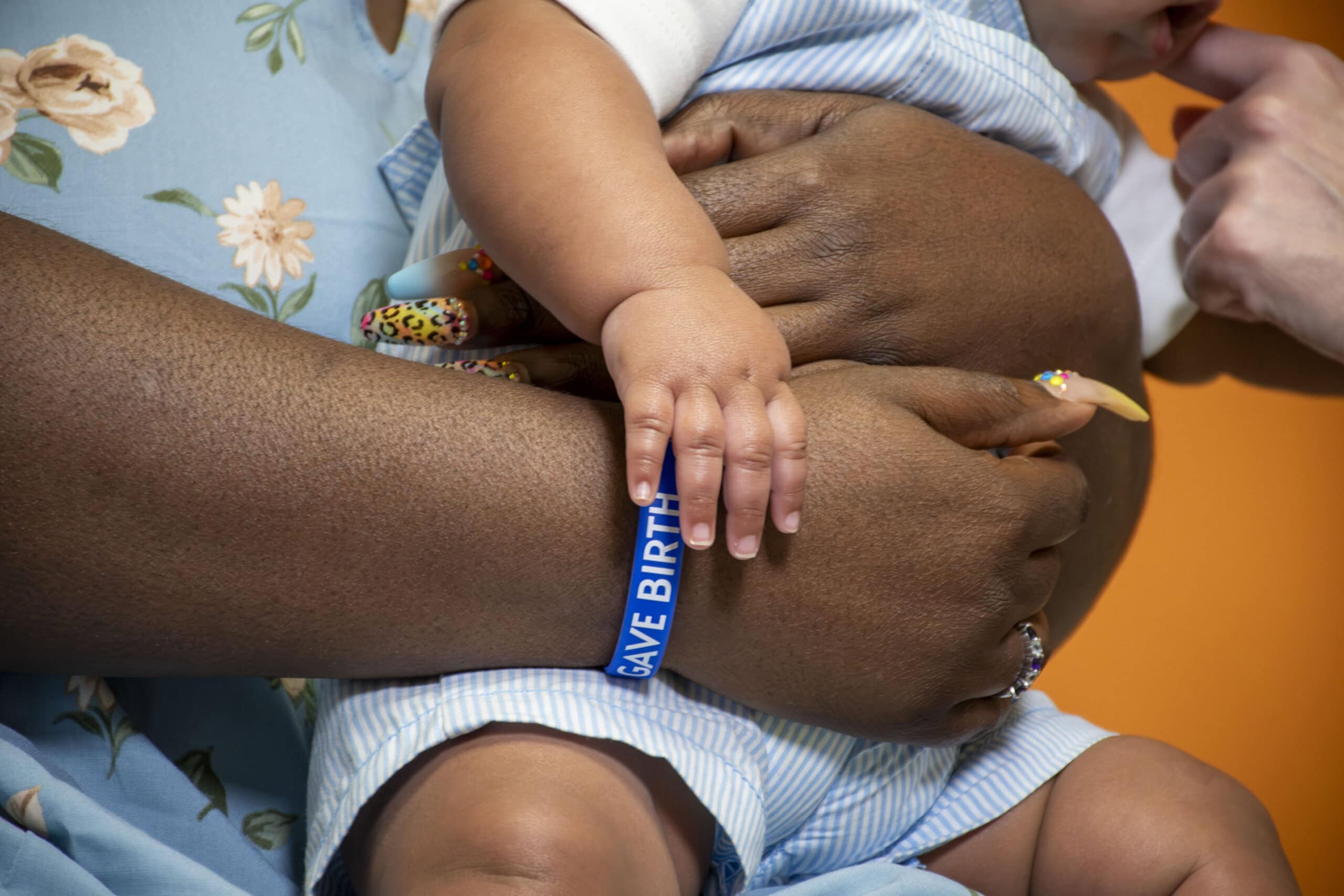
- Distributing bright blue “I Gave Birth” bracelets that the women are advised to wear for at least six weeks, to alert health care providers and emergency responders about complication risks. They include a quick-read (QR) code that links the women to postpartum resources.
- Having nurses contact every postpartum woman within five to 10 days of delivery to ensure they know about and are receiving proper follow-up care for them and their babies.
At last count, 22 of the state’s dwindling number of birth centers were participating in carrying out the initiatives, while the center also works with community health workers and local offices of the state Health Department, among others, to disseminate standardized education about postpartum needs and care.
A snapshot of the center’s efforts between May 1, 2025, and April 30, 2026, shows that of 5,492 women reached by nurses during that time, 1,031 of them — or 1 in 5 — reported a warning sign of a potentially serious postpartum complication, with leg swelling being the most common.
“Each one was a symptom that could have gone unmentioned and unaddressed, but because a nurse called early, it was named, taken seriously, and acted on,” the report said.
It also showed that 1 in 10 women screened positive for postpartum depression, and 12% of those assessed were connected to mental health resources. The report cautioned, however, that some symptoms of postpartum difficulties don’t develop until six months after childbirth, and more than 60% of pregnancy-related deaths occur between six weeks and one year after giving birth.
The women’s most common needs weren’t medical, according to the report. For example, it said 2 in 3 women reported at least one unmet social need, and 71 % of them said they were uninsured. In addition, 63% were enrolled in Medicaid but not WIC (Women, Infants & Children), a state program that provides nutrition support for low-income families; 48% said they couldn’t pay for a $300 emergency; 21% had no regular childcare; 11 % lacked supplies; 11% worried about lack of food; and 9% couldn’t afford housing.
The review found that 61% of women contacted by nurses through the Proactive Postpartum Call Center were enrolled in Medicaid through pregnancy. It said 28% were uninsured and 20% had private insurance, and 20% of those on Medicaid didn’t know their coverage would expire 60 days after delivery.
“Reaching women early is vital to catching potentially life-threatening complications before they become emergencies, but the needs in this report don’t resolve when we hang up the phone,” according to the report, which the center shares with its partners in addressing the maternal health crisis. “What we’re working toward is not just a call center, but a statewide safety net for women after they leave the hospital.”
To reach those goals, the Arkansas Center for Women and Infants’ Health is focusing this year on partnering with additional hospitals and the state Department of Health to reach every postpartum woman, regardless of where she delivers. It is also working on obtaining more complete data to get a better picture of what Arkansas families need, and when, as well as creating a system to make more follow-up contacts with postpartum women throughout the entire year after childbirth, which will require more community health workers.
Krista Langston, executive director of operations for the center, said that this year between March 1 and Aug. 31, the call center contacted 77% of the 12,483 women in Arkansas who gave birth within five to 10 days of discharge. Also, the center distributed 10,315 mother and infant supply kits statewide, and 15,757 women received postpartum “I Gave Birth” bracelets and educational materials.
Meanwhile, 1,249 clinicians and staff from facilities statewide completed training about recognizing and communicating postpartum warning signs.
As of Feb. 20, Langston said, 25 of 30 hospitals participating in a related joint initiative of the center and the Arkansas Perinatal Quality Collaborative (ARPQC) had fully implemented standardized patient education on urgent postpartum warning signs.
That initiative, called Postpartum CARE (Comprehensive Assessment, Resources, and Education), began in September 2025 and runs through February 2027. Its goal is to reduce postpartum mortality through a standardized “patient safety bundle” protocol.
As part of the CARE initiative, Langston said, 26 of the 30 participating hospitals had fully implemented the distribution of “I Gave Birth” or similar bracelets, and 10 of the hospitals had prepared a customized list of community resources for pregnant and postpartum women.
“During this reporting period, the Arkansas Center for Women and Infants’ Health continued building durable statewide postpartum systems, connecting digital access, proactive outreach, standardized education, and hospital-community alignment,” she said.
The center hosted its second Arkansas Maternal Health Roundtable in Central Arkansas on Aug. 20, in partnership with the Arkansas Hospital Association.
It convened participants from birthing hospitals across the state and featured a “fireside chat” with philanthropist Olivia Walton and Gov. Sarah Huckabee Sanders about the new national Healthy Moms, Healthy Babies Initiative.
An Arkansas version of the initiative provides about $45 million annually to improve maternal health in Arkansas by establishing presumptive Medicaid eligibility for pregnant women awaiting approval; increasing Medicaid reimbursements for obstetric services to encourage participation of providers; unbundling covered services to make them easier to obtain; and providing reimbursement pathways for doulas and community health workers.
Among the many maternal and infant health topics discussed at the gathering, which hosted 161 guests, were how to expand access and improve outcomes, policy and reimbursement issues and transformation, and rural maternal health care.
The call for expanding Medicaid coverage in Arkansas to cover postpartum care for a full year after giving birth was the main topic of a panel discussion with Arkansas legislators. The issue is expected to be a major topic of discussion when the state legislature convenes in January.