View Larger Image
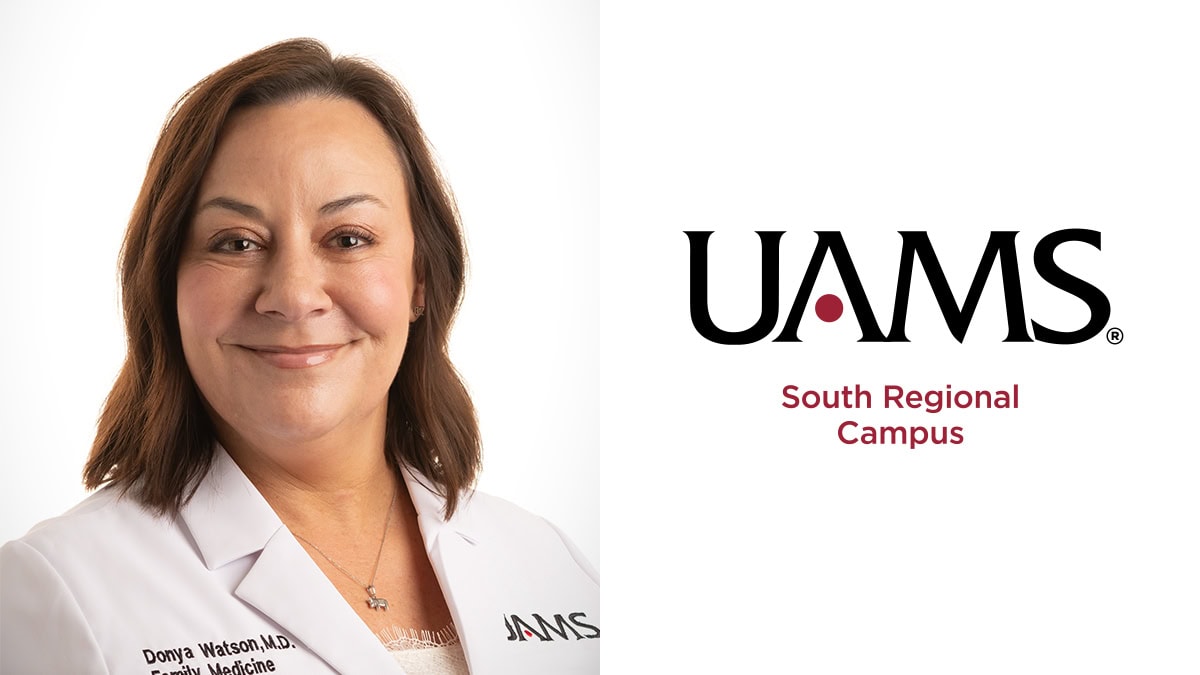
Donya Watson, M.D., program director for UAMS South Regional Campus
UAMS South Regional Campus, South Arkansas College Sign Agreement to Share SouthArk’s Simulation Lab
| EL DORADO — The University of Arkansas for Medical Sciences (UAMS) South Regional Campus in El Dorado and South Arkansas College signed an agreement today to share SouthArk’s simulation lab. Health professional students and residents at both campuses can train with manikins, learning medical procedures and life-saving skills in simulated situations.
“We’ll be able to use their simulation equipment just as they’ll be able to use ours. And in a small town, it’s really important not to duplicate resources,” said Donya Watson, M.D., program director for UAMS South Regional Campus. “So instead of building our own simulation center, we have a cooperative agreement with SouthArk so that we can all work together because, in the end, our goal is the same.”
Stephanie Tully-Dartez, Ph.D., president of SouthArk, said this is the first time the college has collaborated with the UAMS South Regional Campus. SouthArk’s healthcare professional students in nursing, surgical technology, and paramedic training will share the space with residents and medical students from UAMS South Regional Campus.
Family medicine residents at UAMS South Regional Campus will begin using the simulation lab the second year of their residency in 2027. As a rural track program, residents spend their first year training at UAMS in Little Rock before returning to El Dorado for their second and third years. In addition, UAMS South’s surgical obstetric fellow will train in the lab along with family medicine residents from UAMS Regional Campus rural track program in Crossett and rotating medical students from UAMS.
“These interdisciplinary training and simulated work environments are excellent training opportunities,” said Tully-Dartez. “The partnership benefits the students and our community.”
The two institutions have been working out details to share the simulation lab for more than a year, an idea spawned by Richard Turnage, M.D., former vice chancellor of Regional Campuses. After a tour of SouthArk, he saw the financial benefits and opportunities to collaborate in a shared space.
Richard Reeves, UAMS South Regional Campus’ senior administrative director, said Regional Campuses contributed close to $200,000 to add more advanced manikins to the lab’s inventory. SouthArk contributed by enlarging its original simulation lab, taking in an adjacent classroom on the first floor of the school’s Health Sciences Center.
The four-space training wing is equipped with hospital beds, simulated oxygen and suction, medication dispensary, and manikins. The lab’s manikins can be used for simple procedures such as starting an IV or injecting joints. The advanced manikins offer students more complex training and give feedback, validating whether they made the right decision or performed a procedure correctly.
Several of the manikins also have human-like reactions such as eyes blinking, pupils dilating, chest rising, and even shaking hands with the healthcare provider. A manikin named HAL can simulate a seizure, breathing issues, a heart attack, or opioid overdose. NOELLE simulates labor and delivery complications, and newborn TORY is her baby manikin that can suffer from these delivery problems as well.
“The manikins offer training scenarios that are as close to real life as you can get without having real people involved,” Watson said. “The big picture, in my opinion, is comfort, and not being intimidated. The sim lab allows our students and residents to work through stressful, complex situations before a patient’s life is on the line.”
This simulation lab partnership is supported by the Health Resources and Services Administration (HRSA) of the U.S. Department of Health and Human Services (HHS) as part of the Value‐Based Medical Student Education (MSE) Training Program. The contents are those of the author(s) and do not necessarily represent the official views or endorsement of HRSA, HHS or the U.S. government.
UAMS is the state’s only health sciences university, with colleges of Medicine, Nursing, Pharmacy, Health Professions and Public Health; a graduate school; hospitals in Little Rock and Bryant; an orthopaedic hospital; a main campus in Little Rock; a Northwest Arkansas regional campus in Fayetteville; a statewide network of regional campuses; and seven institutes: the Winthrop P. Rockefeller Cancer Institute, Jackson T. Stephens Spine & Neurosciences Institute, Harvey & Bernice Jones Eye Institute, Psychiatric Research Institute, Donald W. Reynolds Institute on Aging, Translational Research Institute, and the Institute for Community Health Innovation. UAMS includes UAMS Health, a statewide health system that encompasses all of UAMS’ clinical enterprise, including affiliated hospitals in Pine Bluff, Helena-West Helena, Mena, and Warren. UAMS is the only adult Level 1 trauma center in the state. UAMS has 3,813 students and 1,030 medical residents and fellows, and two dental residents. It is the state’s largest public employer with about 12,000 employees, including 1,200 physicians who provide care to patients at UAMS, its regional campuses, Arkansas Children’s, the VA Medical Center and Baptist Health. Visit www.uams.edu or uamshealth.com. Find us on Facebook, X (formerly Twitter), YouTube or Instagram.###