Second UAMS Parkinsonism Walk Attracts More Than 400 Participants
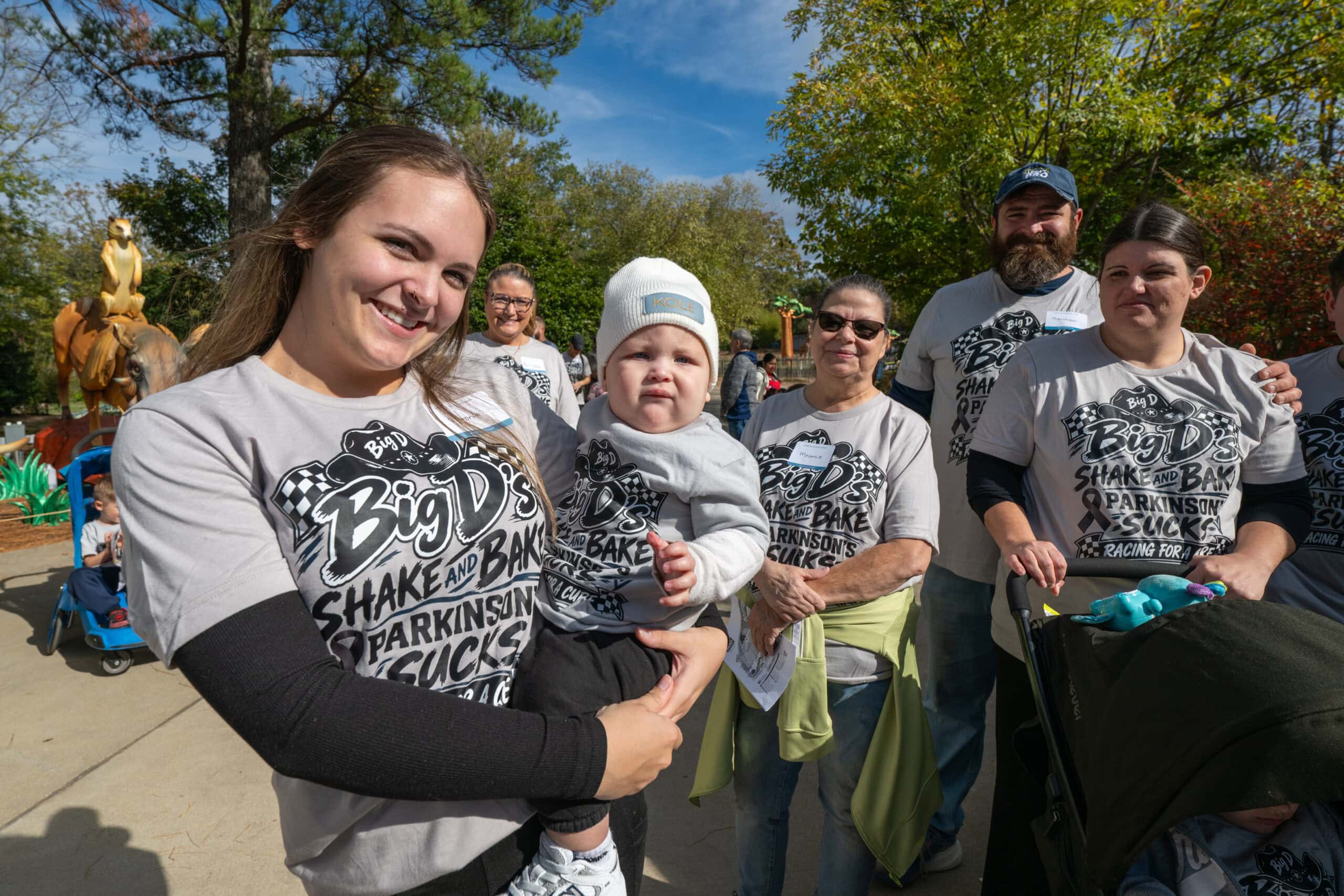
| Buoyed by picture-perfect fall weather, more than 400 people showed up at the Little Rock Zoo on the first Saturday in November to participate in the second University of Arkansas for Medical Sciences (UAMS) Parkinsonism Walk.
The event provided patients, caregivers, and supporters with a chance to visit with each other, as well as UAMS movement disorders specialists and sponsors, and to walk — some with canes and some in wheelchairs — along a 0.3-mile paved path to and from the zoo’s pavilion.
The mostly level path was shared by people of all ages, including babies in strollers and toddlers atop adults’ shoulders, as it meandered past exhibits of elephants, Malaysian tigers, ostriches, and GloWild lanterns shaped like animals and plants. Benches were available along the path for anyone wanting to stop and rest, and a UAMS shuttle provided rides.
Inside the pavilion, participants could pick up bottled water and snacks like yogurt and granola bars, peruse printed educational materials on UAMS and community programs supporting people with Parkinsonism, chat with UAMS staff and representatives of exhibitors such as the Parkinson’s Foundation, and listen to the music of John Lee, a Little Rock guitarist and Parkinson’s patient who emceed the event.
Judy Mullen, a Parkinson’s patient, was one of about 40 patients, caregivers, and supporters wearing black T-shirts with white letters announcing they were part of the Hot Springs Village Fit for Life Fighters, a Rock Steady Boxing group for people with Parkinson’s symptoms.
Noncontact boxing is widely recognized as an activity that helps Parkinson’s patients improve their motor skills and balance; Rock Steady Boxing is a nonprofit organization that offers programs in over 800 locations worldwide, including Hot Springs Village.
Misty Parrish, coach for the Hot Springs Village group who was named 2025 Coach of the Year at the World’s Parkinson’s Conference, was among those at the walk. Mullen said she attends a 90-minute boxing class led by Parrish two or three times a week, and the class “has changed my life.”
Barbera Malm, 78, of Little Rock, said she was diagnosed with Parkinson’s three or four years ago. She and her husband attended the event for the first time this year, and said they enjoyed “getting out for a cause,” particularly on a sunny day with crisp temperatures that warranted a light jacket. Despite having a limp that is unrelated to Parkinson’s, she said she found the walk “very easy.”
Kristen Mote and her daughter, Avery, were among 15 to 20 members of the Rose Bud Church of Christ in White County who attended the walk to honor Liz Thompson, a Parkinson’s patient who is the wife of their preacher, Phil Thompson. The Thompsons also participated in the walk.
Mote said she was also walking in honor of her father, Jimmie Wayne Crockett, who had Parkinson’s disease and died in 2024. She said her dad was a patient of Rohit Dhall, M.D., chair of the UAMS Department of Neurology and one of the organizers of the walk.
“Dr. Dhall really improved his life,” she said. “We just think the world of Dr. Dhall.”
Julie Batategas carried a sign saying, “In Loving Memory of Lori Forrest.”
Batategas walked alongside her father, Alan, a Parkinson’s patient who navigated the walk in a wheelchair and is a patient of Tuhin Virmani, M.D., Ph.D., director of the Movement Disorders program at UAMS. She said she was walking on her father’s behalf as well as in memory of Forrest, a friend who was in his Rock Steady Boxing class in Sherwood and recently died.
David Kern of Little Rock, a Parkinson’s patient, spoke at the event about free Dance for Life classes for Parkinson’s patients offered by Arkansas Festival Ballet. The classes, taught by Rebecca Miller Stalcup, are held Monday mornings and Thursday afternoons at 518 Main St. in Little Rock.
Before the walk began, Dhall and Lee addressed the crowd inside the pavilion.
Lee, 70, who is also a patient of Virmani’s, said he was diagnosed with Parkinson’s about 14 years ago. He encouraged other Parkinson’s patients to participate in ongoing research at Virmani’s Gait Laboratory at UAMS, which studies gait freezing, a common problem for people with Parkinson’s and other movement disorders. Lee said that in January, he plans to start a music program for Parkinson’s patients.
“You might already be a musician, or you might want to learn how to play guitar or ukelele, or just play a tambourine,” he said. “So, we’re going to have a Parkinson’s jam session once a month at UAMS.”
Dhall thanked the crowd for helping spread the word about Parkinson’s disease and related conditions, and said that just as he did last year, he would be walking in memory of his father, who lived with Parkinson’s for about 30 years.
“There are so many of you who have been touched by this disease,” Dhall said, “so we know that there’s a clear need to show our appreciation for your support and to build programs locally that would help manage the disease better and find ways to treat the symptoms of Parkinson’s.”