College of Public Health Department Hosts Girl Scouts
| The University of Arkansas for Medical Sciences (UAMS) Fay W. Boozman College of Public Health Department of Environmental Health Sciences strives to promote the value of science and public health to Arkansans — youth included.
As part of that educational mission, the department recently welcomed the Chipato Valley Girl Scout troop for a special on-campus showcase. The STEM-based event helped the scouts fulfill a requirement for one of their merit badges.
During the Aug. 5 visit, the department’s faculty and staff spoke with the scouts about the impact of science, public health and career options in the field.
Chris Fettes, M.A., program director and instructor in the department, said it was a good time for everyone involved.
“We were happy to speak about our respective research interests and work, both at UAMS and in the community,” he said. “For me, the best part of the showcase was taking the group to BioMed II [a research facility at UAMS] to show them some of the equipment and procedures our faculty use in their labs.”
Instructor Rachel Hale, M.A., said the visit provided a great opportunity to explain how public health has several career options that help entire populations.
“It’s important for young adults to be aware of the wide range of possibilities within public health from lab work to field work and being in partnerships with community members,” Hale said. “I enjoyed sharing my work to illustrate how climate change impacts the health of Arkansans.”
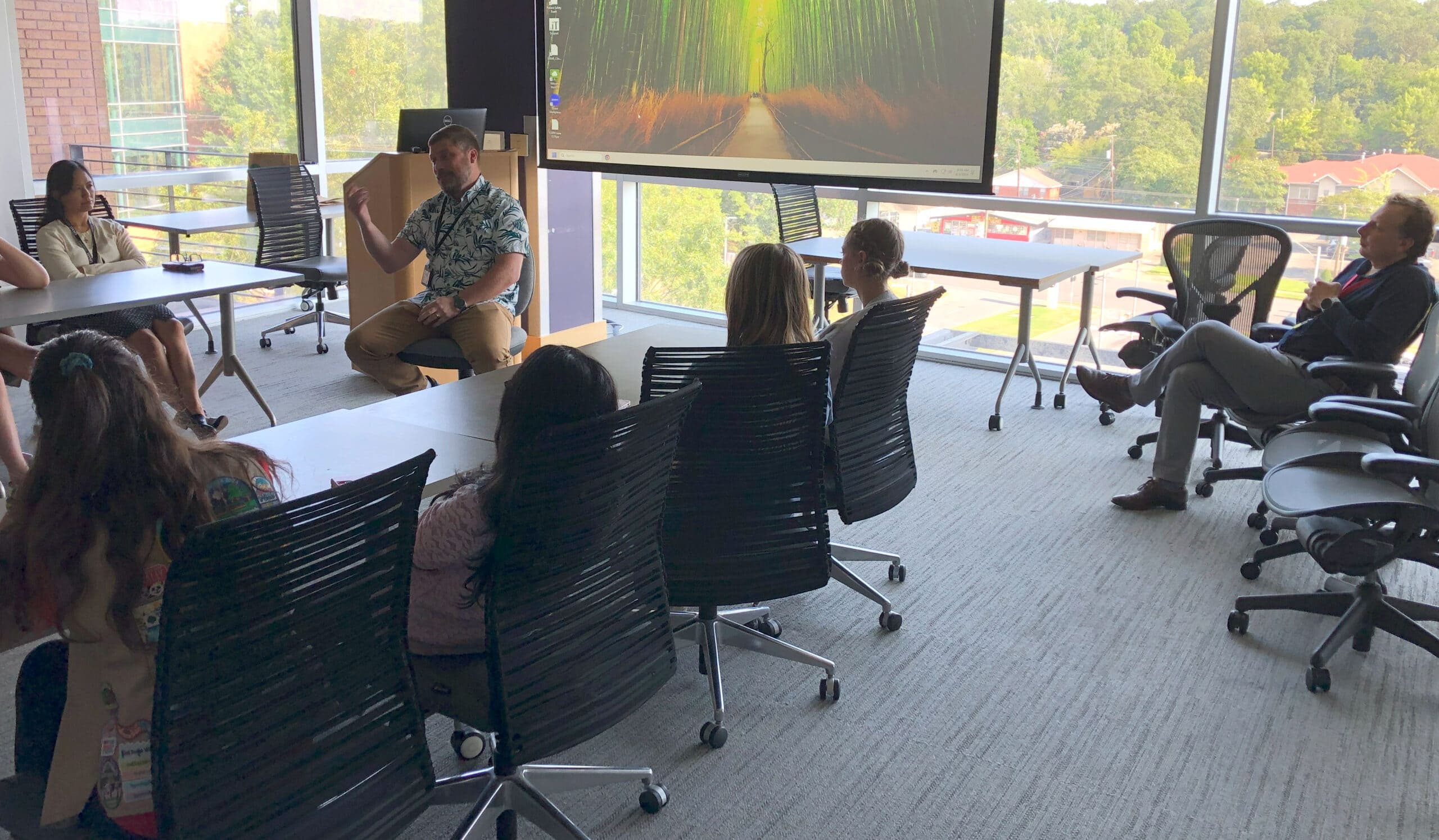
Scott Alsbrook, M.S., instructor in the University of Arkansas for Medical Sciences Fay W. Boozman College of Public Health, speaks to the Chipato Valley Girl Scouts during a special event.
Gunnar Boysen, Ph.D., associate professor for the department, said it was fun speaking with the group about science.
“It’s always good to meet the next generation of future scientists and to learn what young people are concerned about,” he said.
“Interacting with nonscientists, young individuals in this case, forces me to look at my research from a different perspective,” Boysen said. “That makes me a better public health advocate.”
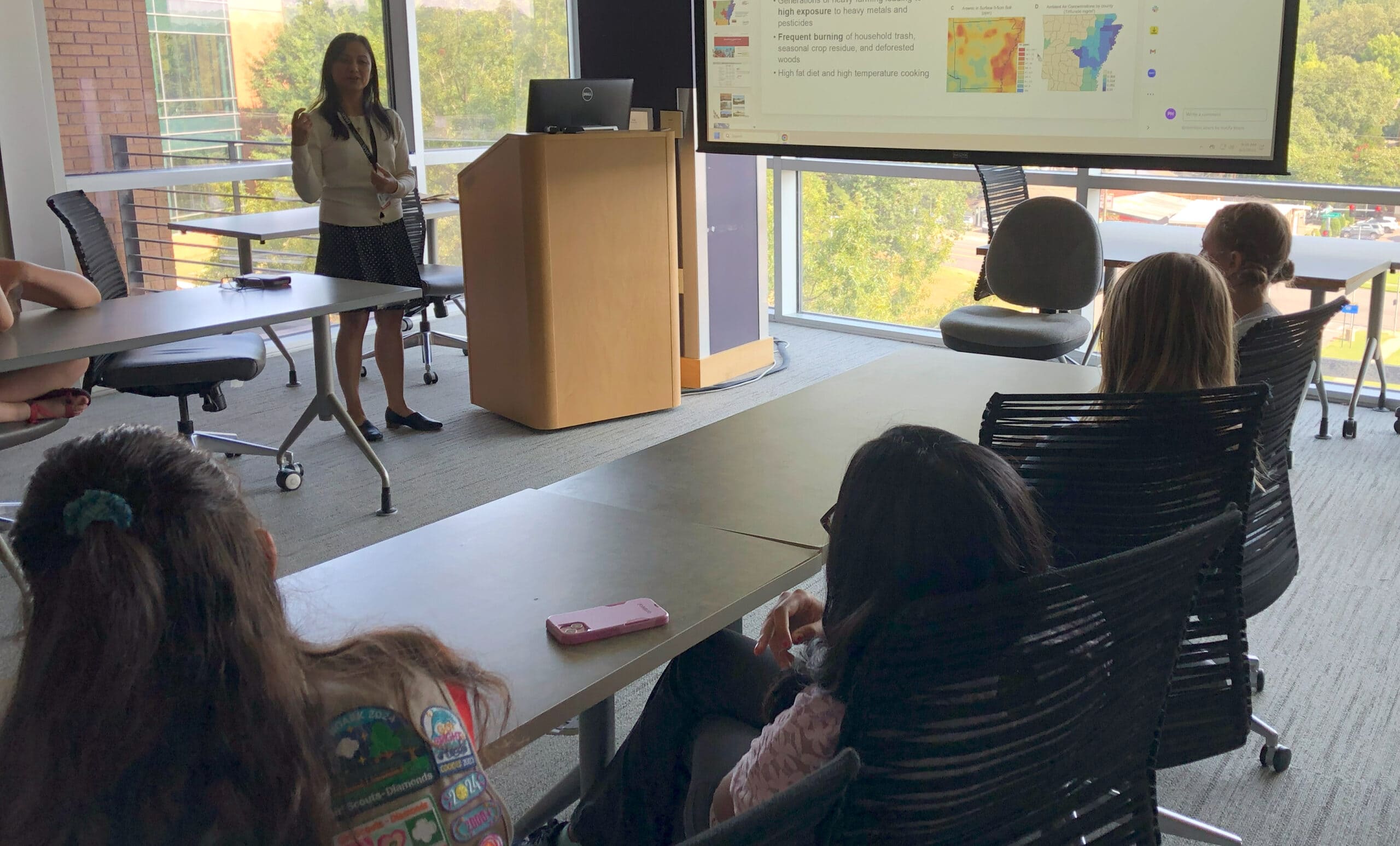
Ping-Ching Hsu, Ph.D., associate professor for the department, gave the scouts a presentation about the Arkansas Rural Community Health Study, a cohort study that focuses on environmental exposure and breast cancer risks in Arkansas.
“I wanted to inspire the young minds and help them become aware of the work of a cohort study and how it can help people gain an understanding of the impact of environmental exposure to health outcomes,” she said. “I enjoyed them asking questions and learning more about scientific research.”
Mitch McGill, Ph.D., an associate professor in the department, appreciated the opportunity to show the group liver cells under magnification. It gave them an introduction to the process of doing scientific lab research.
“It was fun, especially when the students asked questions,” he said. “Interacting with the next generation is fun.”
McGill also enjoyed the chance to show the impact of science to the future leaders.
“One of my most important responsibilities is to help cultivate the next generation of scientists,” he said. “Many of us enter research driven by the hope that our science will change the world. But over time, it becomes clear that one of the most lasting and meaningful ways we can make an impact is by mentoring and educating those who will shape the future.”