
Toronto Neurosurgeon Shares Insights into Brain Cancer Survival in Children
| A renowned pediatric neurosurgeon from Canada recently took the stage in the Jackson T. Stephens Neurosciences & Spine Institute’s Fred W. Smith Auditorium to discuss work at a Toronto brain tumor center that has improved the survival of children with brain cancer.
James T. Rutka, M.D., Ph.D., who practices at The Hospital for Sick Children in Toronto, visited the University of Arkansas for Medical Sciences (UAMS) on Feb. 19 to present the first “Advances in Neurosciences” lecture since the death last summer of M. Gazi Yaşargil, M.D., a former UAMS professor from Turkey who was known as “the Father of Modern Micro-neurosurgery.”
The neurosciences lectureship began in 2008 and was named after Yaşargil and his wife, Dianne, a former UAMS nurse and researcher.
In late February 2025, the UAMS College of Medicine’s Department of Neurosurgery held a two-day symposium in lieu of the annual lecture, in honor of Yaşargil’s upcoming 100th birthday, during which his videotaped remarks, prerecorded at his home in Zurich, Switzerland, were played for the audience. Yaşargil died June 10, 2025, just weeks before his 100th birthday.
Rutka, who has authored over 550 publications and served as editor-in-chief of the Journal of Neurosurgery, told the audience of mostly neurosurgeons and neurosurgery residents, including an online audience from as far away as China, Australia and the United Kingdom, that he had known Yaşargil “quite well.”
“He was a master neurosurgeon,” Rutka said. “He knew what neurosurgery could do. But he also was aware of what neurosurgery was short of doing and appreciated the fact that we needed new ideas or new treatments for such diseases like glioblastoma and the like.”
“I’ll be showing you some tumors where we’ve taken our skills as far as I think we can in neurosurgery,” Rutka told the audience. “Also, I’ll be talking about these kinds of tumors — particularly the cancers of the brain — where we still need a lot of assistance and help.”
He showed videos of some brain surgeries he performed, describing his reasons for certain approaches as the camera dived deep into the brain’s inner cavities alongside surgical instruments.
“We know we can’t cure brain cancer by surgery itself, so I’ll be alluding to how we at the University of Toronto have used our efforts to build a Center for the Study of Brain Tumors, and what we’ve discovered over the years,” Rutka said.
“Dr. Rutka delivered an extraordinary presentation,” said neurosurgeon T. Glenn Pait, M.D. “It was not only scientifically compelling but deeply human. He brought remarkable clarity to complex advances while never losing sight of the children and families at the heart of his work. The audience was particularly moved by the emphasis on the family and the team approach required to care for children with these tumors.”
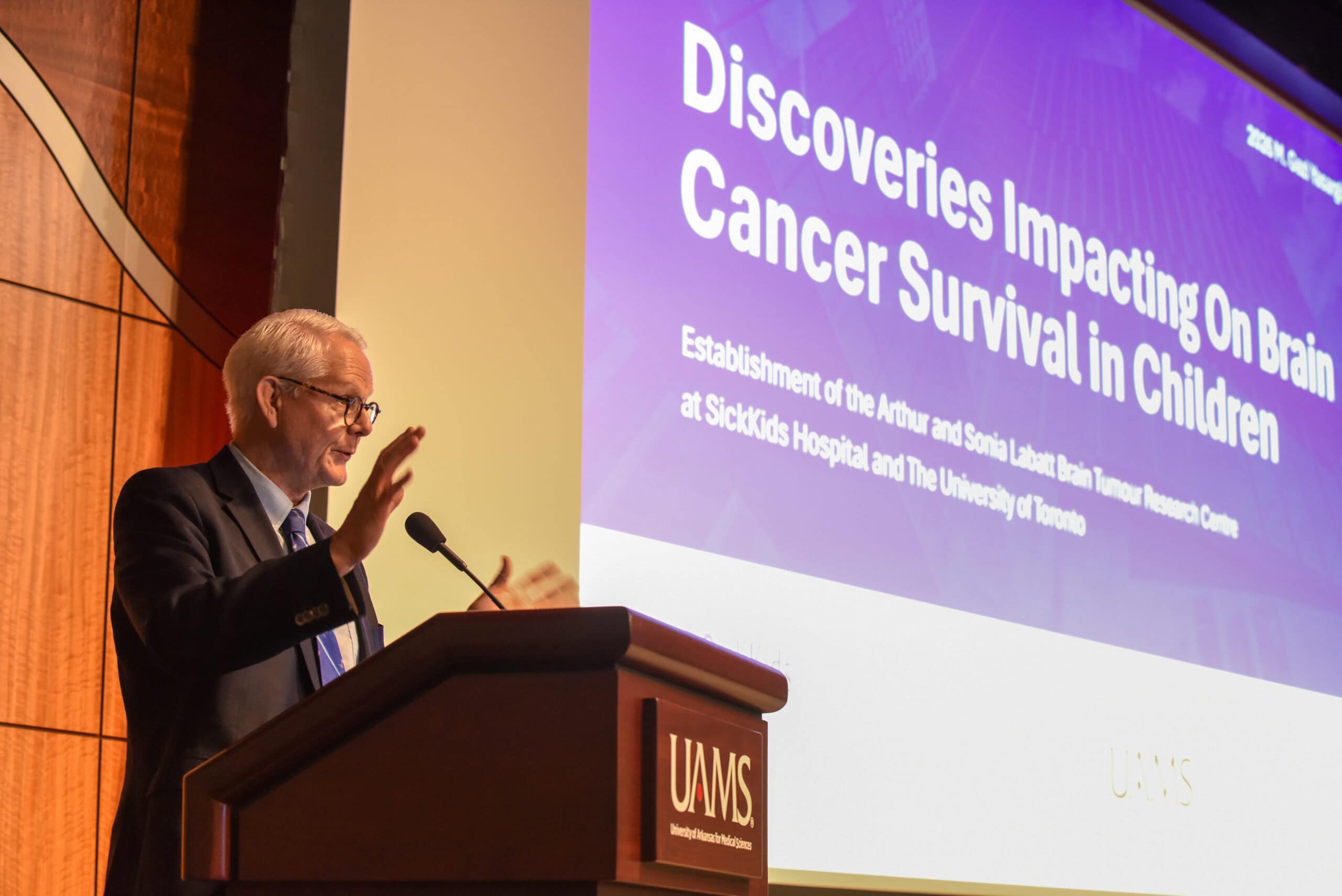
Rutka discusses brain cancer survival in children.JohnPaul Jones
Rutka discussed treatment options for different types of brain tumors and the results of some of those methods, as documented in case studies. At one point, he told neurosurgery residents in the audience, “You should know all these surgical approaches. I’ve used all of these in my practice as a neurosurgeon.”
He talked about the origins of the brain tumor center in Toronto, saying that even several years after it was established, despite having a lot of support, “we needed a catalyst — and this is frequently what is necessary, is to have something happen that would stimulate the growth of a center of this kind. So, we had something called the Spark of Life campaign.”
Rutka said the late Christopher Reeve, a well-known actor who became a quadriplegic and was paralyzed from the neck down after a horseback riding accident that caused a cervical spine injury, and Rick Hansen, a Canadian athlete who became a paraplegic because of a sports injury, led the campaign, prompting significant donations.
He said two donors were so moved by the campaign that they “gave a $5 million donation back in the 1990s that has grown since. And they re-donated years later. They were the catalyst. They allowed us to bring people together to do the work, and we became the first brain tumor research center of its kind in Canada.”
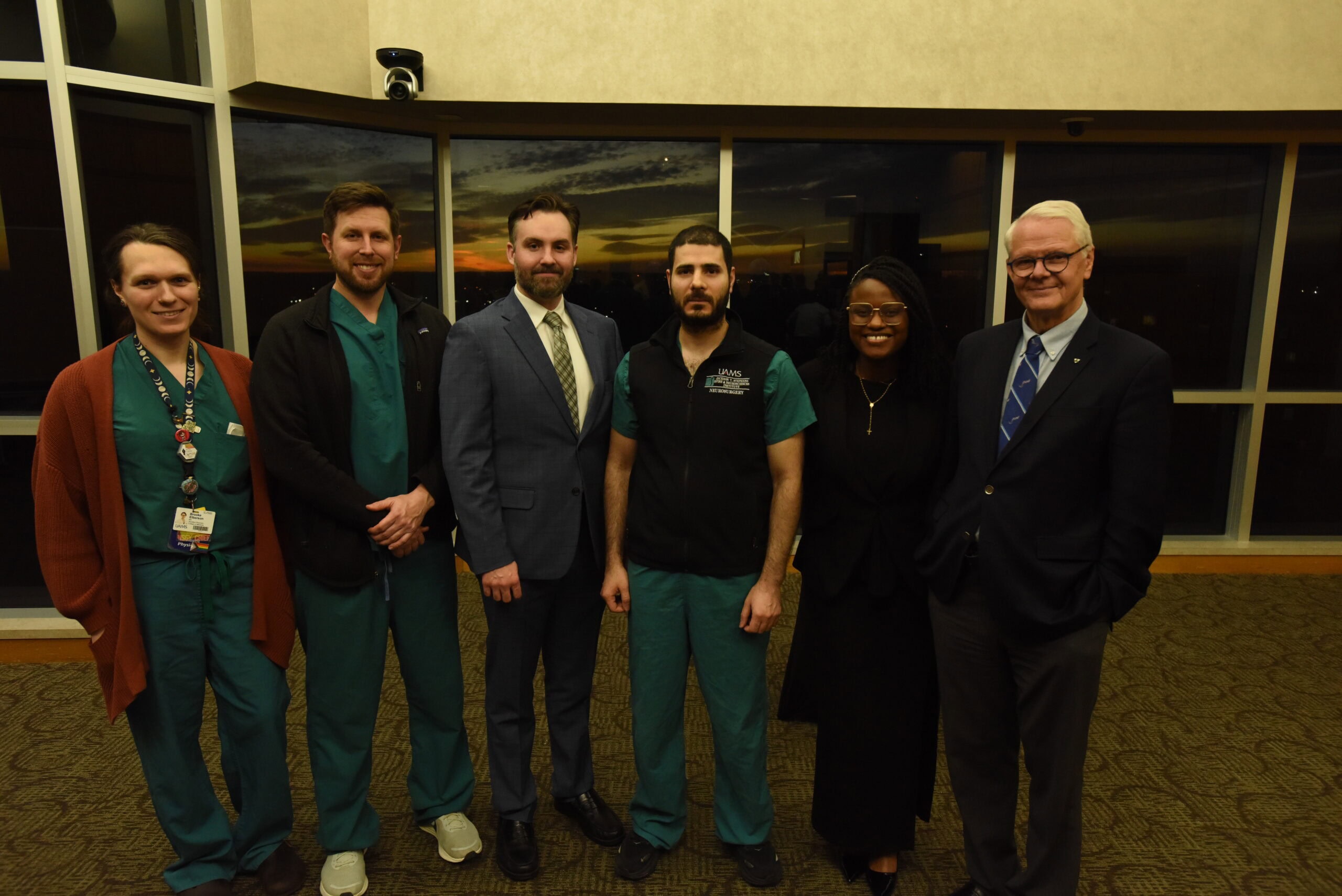
Rutka with UAMS neurosurgery residents.JohnPaul Jones
Eventually, Rutka said, his lab space in the center grew from less than 200 square feet to 30,000 square feet “but it took a lot of time and energy and effort. Now we have 10 principal investigators, but more importantly, we have a critical mass of over 130 researchers working on the problem of brain tumors. It’s wonderful to see that the groups interact with one another and the synergies that take place between the different laboratory groups that are there. It’s making it the largest brain tumor center of its kind in the world now.”
He talked about discoveries resulting from the work of researchers at the center that have led to new treatments, such as immune therapies, for brain tumors.
Rutka also said the center puts on several events every year to raise funds for research and awareness, allowing the center’s work to keep moving forward.
“To paraphrase Mother Theresa,” he said, “we can’t all do big things all the time, but we can do small things in a big way.”
The M. Gazi and Dianne Yasargil lectures are intended to provide a forum for distinguished scholars to share important advancements, not only in neurosurgery but in closely related disciplines such as neurology, oncology, and the broader field of medicine.