
Amber Kaufman, MPA, Dedicates Her Career to Serving Those in Need
| Amber Kaufman, MPA, enjoys addressing the shortcomings of a community.
A program director for the University of Arkansas for Medical Sciences (UAMS) Fay W. Boozman College of Public Health’s Center for the Study of Obesity, Kaufman is dedicated to helping people in need.
“The individuals who have the biggest impact in the world are in the trenches working daily to fight for others,” she said.
“Something I love about the center’s projects is we’re not isolated in the office 40 hours a week,” Kaufman said. “We’re in the community helping people. I like that flexibility.
“Working to help ourselves, our families, our communities, that’s what we’re here for.”
RAISED TO WORK AND SERVE
A native of St. Vincent, Arkansas, an unincorporated community 10 miles north of Morrilton, Kaufman knows all about hard work.
Kaufman grew up on a turkey and cattle farm that has been in her family since 1918. Doing manual labor in the turkey house year-round and spending summers on a tractor, cutting or raking hay was the norm for Kaufman.
“We were raised to work,” she said. “We had to work to help our parents make sure everything got done. Each day after school my siblings and I were responsible for chores out on the farm.”
The Kaufman family’s commitment to hard work was not exclusive to the farm. Her grandparents and parents were all active in serving the St. Vincent community. Kaufman’s father served as a local school board member, Farm Bureau officer, and community leader. Academics were an important priority in the Kaufman household. Kaufman attended Wonderview High School where she was one of 35 students in her class and a member of multiple clubs and organizations.
In 2006, Kaufman graduated from Wonderview as co-valedictorian and received a full academic scholarship at the University of Central Arkansas (UCA) in Conway, less than an hour away from St. Vincent.
She majored in public administration because she recognized that to make an impact, change must be made systemically.
Kaufman worked on campus for five semesters as a resident assistant in a dormitory and twice served as a senator at large on the school’s Student Government Association.
“It was a formative experience learning how hard leadership can be,” she said. “But also, it was important for me seeing how there are people who get in influential positions and don’t do anything, or they do the bare minimum. That made an impact on me. I made it a point to never get in a position of power and not do anything with it.”
Additionally, she was part of UCA’s Norbert O. Schedler Honors College and appreciates how it enhanced her outlook regarding culture and society.
“The honors program taught me to be the person I wanted to be,” Kaufman said. “I learned a lot about how many problems there were in the world. Due to being in the honors program, I knew I wanted to work for an international nonprofit for children.”
Ultimately, Kaufman earned a bachelor’s degree in 2010. During the three-month gap between graduation and her departure for the Philippines to serve as a Peace Corps volunteer, Kaufman completed 300 AmeriCorps service hours with educational gardens at the Winthrop Rockefeller Institute.
SERVING OVERSEAS
Kaufman learned about the impact of Peace Corps as a student at UCA while participating in a summer study abroad program in Honduras and Belize. The following summer, she interned at the organization’s headquarters in Washington, D.C., before ultimately applying to serve as a volunteer and being assigned to work with at-risk children and youth in the Philippines.
“It was a very humbling experience,” she said. “Being in the Peace Corps in the Philippines, I learned a lot about empathy.”
Kaufman completed three months of in-country language and job skills training before being sworn in as a volunteer. Kaufman began her assignment working at an orphanage for girls ran by nuns. She stayed there for a year before transferring to work with a parents’ association associated with an international nonprofit. In that assignment, she worked with 960 sponsored children in 13 Philippine communities. Most of these families earn less than $2 per day. She went into local communities and homes to interview the children and their parents in the local dialect. She’d then write a report in English on how each child and family were doing to be sent to the sponsor. Kaufman also worked with local community partners and volunteers to implement the nonprofit’s programs and activities.
“It was an inspirational opportunity,” she said. “You could tell the parents cared about their community, and they cared especially for the kids in the community.” Kaufman was selected as one of four volunteers in her batch to receive a one-year extension to her original two-year contract.
Kaufman was one month from completing her three years of volunteer service when a category 5 Typhoon Haiyan hit the nation causing historic damage.
“It was like a tornado, except it lasted several hours,” Kaufman said. “The city was ripped apart piece by piece. When the winds and the rain subsided, my city was 90% destroyed. There was no way in or out for the first several days, so I and the other Peace Corps volunteers could not immediately evacuate. Luckily the hotel we had been ordered to stay in was not severely damaged, so our main concern was rationing our food and water. I went out to a few of my communities to work and help get one of the first reports of the devastation out with the hope that aid would follow.
“The final lesson that the Filipino people taught me was one of resilience and gratitude. I met a stranger in the market who said, ‘Thank goodness it was a typhoon and not a fire, so that we have something left to try and rebuild from.’ Immediately following the devastation, Filipinos began picking up whatever debris or remnants remained and working to repair and rebuild their homes, businesses, and lives before the next forecasted storm hit a few days later.”
In the aftermath, due to the lack of resources throughout the country, Peace Corps volunteers from the U.S. in impacted regions were consolidated in Manila, the nation’s capital. Not long afterward, Kaufman and her colleagues were sent back to the U.S.
“I was proud that I made a difference through the relationships that I built with people,” Kaufman said. “The Philippines forever changed who I am and the values that I have.”
Kaufman returned to the United States motivated to continue serving people in need, pursue a graduate degree, and to be closer to her family, including her first baby nephew.
CULTIVATING GOOD
Kaufman moved to Athens, Georgia, and enrolled in the University of Georgia Master of Public Health Public Administration program. Kaufman began the coursework in fall 2014, later earning the degree in the spring 2016.
“I knew that if I wanted to cultivate systemic change, I needed to increase my technical skills,” she said. “I pursued the master’s degree so I could gain additional knowledge to lead projects and programs and merge it with my heart to serve — and hopefully increase my impact.”
Following graduation, she started working as a civilian for the Georgia National Guard Youth ChalleNGe Academy in Milledgeville, Georgia. When the program opened in fall 2016, she was responsible for teaching life skills and being a case manager.
Kaufman remained with the program until 2020 when it was closed due to statewide budget cuts. By that time, she had ascended to acting director of the academy.
She then accepted an offer to work in the Georgia National Guard State Personnel Office. After a couple of years working for the state HR team, her mother’s health began to worsen. Eventually, Kaufman received an opportunity to work remotely — giving her the chance to return to her family’s farm in St. Vincent, Arkansas to help her dad and family take care of her mom.
Shortly after Kaufman moved back to Arkansas in November 2022, her mother was diagnosed with a recurrence of ovarian cancer. Immediately, she began chemo treatments and later participated in a clinical trial.
Despite her mom’s condition, Kaufman remained focused on serving Arkansans. The service-based work she had done in other communities, she wanted to continue in Arkansas. To her delight, Kaufman landed a job with the UAMS College of Public Health.
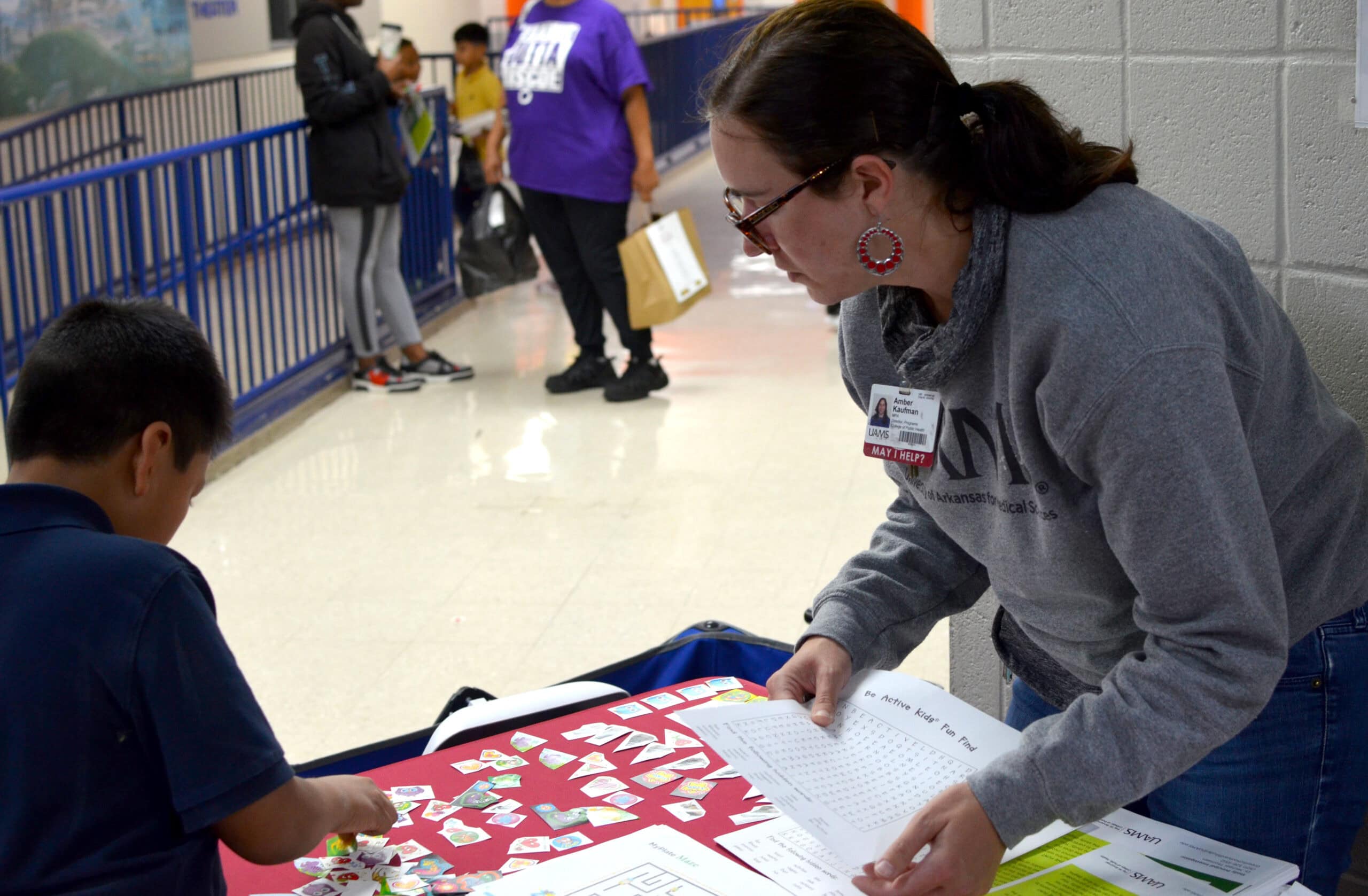
Amber Kaufman, MPA, a program director for the Center for the Study of Obesity, is shown at Stephens Elementary in Little Rock passing out info, games and stickers to a student.
She initially worked as an executive assistant in the dean’s office before transferring to the Center for the Study of Obesity in 2024. Among Kaufman’s duties for the center are assisting with proposals for potential center projects and grants, helping with implementing programs and research, collecting data, and creating systems to best use the data.
She lauded the center’s chair, Michael Thomsen, Ph.D., for how their projects place them out in the community where they can interact with and help Arkansans.
“It’s nice to be with people who care about public service and doing projects that make things better in this world,” she said.
Kaufman, who lost her father to cardiac arrest in August 2023 and her mom to ovarian cancer a few months later, strives to set a standard of service that would make her parents proud.
“I always try to create whatever good that I can,” she said. “If everyone tries to do good in small ways, collectively it can make a big impact.”