View Larger Image
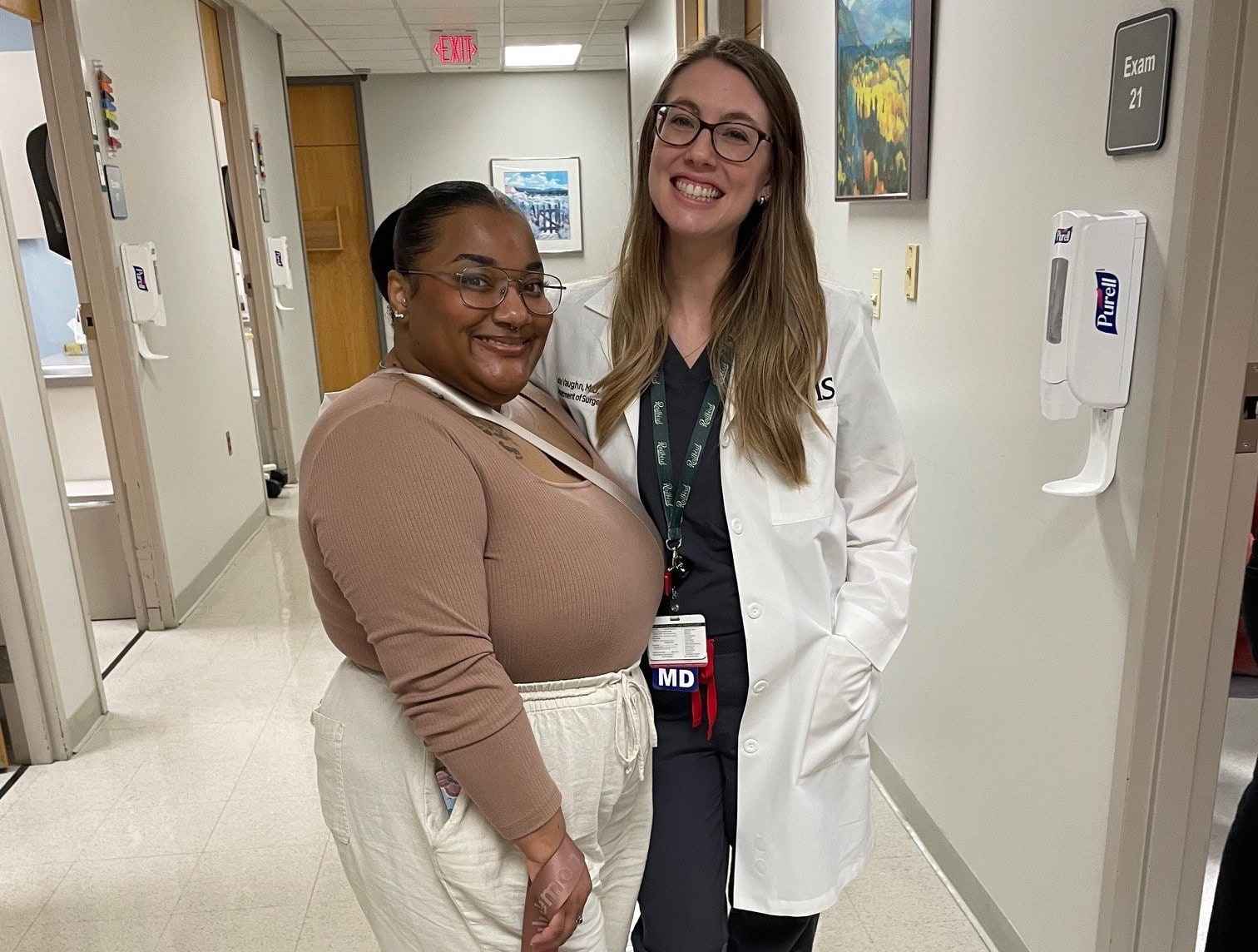
Jazmin Johnson and UAMS surgeon Lexie Vaughn, M.D.
Bariatric Surgery at UAMS Weight Loss Clinic Transforms Young Mother’s Life
| March 27, 2026 | Jazmin Samone Johnson, a married mother of four, was diagnosed in 2016 with polycystic ovarian syndrome (PCOS), a hormonal disorder that caused irregular periods, excessive hair growth, acne, and weight gain.
As she struggled to manage the symptoms, she became increasingly anxious and depressed and eventually was also diagnosed with chronic high blood pressure and severe obesity.
Then in 2023, she was referred to Lakshmi P. Menon, M.D., an endocrinologist at the University of Arkansas for Medical Sciences (UAMS) who prescribed monthly injections of Trulicity to manage her obesity while reducing her risk of heart attack and stroke.
After several months of injections, Johnson lost 21 pounds.
“I was feeling amazing, seeing the scale go down, and the weight slowly melting away,” she said recently, noting that her weight dropped from 259.5 pounds to 238.5 pounds.
“Unfortunately, that came to an end due to my insurance denying coverage for the injections,” she said. “My weight quickly went back up to 260, and that is the biggest I have ever been. Although I again started every diet and workout plan I could find, depression crept back in and caused me to have an unhealthy relationship with food.”
It wasn’t until August 14, 2025, when Johnson underwent bariatric surgery at the hands of Lexie Vaughn, M.D., a surgeon in the UAMS Health Medical and Surgical Weight Management Clinic, that she found real relief. She dropped 15 pounds immediately, and 40 pounds altogether in the first six months after surgery, with continued weight loss expected over the next six to 12 months.
UAMS offers three types of bariatric procedures: the sleeve gastrectomy, which Johnson underwent, as well as the Roux-en-Y gastric bypass and the Single Anastomosis Duodeno-Ileal Bypass (SADI). The sleeve gastrectomy removes about 80% of the stomach, thereby restricting the amount of food a patient can eat before they feel full. The gastric bypass and the SADI use a combination of restriction, such as the sleeve, in addition to bypassing a portion of the intestine, reducing nutrient and caloric absorption.
“I am now in a better head space mentally,” Johnson said recently. “My confidence is at an all-time high. Being able to walk a few miles without stopping to catch my breath, fitting in smaller clothing, and developing a healthier relationship with food has been a major game changer to me.”
Now 35, she said, “I go to the gym three to four times a week and encourage my family to join me so we can all live a better, healthier lifestyle. I no longer crave fast foods or fried foods. I enjoy watching my stomach go down slowly but surely.”
Vaughn praised Johnson’s dedication to her new lifestyle, noting that a bariatric surgery patient’s diet and lifestyle modifications are the key to long-term success.
“Bariatric surgery is just one of the tools that we have for treating obesity and the health problems that are related to it,” Vaughn said, “but bariatric surgery is actually the most effective in terms of the amount of weight a patient can lose, as well as the most durable, meaning long-lasting, of all the options.”
Bariatric surgery can allow a patient to lose 60% to 80% of their excess body weight. Vaughn said the weight loss typically happens within the first 12 to 18 months after surgery.
Johnson, a former UAMS employee who is now a data analyst at another central Arkansas hospital, said her stomach is now “literally the size of a banana,” which helps ensure that she doesn’t overeat.
“I chose to have bariatric surgery to be a healthier version of myself and to be around longer for my children” — now 4, 9, 13 and 16 — she said. “Before surgery, I would think about who would take care of them if I were gone. Trying to lose weight and develop a healthier lifestyle was a big struggle before, and giving up was always easy because I didn’t hold myself accountable. This surgery has changed my life completely.”
“I chose UAMS to go through with my procedure due to having a great relationship with my doctors, who also work at UAMS,” Johnson added. “The love and care that I have received as a patient at UAMS has always been a great experience. From doctors to nurses, I have always received quality patient care. So, choosing UAMS for bariatric surgery was an instant yes. And surely enough, I was not let down.”
Vaughn said she met with Johnson several times in the clinic before the day of surgery, and Johnson also met with some of the clinic’s nurse practitioners, physician assistants, a dietician and a psychologist, to be sure she was prepared for the surgery and the continuing journey afterward.
“It is really a multidisciplinary approach, and we take every patient through the whole process,” Vaughn said.
“Bariatric surgery and weight loss in general are really life-changing, because obesity is related to much more than physical appearance and a number on a scale,” Vaughn said. “It can have a huge impact on a patient’s entire health, and so it can be related to a lot of different health problems and have a serious impact on the way a patient feels on any given day.
“With the weight loss comes improvement in all those things,” Vaughn continued. “Patients can come off medications that they’ve been on for a long term. They can see a cure or a remission of diseases that they’re seeking treatment for, and they can just generally feel better, have more energy, sleep better, and see their aches and pains go away. The whole quality of life improves pretty significantly.”
To be eligible for bariatric surgery, a patient must be considered obese, which means having a body mass index (BMI) of above 40, or a BMI above 35 with an associated obesity health-related problem such as high blood pressure, sleep apnea, fatty liver or Type 2 diabetes.
“Any patient that meets that criteria is eligible to see a bariatric surgeon to discuss surgery as a possibility,” Vaughn said. “The patients go through a really long process to get kind-of optimized for surgery, because it’s like a lifelong journey for these patients, and it takes a lot of effort on the patient’s part to do all the hard work. It’s kind of a joint discussion between the surgeon and the patient to determine if that’s the right pathway for the patient. The day of surgery is kind-of the easiest part of the whole journey, because there’s a lot of work that goes on, on the front end, and then a ton of work for the rest of your life after surgery.”
Johnson said her entire weight-loss experience at UAMS “was the most amazing experience I’ve ever had at a hospital. From start to finish, everyone came in and checked on me and made sure I was okay. The nurses helped me walk afterward, made sure I had something to drink, and made sure I stayed on my schedule.”
She was also part of a pre-op bariatric support group, followed by a post-op bariatric support group that meets monthly at UAMS. She said the forum allows the participants to share frustrations when they think their weight-loss journey is stalling and to receive much needed encouragement from each other.
“My pre-op care was amazing,” Johnson said. “Having doctors and nurses that show that they care about you and your goals, people who were willing to take as much time as needed to hear about my medical issues and were quick to give informative information.
“My post-op care was nothing short of pure awesomeness,” she added. “Dr. Vaughn’s team did an outstanding job from beginning to end. They made sure I felt seen and heard.”
The UAMS Health Medical and Surgical Weight Management Clinic is located in the UAMS Outpatient Center on the Little Rock campus.