UAMS Experts Discuss Complementary Therapies, Exercise, Research at Parkinson’s Symposium
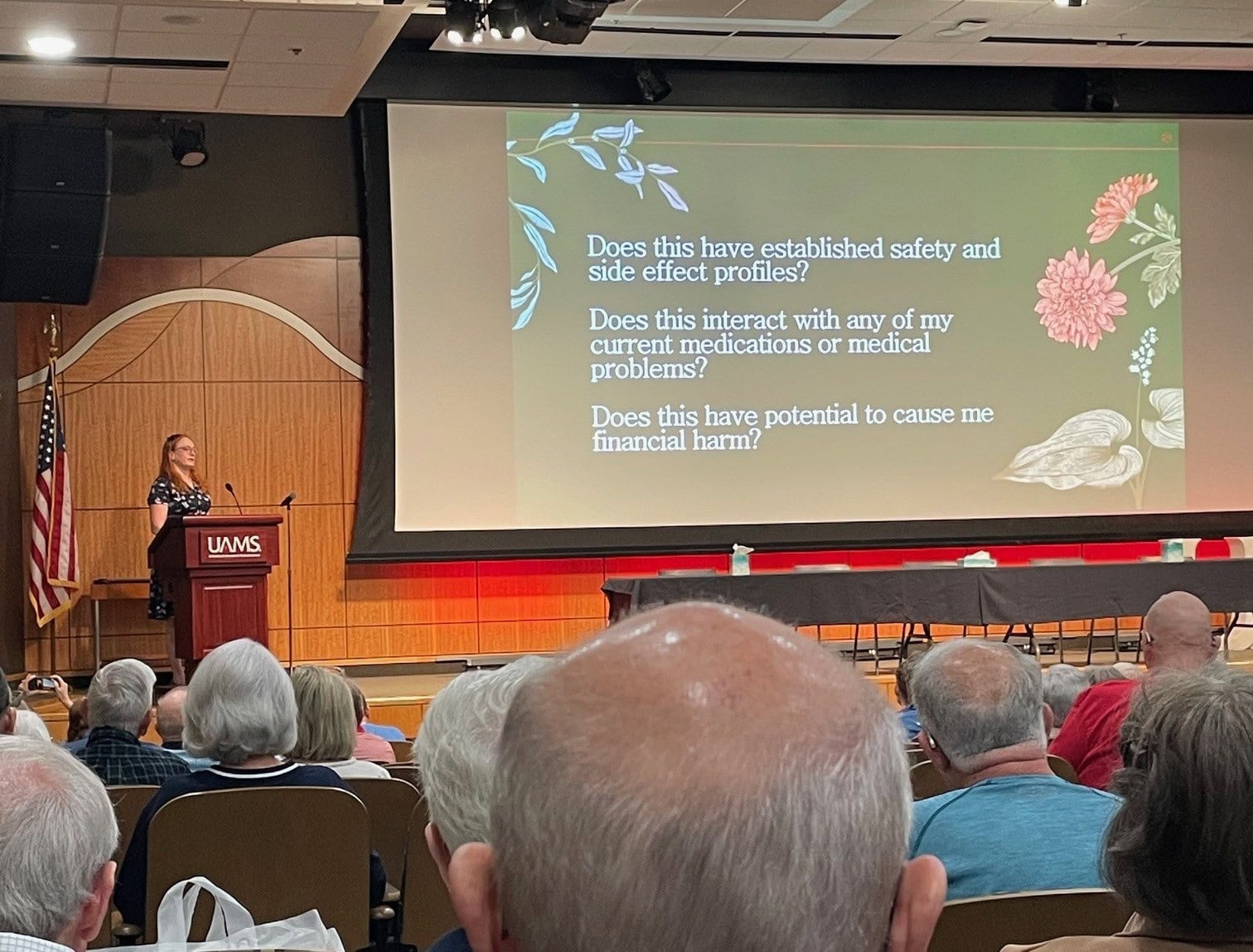
| While she’s open to Parkinson’s disease patients using dietary supplements alongside conventional medicine to ease their symptoms, neurologist Hillary Williams, M.D., a movement disorders specialist at the University of Arkansas for Medical Sciences (UAMS), encourages patients and their caregivers to have “a little bit of healthy suspicion” about claims made by the makers of some supplements.
At the 11th Annual Parkinson’s Symposium held April 12 at UAMS, she warned patients and caregivers that there can be dangerous differences between the dietary forms of supplements and the more concentrated extracts — particularly of garlic, ginger and green tea — and said overpriced supplements with unproven claims often unnecessarily deplete her patients’ bank accounts.
Other UAMS experts on Parkinson’s disease discussed the benefits of exercise, drug and research updates, and the psychosis and paranoia that is believed to be experienced by one in three Parkinson’s patients, to round out the event held in UAMS’ Jackson T. Stephens Spine & Neurosciences Institute.
Audience members filled nearly every seat in the 12th-floor Fred Smith auditorium while others watched virtually from across the state as the presentation of the UAMS Department of Neurology’s Movement Disorder Clinic explored the latest advances in the diagnosis and treatment of Parkinson’s disease and atypical Parkinsonism.
Parkinson’s disease is a progressive nervous system disorder that is associated with a loss of motor control, such as shaking or tremor at rest and slowness with movements, as well as nonmotor symptoms such as depression and anxiety. It affects an estimated 10 million people worldwide. Atypical Parkinsonism patients have additional symptoms such as cognitive defects and difficulty regulating blood pressure and other automatic bodily functions, including vision.
Although Parkinson’s disease isn’t considered to be hereditary, 10% to 15% of Parkinson’s cases are caused by inherited genetic mutations, researchers now believe.
Williams said that her views on complementary medicine for Parkinson’s disease have changed over time, and while she now agrees that some nontraditional therapies are promising, she hates hearing about patients being taken advantage of financially by companies selling overpriced supplements.
She warned patients that concentrated forms of some otherwise safe substances can do more harm than good. For example, “green tea extract is very different from green tea,” with the concentrated forms once causing “hundreds of cases of liver failure across the United States.”
Similarly, she said, turmeric, a spice increasing in popularity for medicinal purposes, is perfectly safe in dietary form, but “in the concentrated form, especially when added to black pepper,” as it is in some formulations, can increase the incidence of liver failure, although that is rare.
Williams had harsh words for an over-the-counter dietary supplement billed as supporting brain function and memory, saying studies have shown it has “no efficacy over placebo,” yet costs $120 a month. She added that the manufacturer is facing several lawsuits over deceptive marketing.
Anyone who wants to take a supplement to alleviate Parkinson’s symptoms should consult reliable laboratories such as Consumer Lab, USP and NSF International, Williams said. The labs don’t test whether the supplements work but verify that they “contain what they say they do and don’t contain other things.’
She noted that one study found that Vitamin D supplements are “just one of many over-the-counter supplements that contained anywhere from 9% to 140% of the stated dose, so you may not be receiving the amount you think you are.” She also warned that some supplements have been found to contain contaminants, and others interfere with prescription medication.
“Just because something is natural doesn’t necessarily mean it’s safe,” Williams said, adding that “none of these supplements, even in their best claims, can come down to what exercise does for our body. So, get out and move. Some of my favorites that I recommend are a seated bike, Rock Steady Boxing or other boxing programs for Parkinson’s,” as well as water exercise and dance.
Rock Steady Boxing is an exercise program founded in 2006 by Scott C. Newman, who was diagnosed with Parkinson’s disease at age 40. It seeks to improve the lives of Parkinson’s patients through a boxing-based curriculum, and holds classes at gyms across the globe, including in Arkansas.
Symposium participants also heard from Jessica Holton, an occupational therapist at UAMS, and Phil McElvy, a physical therapist at UAMS, who recommended consistent participation in stretching, aerobic, strength-training and agility activities, including classes held specifically for Parkinson’s patients at the Donald W. Reynolds Institute on Aging.
The symposium, moderated by its founder, UAMS neurosurgeon Erika Petersen, M.D., included an update on ongoing research in the development of disease-modifying treatments for Parkinson’s by Rohit Dhall, M.D., chair of the UAMS Department of Neurology and director of the Parkinson’s Foundation Comprehensive Care Center for Parkinson’s disease at UAMS.
“Many people feel that the development of these drugs is too slow to have an impact on us now,” Dhall said. “The message I want to convey is that these drugs will meaningfully improve disability, and that’s why I continue to be engaged in this.”
He said research at UAMS is focused on both the progression side of the disease and ameliorating symptoms.
He said genetic testing for Parkinson’s is “one of the research studies available to us, for us to improve our understanding of Parkinson’s, how it affects you, and understand what treatment options may exist now or in the future.”
“I encourage everybody to get gene testing done,” Dhall said, noting that there are areas where genes play a critical role in the propagation of damage at the cellular level, “so understanding that allows us to both see if there are targeted therapies that we can use to slow the degeneration of Parkinson’s, not just based on the gene itself but on some of the downstream mechanisms.”
He said clinical trials at UAMS are testing gene-based treatments as well as monoclonal antibodies, noting that, “if a drug is tested and is found to be positive in a certain number of Phase 3 trials,” such as one going on at UAMS, “then it technically can be marketed after approval.”
Dhall said researchers at UAMS are working on developing drugs to reduce fluctuation of Parkinson’s motor symptoms.
Hannah Schweitzer, Ph.D., a neuropsychology fellow at UAMS, briefly discussed the types of psychosis that can affect Parkinson’s patients — visual, auditory, presence hallucinations and passage hallucinations — and then a panel of experts closed out the symposium by taking questions directly from the audience.