View Larger Image
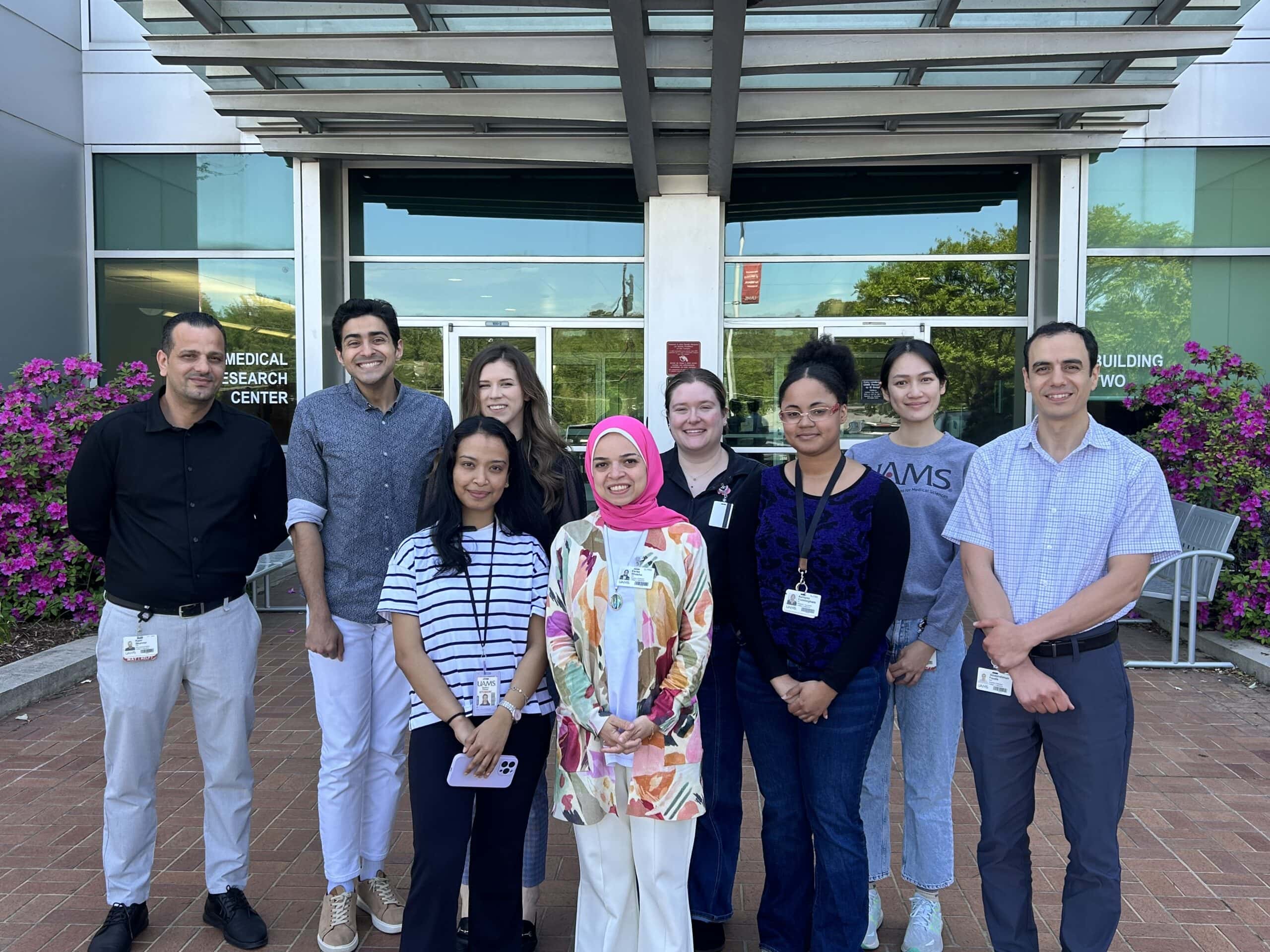
Abdel Fouda, Ph.D., right, and members of his laboratory.
UAMS Researchers Identify New Ways to Protect Vision, Regrow Nerves in the Eye
| Scientists at the University of Arkansas for Medical Sciences (UAMS) have discovered how to “reprogram” immune cells to help the eye heal after traumatic injuries and diseases such as diabetic retinopathy.
Findings from research led by Abdel Fouda, Ph.D., an associate professor in the UAMS College of Medicine’s Department of Pharmacology and Toxicology, were recently published in two peer-reviewed scientific journals: Cell Death & Disease and Cell Death Discovery, both of which are part of Nature, the leading international weekly journal of science.
The findings offer new hope for patients with vision loss caused by ischemia, a condition in which reduced blood flow restricts oxygen and nutrients to tissues. Ischemia can occur with physical trauma to the optic nerve or with such conditions as diabetic retinopathy and central retinal artery occlusion, often called “eye strokes.” All have very few treatment options.
While each study looked at a different eye condition — one focusing on traumatic eye conditions and the other on diabetic retinopathy — researchers found that in both cases, the body’s natural process of clearing away dead cells was hindered by too much of the enzyme HDAC3 in immune cells.
“We found HDAC3 to be increased in immune cells in these retinal diseases, playing a central role in disease progression,” said Fouda, who also works closely with clinicians and researchers in the UAMS Harvey & Bernice Jones Eye Institute. “Our lab is focused on understanding how the eye’s own immune system can be turned from a source of inflammation into a dedicated repair crew. We have found that by targeting specific molecular switches, we can help the eye ‘clean up’ damage and even start to regrow lost vital nerve connections.”
The first study focused on efferocytosis, a process by which dead cells are removed by immune cells to resolve inflammation, in diseases such as diabetic retinopathy. Fouda said restricted blood flow can leave behind dead cells that act like “toxic trash,” causing further inflammation and permanent vision loss.
His team discovered that a protein called CD5L acts as a master regulator in the cell cleanup process, and that by increasing the amount of CD5L, immune cells clear debris more effectively, protecting delicate eye tissues.
The second study addressed traumatic optic neuropathy, which can occur after a severe head or facial injury and often leads to permanent blindness. By blocking the HDAC3 enzyme in certain immune cells, the UAMS team created an environment that encourages nerves to regrow. In laboratory models, Fouda said, this approach saved nerve cells and improved their connection to the brain, suggesting a restoration of visual function.
“This work has been a three-year journey, and I am incredibly glad it is finally out,” said Rami Shahror, Ph.D., the study’s first author and a senior postdoctoral fellow at UAMS. “While these findings are preclinical, they have strong translational potential.”
Translational research strives to turn scientific discoveries into practical solutions.
“We have already obtained a provisional patent on the use of CD5L as a therapeutic in central nervous system (CNS) injuries,” Shahror said.
Nancy Rusch, Ph.D., distinguished professor and chair of the department who was also one of the study’s authors, praised the findings and the collaboration.
“Dr. Fouda’s research team is making cutting-edge discoveries to mitigate retinal disease and preserve vision,” she said. “His collaboration with clinicians at the Jones Eye Institute ensures that bench findings will be leveraged to improve patient care.”
The research highlights the collaborative spirit at UAMS between basic scientists and clinical experts.
“By working closely with doctors who see these patients every day, we can ensure our lab discoveries are moving toward real-world treatments,” Fouda said.
UAMS is the state’s only health sciences university, with colleges of Medicine, Nursing, Pharmacy, Health Professions and Public Health; a graduate school; a hospital; a main campus in Little Rock; a Northwest Arkansas regional campus in Fayetteville; a statewide network of regional campuses; and seven institutes: the Winthrop P. Rockefeller Cancer Institute, Jackson T. Stephens Spine & Neurosciences Institute, Harvey & Bernice Jones Eye Institute, Psychiatric Research Institute, Donald W. Reynolds Institute on Aging, Translational Research Institute, and the Institute for Community Health Innovation. UAMS includes UAMS Health, a statewide health system that encompasses all of UAMS’ clinical enterprise. UAMS is the only adult Level 1 trauma center in the state. UAMS has 3,553 students and 1,030 medical residents and fellows, and two dental residents. It is the state’s largest public employer with about 12,000 employees, including 1,200 physicians who provide care to patients at UAMS, its regional campuses, Arkansas Children’s, the VA Medical Center and Baptist Health. Visit www.uams.edu or uamshealth.com. Find us on Facebook, X (formerly Twitter), YouTube or Instagram.
###