View Larger Image
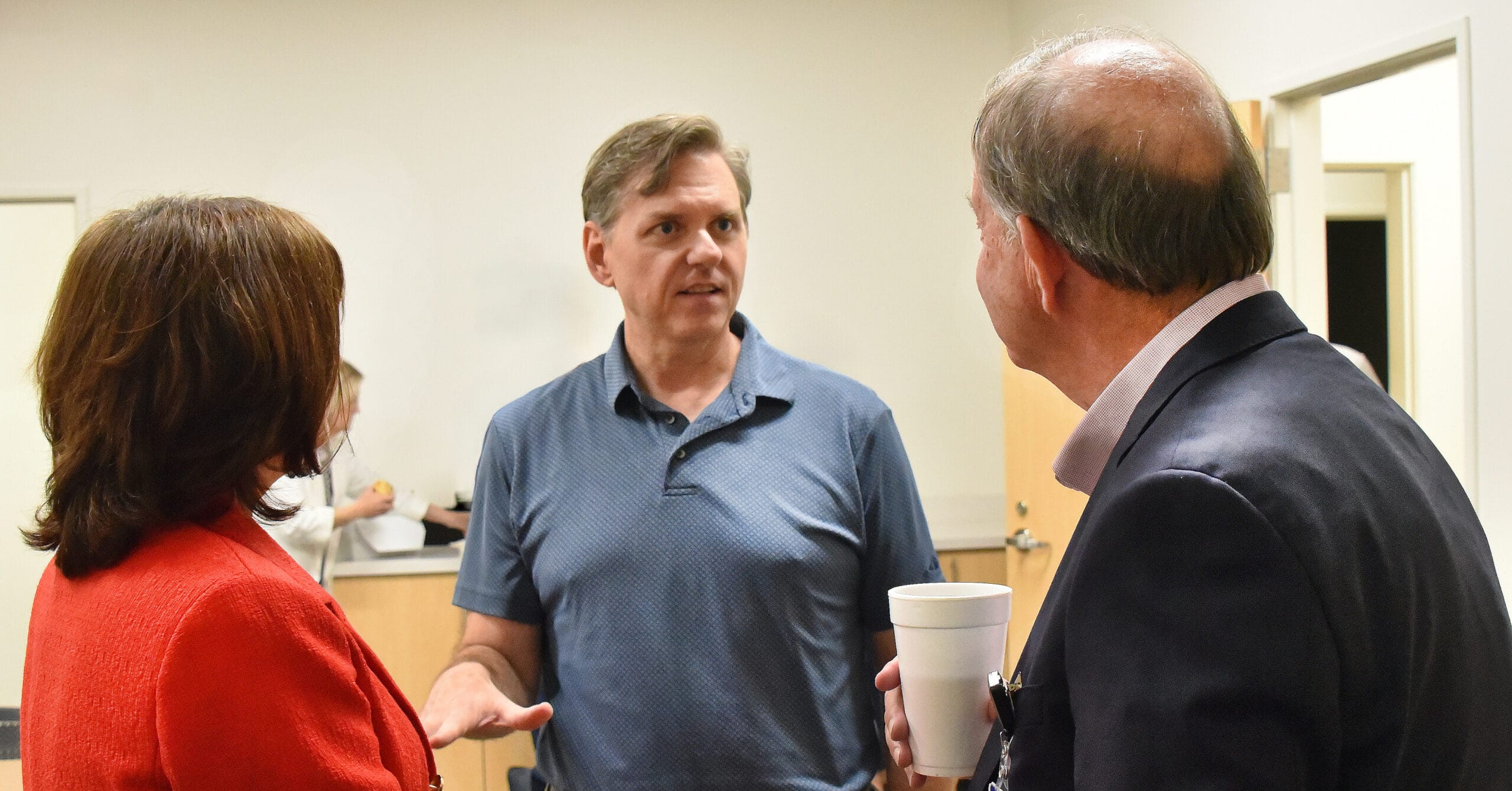
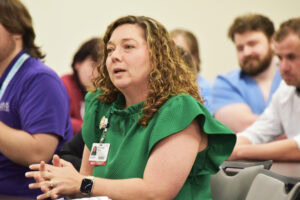
Timothy Abels, M.D., third-year resident at UAMS North Central, speaks to Chancellor Barnes and Provost Gardner.
Image by Andrea Hooten
Technology, Transportation Top Topics at UAMS North Central Town Hall
| Employees at the University of Arkansas for Medical Sciences (UAMS) North Central Regional Campus in Batesville shared their ideas and frustrations in caring for rural patients at a recent town hall with Chancellor C. Lowry Barnes, M.D.

Chancellor Barnes spoke to the employees of UAMS North Central Regional Campus in Batesville, his fifth regional campus town hall.Andrea Hooten
Several questions centered around artificial intelligence (AI) and how UAMS can lasso it.
A popular AI tool for healthcare providers is Ambient AI, which captures notes before, during, and after a patient visit. Third-year resident Audra Staley-Favano, M.D., said she sees a struggle to maintain quality healthcare with a climbing patient load and asked for Barnes’ suggestions on managing the two. Maintaining that balance is a struggle for every provider, said Barnes, but Ambient AI can help.
“So, the less time you’re spending documenting, the more time you’re spending taking care of patients. But (quality versus quantity) is a problem. It’s something you’ll deal with the rest of your career. There’s no great answer on how you keep your quality up, but it’s something that, hopefully, you’ll have the internal drive to do,” Barnes said, who uses Ambient AI with his orthopaedic patients.
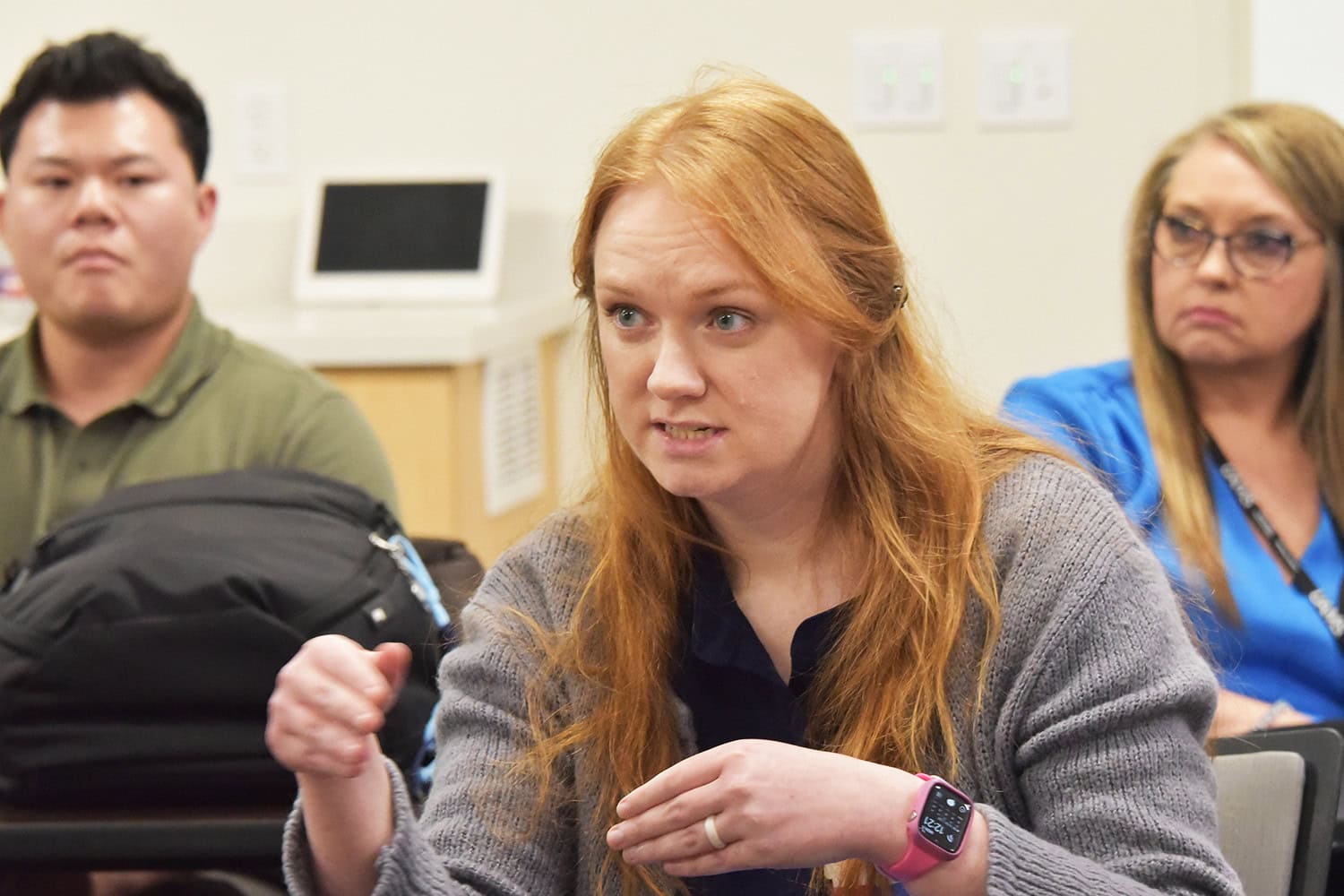
Audra Staley-Favano, M.D., MPH, asks how to balance clinical quality with patient volume.Andrea Hooten
Jed Whitt, M.D., a third-year resident, and Austin McNamara, M.D., faculty member, said Ambient AI creates more of a bottleneck than a benefit for the Batesville providers who use EPIC, UAMS’ electronic medical records platform. Users must manually copy and paste the AI-generated notes, which negates the efficiency benefits. McNamara said the problem may be unique to the UAMS North Central Regional Campus, but Barnes questioned if other regional campuses had the same issue. He said he will look into a solution.
Timothy Abels, M.D., also a third-year resident, asked if UAMS has a strategy for incorporating more AI.
“AI is going to be a part of everything we do, from revenue cycle to registration to patient care. Every aspect of what we do, including population health,” Barnes said.
Stephanie Gardner, Pharm.D., Ed.D., provost and chief strategy officer for UAMS, said UAMS has an AI committee focused on governance but is forming a separate committee on AI innovation. She encouraged anyone at the UAMS North Central Regional Campus to submit ideas for the new committee and for possible rural health transformation grant funding.
Listening and Taking Action
Since he was named chancellor earlier this year, Barnes has held town halls at five regional campuses. John Dang, D.O., a third-year resident, asked what concerns were brought up at other campuses and if Barnes had addressed any of them.
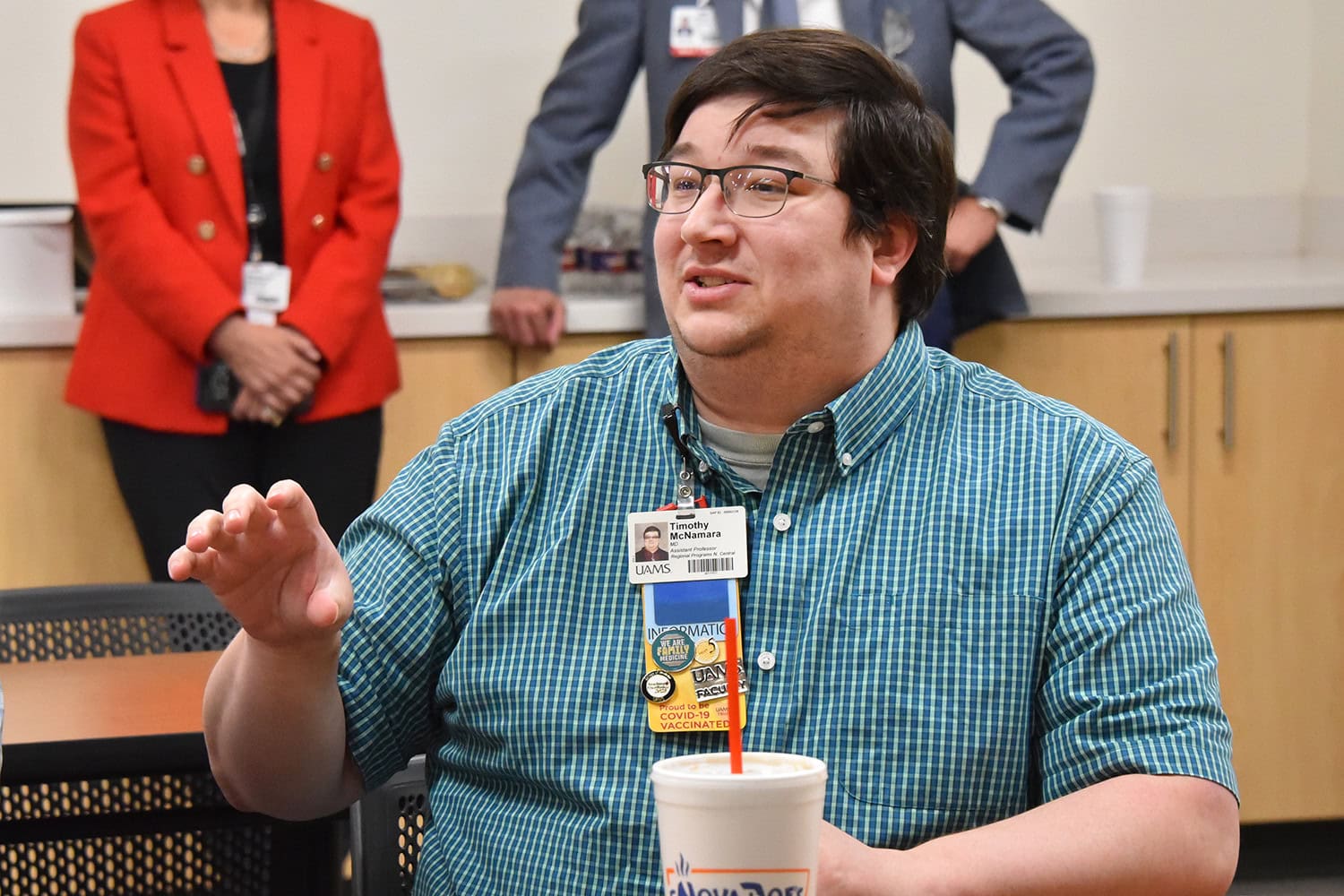
Austin McNamara, M.D., a faculty member at UAMS North Central, describes the bottleneck of incorporating AI with EPIC.Andrea Hooten
One common request was increased transportation for rural patients.
At the March town hall at UAMS South Regional Campus in El Dorado, a cancer patient navigator said many of her patients don’t have transportation to Little Rock for treatments. And Jackie Brickey, the population health manager at the UAMS Northeast Regional Campus in Jonesboro, asked at the April town hall if UAMS could share transportation costs with another entity.
“We are working on transportation,” said Barnes. “Our goal would be that each regional program would have a sprinter van that’s handicap accessible that would leave that site every morning at a certain time and return at a certain time every day. Folks who need to go to UAMS for specialty care could get there and come back in the same day.” Barnes added that the vans will cost about $2 million along with $150,000 per year for maintenance.
UAMS is also working to bring screening services to rural patients. The UAMS MammoVan, a mobile mammography unit, will begin traveling to the regional campuses so rural patients can schedule their annual breast cancer screening. UAMS has also ordered a few low-dose computerized tomography (CT) scanners for regional campuses, which can catch lung cancer early.
Improving Revenue, Growing Education
The chancellor reported that UAMS has been “in the black” six of the past nine months and is more than $20 million ahead of budget.
“We want to see if we can grow our way out of challenges, get our denominator bigger,” Barnes said. “I think most of you probably understand that the margins in healthcare are very low now. We’re talking 2% to 3% margins. Well, that’s not very much. If you also have research and education, which you do in addition to patient care, research and education don’t pay for themselves.”
Barnes is seeking ways to expand the UAMS footprint by working with other hospitals and looking at educational opportunities. One degree program in high demand is the physician assistant program with more than 600 applications for 40 spots, but UAMS is planning to increase that to 60.
“It’s much more competitive to get into PA school than it is to go to med school,” Barnes said.
UAMS has also partnered with the University of Arkansas to strengthen research collaboration and to develop a six-year B.S. to M.D. degree program, only the third program of its kind in the nation.
For a broader look at UAMS’ rural healthcare programs that impact the health and well-being of rural Arkansans, visit the UAMS rural health hub.