View Larger Image
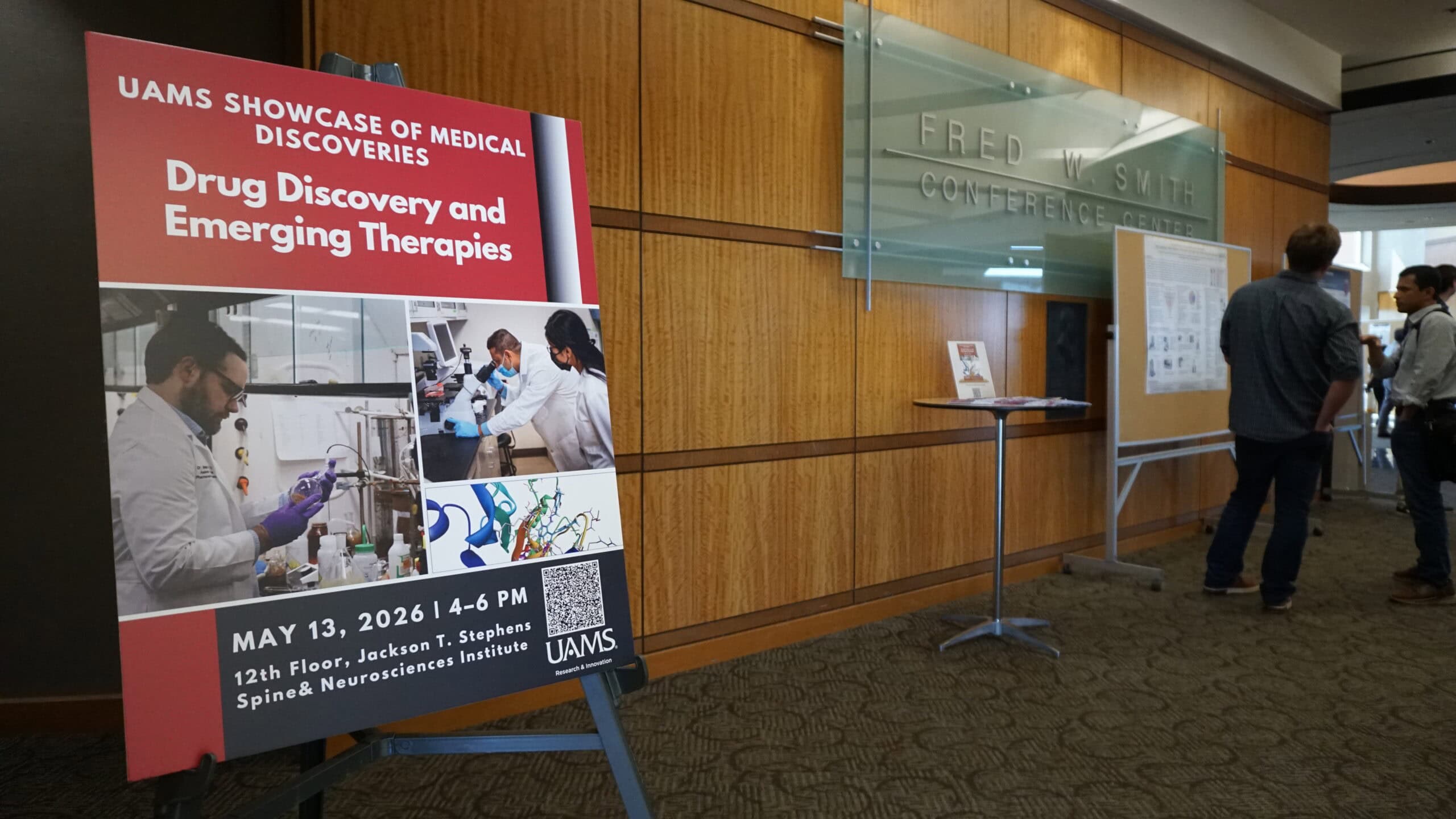
The May 13 Showcase of Medical Discoveries highlighted next-generation treatments for cancer, infectious diseases, retinal injury, and more.
Image by Shea Stewart
UAMS Drug Discoveries, Emerging Therapies Highlighted at Research Showcase
| Advances at the University of Arkansas for Medical Sciences (UAMS) in developing next-generation treatments for cancer, infectious diseases, retinal injury, and more were the focus of the May 13 Showcase of Medical Discoveries.
Held on the 12th floor of the Jackson T. Stephens Spine & Neurosciences Institute, the showcase spotlighted drug discovery and emerging therapies at UAMS, featuring innovative projects, collaborative efforts, and impactful discoveries advancing health and science.
Presenters included faculty, staff scientists, postdoctoral fellows, and students whose work reflects the depth and diversity of research and innovation at UAMS.
“This Showcase of Medical Discoveries captured one of the many things that UAMS does really well, which is the discovery and manipulation of compounds and the treatment of different conditions that can then make their way ultimately into translational clinical approaches,” said Daniel Voth, Ph.D., UAMS vice chancellor for Research & Innovation, which sponsors the Showcase of Medical Discoveries series.
“Also, while a celebration of UAMS research and innovation, the showcase is an opportunity for UAMS researchers and scholars to gather and spark collaboration. The room is filled with some of those collaborations. This is important work, and we’re proud of the groups who do this work.”
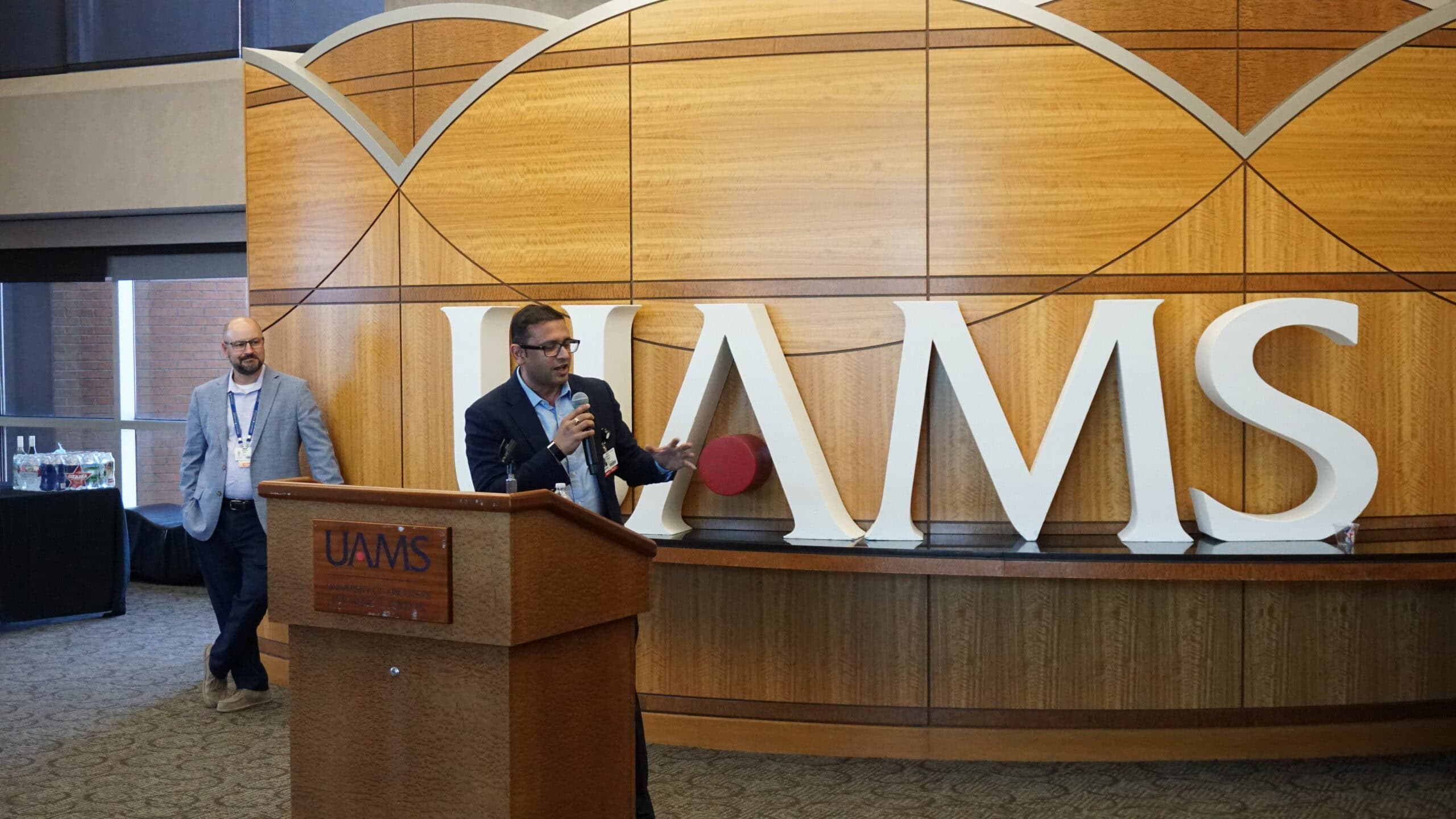
Amit K. Tiwari, Ph.D., professor of pharmaceutical sciences and associate dean of research in the College of Pharmacy, welcomed attendees to the May 13 Showcase of Medical Discoveries.
Twenty-two posters were presented at the event, including work from the lab of Amit K. Tiwari, Ph.D., professor of pharmaceutical sciences and associate dean of research in the College of Pharmacy.
The Tiwari Lab focuses on overcoming the challenge of drug resistance in cancer treatment. The lab brings together medicinal chemistry, pharmacology, systems toxicology, and pharmaceutical engineering to develop new therapeutics and delivery strategies that can bypass resistance mechanisms and improve treatment response in therapy-resistant cancers.
“Drug discovery and emerging therapies are a unifying theme,” Tiwari said. “We have the education mission and clinical mission, but everything ties to drug discovery and emerging therapies. It was great to witness how UAMS is advancing in these fields, and the amazing collaboration that is driving those advancements.”
The research of the lab of Tudor Moldoveanu, Ph.D., an associate professor of biochemistry and molecular biology in the College of Medicine, was featured on three posters.
The Moldoveanu Lab seeks to understand and manipulate cell-death pathways in human cancer, with a focus on normal programmed cell death and unplanned cell death, which are ubiquitously implicated in human disease when dysregulated.
The lab uses high-resolution, structural biology techniques such as cryo-EM, X-ray crystallography, and NMR spectroscopy to determine protein and nucleic acid structures and further explain their molecular mechanisms.
“Our long-term goal is to translate some of our discoveries into cancer therapeutics,” said Moldoveanu, who is also director of Screening and Drug Discovery Resource (SDDR) and a Cancer Therapeutics Program co-leader in the UAMS Winthrop P. Rockefeller Cancer Institute. “We also seek to support UAMS investigators in accessing the infrastructure and expertise for small-molecule drug discovery. Attending the Showcase of Medical Discoveries offers opportunities to connect with our colleagues and share our discoveries and expertise in the field of interest, establish collaborations, and advertise SDDR to the UAMS community.”
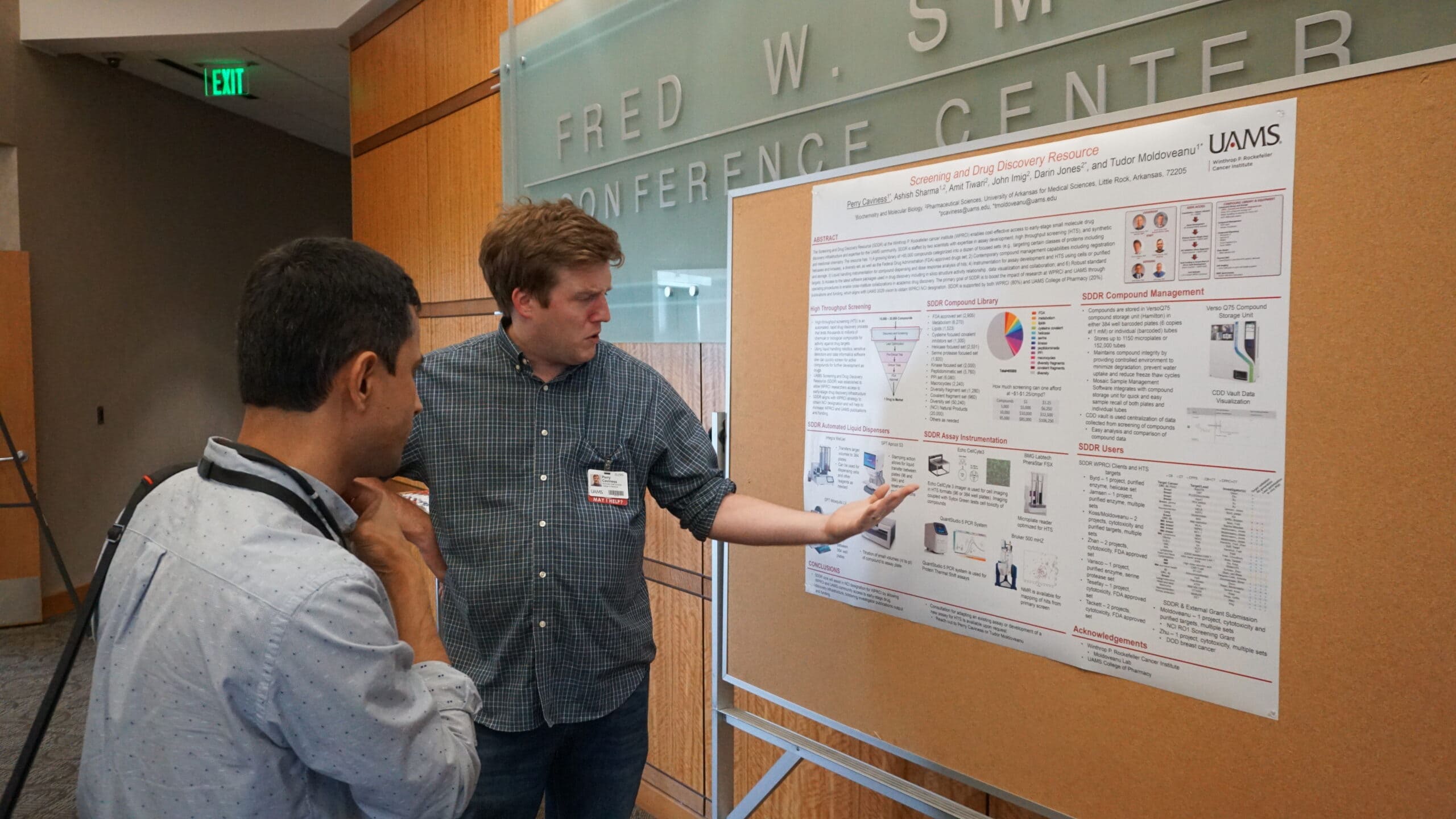
Perry Caviness, Ph.D., an associate staff scientist in the SDDR and a member of the Moldoveanu Lab, talks about the lab’s research.
Perry Caviness, Ph.D., is an associate staff scientist in the SDDR and a member of the Moldoveanu Lab. He presented a
poster explaining the resources offered by the SDDR, which enables cost-effective access to early-stage, small-molecule drug discovery infrastructure and expertise for the UAMS community.
“Being able to communicate what is discovered through your research, whether that be in a formal presentation or a more casual conversation, is an essential skill I think all should work to develop early in their research career,” he said. “Communicating your results clearly and in easy-to-understand language is the ultimate test of your own comprehension of your research topic.”
Ashish Sharma, Ph.D., another associate staff scientist in the SDDR and Moldoveanu Lab member, presented on the lab’s study of small molecule activators of apoptotic programmed cell death that serve as useful chemical probes for mechanistic apoptosis studies and preclinical cancer research.
“For early-career researchers, events like the Showcase of Medical Discoveries are highly valuable,” he said. “It gives us the chance to interact with different people across campus. These interactions open doors for exciting new collaborations and the opportunity to work together.”
View the May 13 Showcase of Medical Discoveries booklet to see all posters.