View Larger Image
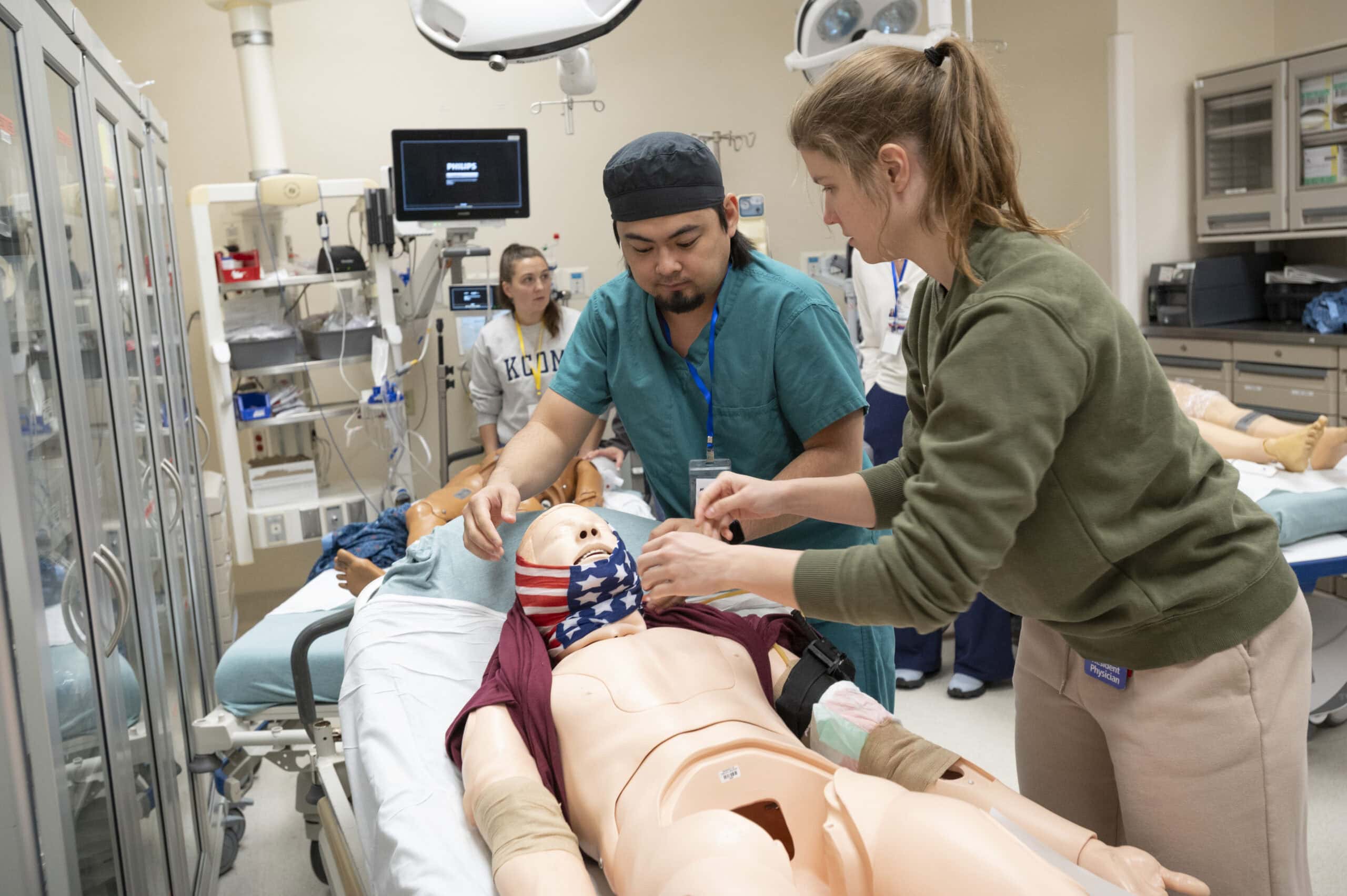
Emergency medicine residents simulate caring for a patient in a multi-vehicle pileup with 16 injured people.
Image by Evan Lewis
Emergency Medicine Residents Experience Mass Casualty Simulation
| Emergency medicine residents at the University of Arkansas for Medical Sciences (UAMS) received hands-on training in handling a mass casualty incident when the emergency room was suddenly inundated May 13 with standardized patients from an imagined collision between a bus and a pesticide-hauling 18-wheeler.
Three patients who arrived at the UAMS Emergency Department (ED) in ambulances and one who stumbled in after being dropped off by an unknown driver were actually medical students pretending to have such injuries as breathing difficulties, burns, and deep puncture wounds that spurted blood, indicating life-threatening arterial bleeding.
But the Metropolitan Emergency Medical Services (MEMS) medics who jumped out of ambulances and wheeled patients into the emergency room while relaying information about their conditions and the accident scene were actual medics borrowing from their experiences in the field.
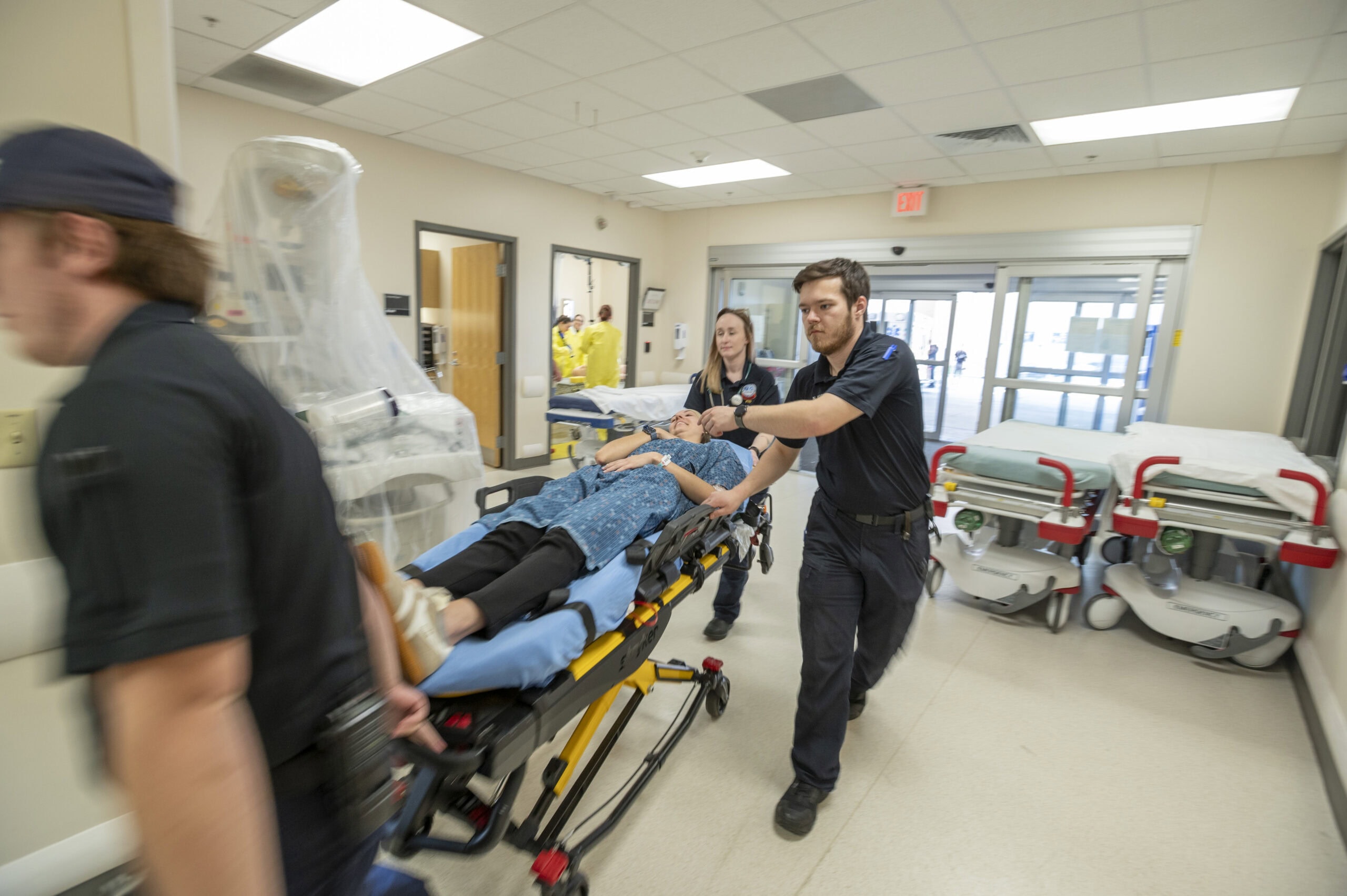
Image by Evan Lewis
“The mock mass casualty event gave our emergency medicine residents invaluable hands-on experience in a realistic, high-pressure scenario,” she said. “It’s one thing to learn procedures on paper but applying skills under pressure — while coordinating seamlessly with nurses, paramedics, and other team members — demonstrates the importance of interdisciplinary teamwork.
“Equally valuable,” she said, “is seeing how the entire emergency response system functions, which helps residents understand logistics, communication, and resource management in real time. Exercises like this are critical for preparing residents to respond effectively in the unpredictable ER environment, giving them the confidence and experience to act decisively when every second counts.”
“The emergency department never takes a day off,” said John Martindale, M.D., director of simulation education for the residents. “When disaster strikes, whether it’s a chemical spill, large motor vehicle accident, natural disaster, or man-made incident, numerous agencies spring into action. This was a test of departmental protocols and an opportunity to educate our residents on how to be leaders when a crisis strikes.”
Bouldin said the mass casualty scenario, concocted by UAMS emergency medicine physician Brandon Morshedi, M.D., assumed that there were 16 people injured in the accident, which involved a chemical spill and fire, and that the Arkansas Trauma Communications Center (ATCC), operated by the state Department of Health, coordinated their transport to several area hospitals, resulting in UAMS receiving three of the injured.
The fourth ‘drop-off’ patient in the simulated scenario represented a common occurrence during mass casualty events, underscoring the need for emergency room doctors to regularly update the ATTC about the number of patients being treated, to help balance the patient load at each hospital.
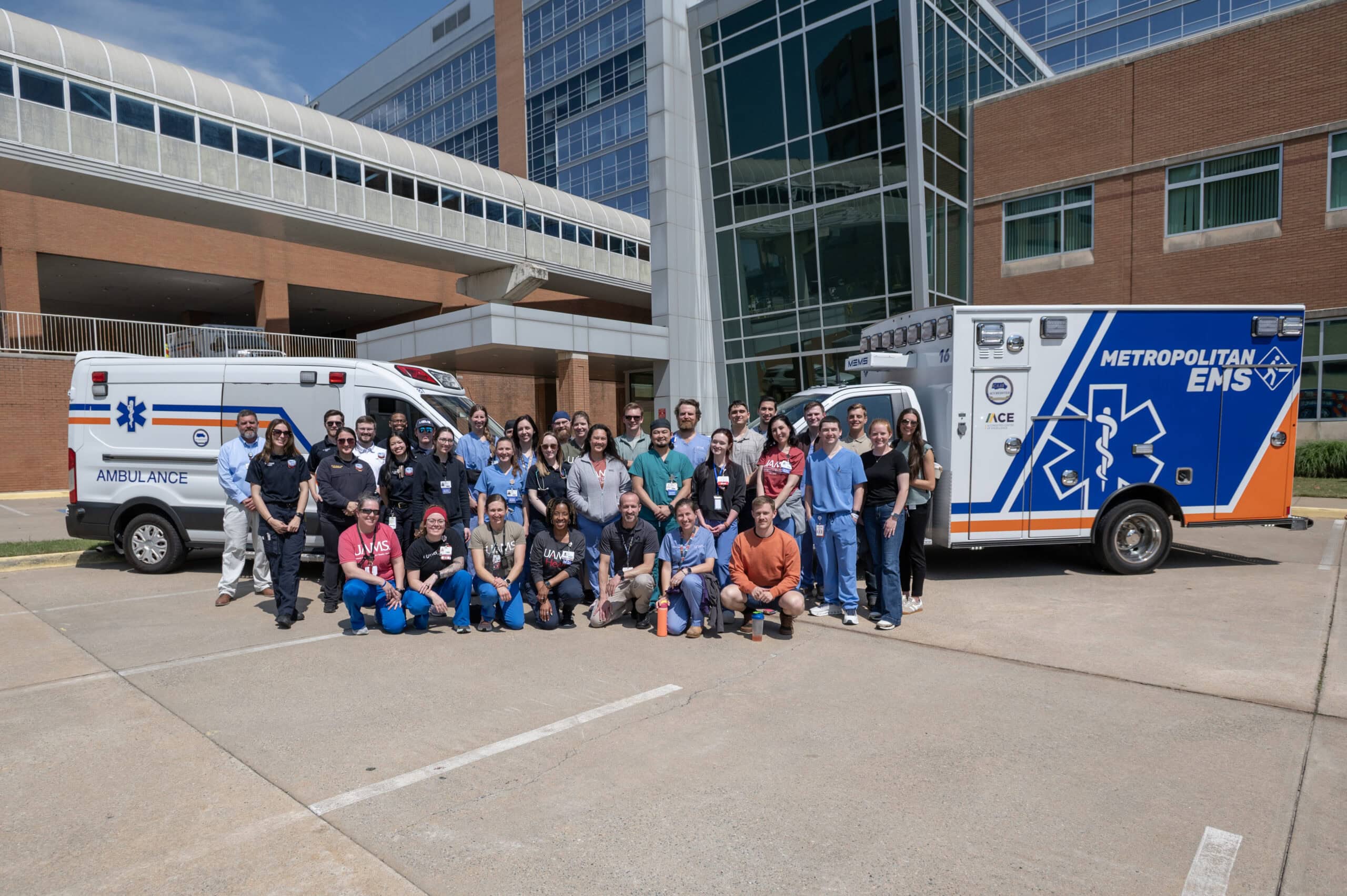
The participants paused after the drill to pose for a picture outside the emergency room.Evan Lewis
“Participating in multidisciplinary mass casualty incident drills alongside EMS gives emergency medicine residents invaluable, real-world experience in leadership, communication, triage, and systems-based care that they will carry into their future roles as physicians in community hospitals,” said Morshedi, who is also chief medical officer of MEMS.
“These exercises are most effective when hospitals, including nursing, physicians, ancillary staff, and leadership, as well as EMS agencies and public safety partners, train together,” he added, “because true disaster readiness in Central Arkansas depends on collaborative practice, coordinated decision-making, and strengthening relationships before a real mass casualty incident ever occurs.”
Once the medics handed over the patients to the ED staff in a room near the ambulance bay, the students left and were replaced with mannikins with realistic oozing blood and injured body parts, and “my residents figured out what to do with them next,” Bouldin said.
The residents used a triage process to try to stabilize the patients before sending them to other areas of the hospital, such as the operating room.
In this scenario, the threat of pesticide contamination led ED workers to quickly set up a decontamination room just inside the door to the building.
Bouldin said patients who hadn’t already been cleared of potential contamination by paramedics — namely, the drop-off patient — had to be examined in the decontamination room, where residents wore bright yellow protective gear, before entering the larger space where real-life emergency treatment was also underway.
Next, the medical students took on new roles as news reporters who crowded around the residents in a separate room and thrust microphones into their faces, demanding answers about the accident and the injuries.
Jerilyn Jones, M.D., MPH, an emergency medicine and EMS fellowship-trained physician, later listened to the residents’ thoughts about the experience and reiterated that they should steer questions to UAMS’ official spokesperson, while relaying proper “crisis communication” tactics if compelled to say something.
She shared tips drawn from her personal experiences speaking to media during the COVID-19 pandemic, and in her role as medical director of the Office of Preparedness and Emergency Response Systems at the Arkansas Department of Health.
Her station also exposed the residents to the concept of ‘hospital incident command,’ and more specifically, UAMS’ plan for handling mass casualty incidents.
“All disasters come with a significant amount of chaos,” Jones said. “Understanding that there is a system in place designed to bring some order to the chaos instills a sense of confidence and allows providers to do what they do best — take care of patients.”
The mock disaster was split into several different sessions to give each of the residents a chance to fully participate. Meanwhile, as it unfolded, ambulances that weren’t part of the drill also pulled into the ambulance bay and delivered actual patients to the ED.
“It gave me a first look into front-line patient care, and it was awesome to act as a patient and see what the residents’ actions were,” said Natalie Hale, a first-year medical student who posed as a patient and said she is “very interested” in becoming an emergency room physician.
Anthony Aloi, a second-year medical student who plans to specialize in emergency medicine, added, “I think it was perfect. It was very oriented to what they wanted the residents to work on.”
Rylee Yarbrough and Noah Wood, both fourth-year medical students on the verge of becoming emergency medicine residents themselves, said the event provided an opportunity to ask questions and to interact with some of the staff they will work alongside starting in July.