View Larger Image
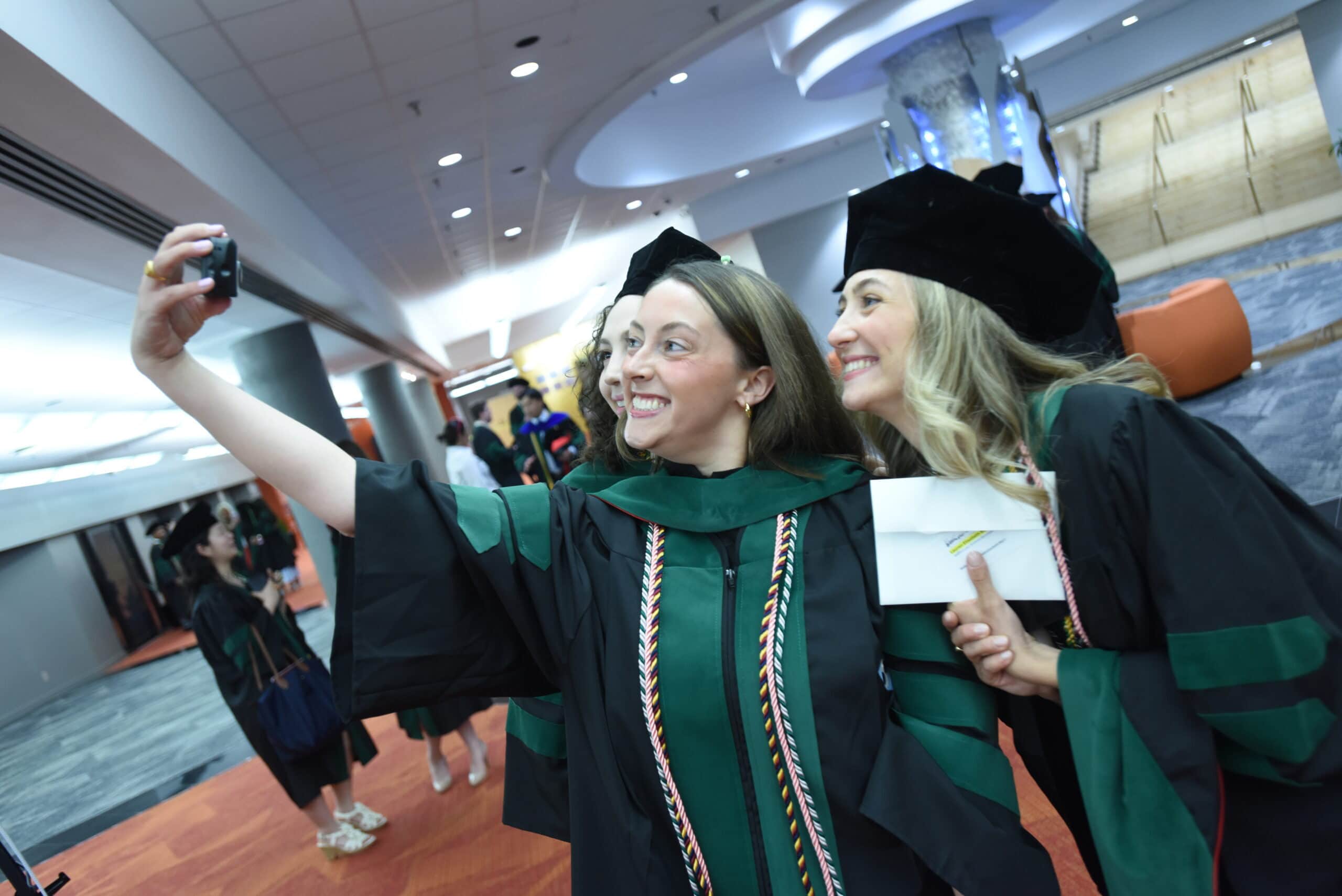
Newly sworn-in doctors pause for a photo after the ceremony.
Image by Johnpaul Jones
UAMS College of Medicine Celebrates Class of 2026
| They walked into the Statehouse Convention Center in downtown Little Rock as fourth-year medical students, and less than three hours later, after reciting the Hippocratic Oath before family, friends, mentors, and university leaders assembled in a sprawling conference hall, they walked out as doctors.
Equal parts somber and giddy, the May 15 event marked the 147th commencement for the University of Arkansas for Medical Sciences (UAMS) College of Medicine and, for the 167-member Class of 2026, the end of a four-year journey to earn medical degrees.
Between entering the hall in a procession of green-trimmed black gowns with cap tassels dangling to the right and leaving with doctoral hoods over their shoulders, tassels now turned to the left, the graduates listened to some strong praise and heady advice.
“We gather tonight in an atmosphere of celebration and a huge sense of pride in the accomplishments of these students,” said James Graham, M.D., executive associate dean for academic affairs, as he prepares to retire after 35 years on the UAMS faculty.
“They have worked hard, they have sacrificed, and they have achieved the necessary knowledge and skills to be a physician,” Graham added. “Having watched these graduates overcome the challenges of medical school, we gather tonight with hope and confidence for the future.”
The college’s interim dean, Ronald Robertson, M.D., offered comfort, telling the students that as a UAMS graduate himself, he knew they were “going through a lot of emotions right now — being overjoyed, invigorated, likely a little anxious about what lies ahead.”
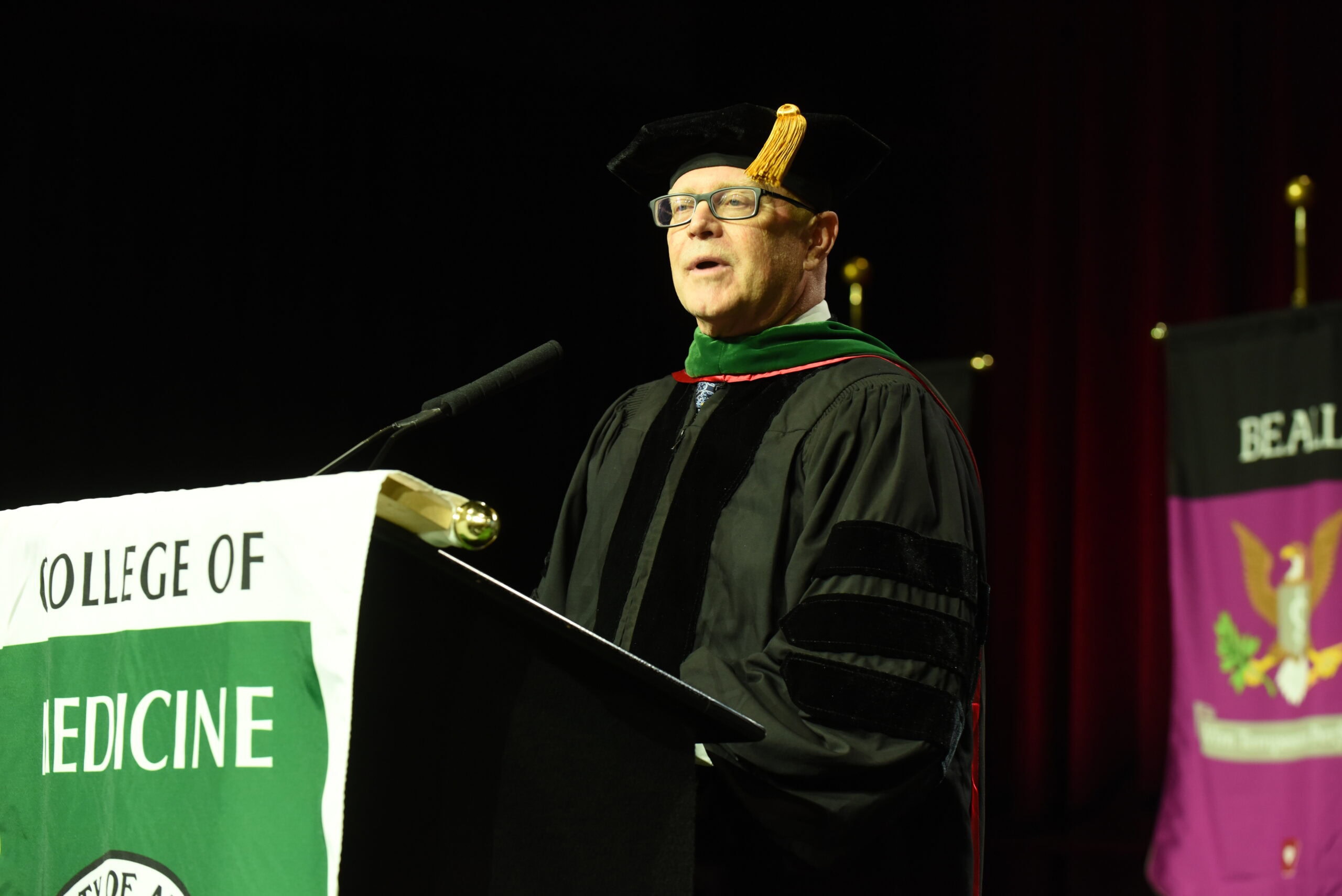
Ronald Robertson, M.D., interim dean of the College of Medicine, offers advice to the class.Johnpaul Jones
He assured them, however, that whether relocating or staying at UAMS for their residencies, which range from three to seven years depending on their medical specialty, “there is always a highly supportive team around you at every phase of your career.”
“These are a lot of big changes, and there’s also no doubt that medicine is a very demanding profession, but also a very fulfilling one,” said Robertson, a nationally respected educator in trauma care who has been on the faculty since 1996.
“I know that you will embrace this responsibility with earnestness, compassion, empathy, and hopefully a little dose of good humor,” Robertson told the graduates from the stage. “Some of you will be focused on treating key conditions. Others will be more focused on chronic disease management and prevention. Some of you will be biomedical researchers, while others will be examples for the next learners, and many of you will have several of these roles.
“Each,” he emphasized, “is equally important, and each of you will contribute significantly to improving the health of communities that you will serve.”
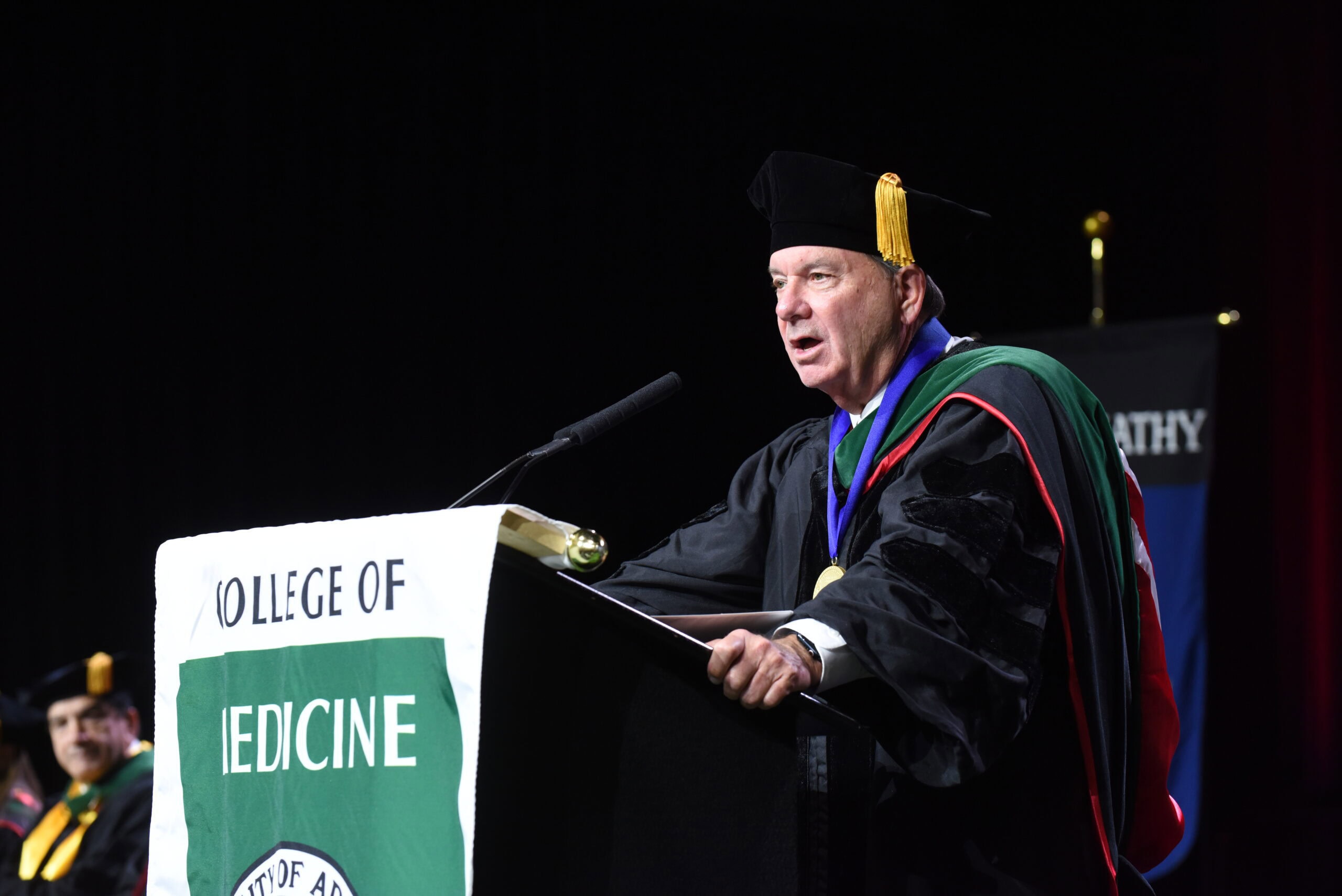
C. Lowry Barnes, M.D., UAMS chancellor, shares praise and advice.
Next up was Chancellor C. Lowry Barnes, M.D., who congratulated the graduates who came together to celebrate after studying at both the Little Rock and Fayetteville campuses, saying, “What an extraordinary achievement. What an effort. What a result.”
Barnes shared the story of his career, which began when he graduated with honors from UAMS 40 years ago before completing an internship and residency in orthopaedic surgery. After a stint in private practice, he returned to UAMS in 2014 and founded The Orthopaedic and Spine Hospital that opened on campus in 2023.
“At the time,” he said, referring to his graduation from medical school in 1986, “my focus was entirely on becoming an orthopaedic surgeon. Administration and medical leadership were nowhere on my radar.”
However, Barnes said, “medicine has a way of opening doors that you never imagined. The opportunities before you will evolve over time. Your path may not look exactly as you expect today, and that is one of the great direct gifts of our profession. Tonight marks both the ending and the beginning.”
He reassured them that while “the science of medicine will continue to evolve, technologies will change, treatments will advance, and artificial intelligence, precision medicine and innovation we cannot yet imagine will reshape healthcare during your careers, the heart of medicine will remain the same.”
“Be the physician who listens carefully, explains clearly, sits down, and sees the person behind the diagnosis,” Barnes advised, adding, “the white coat is not a symbol of status, but a symbol of responsibility — the responsibility to serve with integrity, respect, and unwavering dedication.”
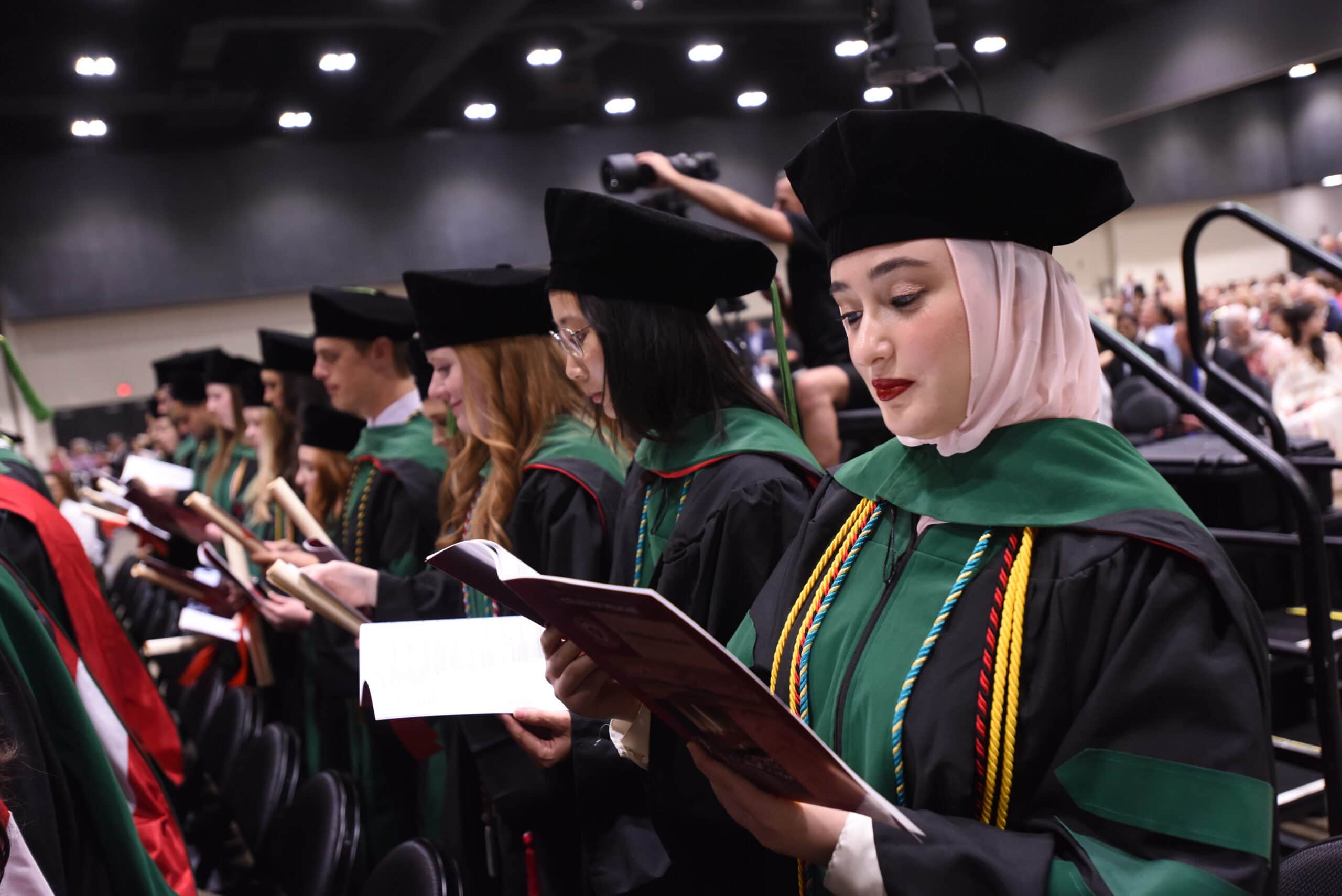
Medical students on the verge of becoming doctors recite the Hippocratic oath.Johnpaul Jones
Acknowledging that medicine can be demanding physically and emotionally, the chancellor also encouraged them to protect their well-being, support each other, seek mentors, and “stay connected to the purpose that brought you to medicine in the first place.”
Jay B. Silveria, president of the University of Arkansas System, said the system’s 22 campuses and divisions graduate 15,000 to 20,000 students every year. While the UAMS College of Medicine is just part of that achievement, he reminded them to remember that they are “part of something very big — a system that makes a difference statewide and has a reasonable impact.”
The students listened to the annual farewell “address to the class,” given this year by Jacob Filipek, M.D., an associate professor of pediatrics whom the class chose to deliver it, as well as a response from Jared Canonigo, class president.
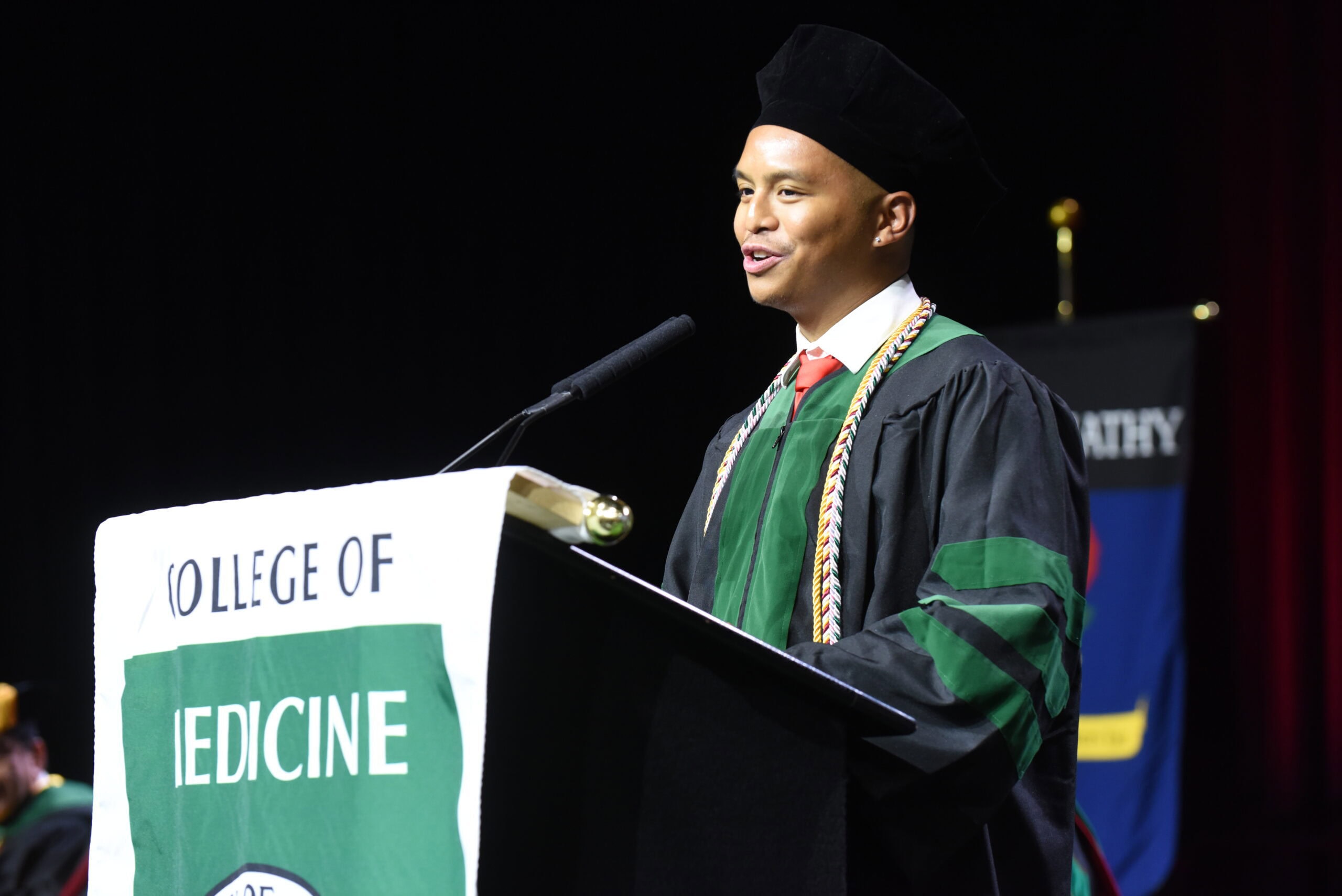
Class of 2026 President Jarod Canonigo thanks the faculty on behalf of the class.Johnpaul Jones
After Barnes conferred medical degrees on the graduates, each walked across the stage, accompanied by family or friends, to receive their doctoral hoods and diplomas from Becky Latch, M.D., the college’s associate dean for student affairs, and pause for their first photos as physicians.
Before lining up again to follow university leaders dressed in full regalia out of the hall, the graduates stood and, in unison, recited the Hippocratic Oath, administered by Robertson.
In the process, they left medical school behind and joined the ranks of medical doctors.
The crowd cheered.