View Larger Image
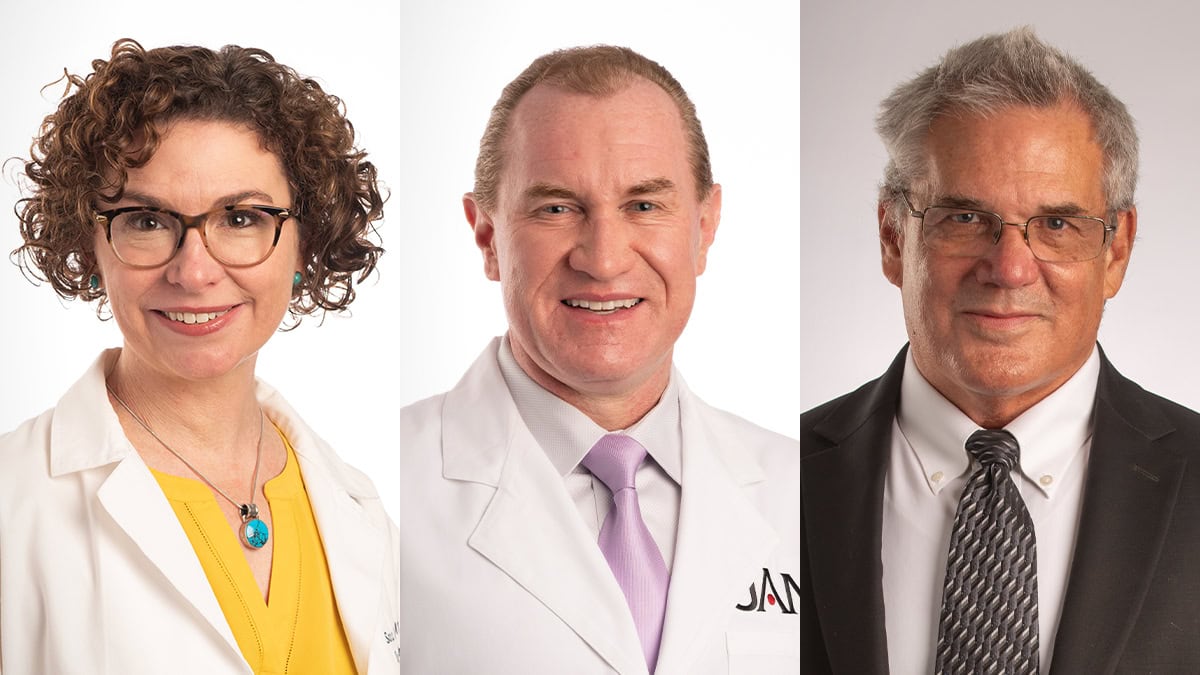
Sara Shalin, M.D., Ph.D.; William Steinbach, M.D.; Mark Smeltzer, Ph.D.
UAMS Awarded $2.6 million for Joint M.D./Ph.D. program
New CREST Program Positions UAMS as Elite Training Center in South
| LITTLE ROCK — The University of Arkansas for Medical Sciences (UAMS) has been awarded a $2.6 million grant from the National Institutes of Health to help train joint M.D./Ph.D. students to become top-notch clinician-scientists.
To be dispersed over five years, beginning July 1, the federal funding will enable UAMS to increase its seven-to-eight-year dual-degree program from the current 22 students to eventually 32 for the purpose of improving healthcare needs unique to the region, which is considered underserved in dual-degree practitioners.
“This training grant is going to enable us to strengthen and expand our existing M.D./Ph.D. program,” said Sara Shalin, M.D., Ph.D., a UAMS professor of Dermatology and Pathology who directs the UAMS College of Medicine’s dual-degree program — the only one in the state. “It is going to increase the amount of support that we can provide to the students and to the program itself.”
The funding is provided by the National Institute of General Medical Sciences (NIGMS), a branch of the NIH, through its Medical Science Training Program (MSTP) for the purpose of developing “a pool of well-trained clinician-scientists leaders available to address the nation’s biomedical research needs.”
Specifically, the MSTP grant provides support to institutions “to develop and implement effective, evidence-informed approaches to dual-degree training and mentoring that will keep pace with the rapid evolution of the biomedical research enterprise and lead to the completion of both a clinical degree (for example, M.D., D.O., DVM, DDS, Pharm.D, etc.) and a research doctorate degree (Ph.D.).”
There are more than 120 combined M.D./Ph.D. programs in the United States, but only 58 of them are NIH-funded MSTPs.
The ultracompetitive MSTP designation adds a layer of prestige and competitiveness to any M.D./Ph.D. program and also guarantees financial support for its students in the form of full tuition and a generous stipend — in this case, about $28,000 a year.
“This landmark achievement establishes the only MSTP in a four-state region, including Arkansas, Oklahoma, Louisiana, and Mississippi, positioning UAMS as a premier hub for biomedical research and elite clinical training in the South,” said William Steinbach, M.D., chair of the UAMS Department of Pediatrics and pediatrician-in-chief at Arkansas Children’s Hospital.
Shalin, Steinbach, and Mark Smeltzer, Ph.D., a professor in the UAMS Department of Microbiology and Immunology and director of the UAMS Center for Microbial Pathogenesis and Host Inflammatory Responses, are the principal investigators for the new program, called the Clinician Research Education and Scientific Training (CREST) program.
Graduates of MTSPs primarily work in academic medical centers, biomedical research universities, government organizations such as the NIH, and the biotechnology or pharmaceutical industry. They spend roughly 80% of their time directing a research laboratory and 20% treating patients in a clinic, although there can be considerable variation in the way they employ their dual-degree training.
The MSTPs are “part of elite academic healthcare organizations, so for us to receive this designation, it really recognizes the potential for UAMS to serve as a training center for clinician-scientists,” Shalin said.
Smeltzer agreed, saying, “I have been mentoring M.D./Ph.D. students at UAMS for over 25 years. During that time, our program has trained outstanding clinician scientists even without the resources of a MSTP program. Having a formal NIH-funded MSTP program, something that has never existed in Arkansas, will exponentially magnify that success by allowing us to attract and train exceptional students in a highly structured and supportive environment. By ultimately allowing us to leverage that environment to keep these clinician scientists in Arkansas, we can better serve the healthcare needs of all Arkansans. It is a game changer, and I am very proud of having helped with that.”
“A truly prestigious academic medical center is defined by its ability to champion three critical missions: delivering cutting-edge patient care, fostering a culture of discovery to uncover new cures, and training tomorrow’s healthcare workforce while improving healthcare access for an entire state,” Steinbach said. “Nationally, the highest echelon of academic medicine is defined by universities that hold three specific campuswide designations: an NIH-funded Clinical and Translational Science Award (CTSA), a National Cancer Institute (NCI) designation, and an NIH-funded Medical Scientist Training Program (MSTP).
“With UAMS already holding a CTSA (administered by its Translational Research Institute) and having recently submitted its application for NCI designation,” he continued, “the addition of the MSTP grant officially elevates the university into this elite tier of American medical centers.”
In applying for the grant, UAMS said the funding “would be transformative and allow us to build on the strong foundation of our existing institutionally funded M.D./Ph.D. program to recruit, train, and retain students to address the critical need for clinician-scientists to tackle healthcare needs in Arkansas and the surrounding mid-South region. Students will be specifically recruited with an emphasis on those from medically underserved regions and supported by a proactive mentoring program that purposefully integrates across all aspects of the M.D. and Ph.D. phases of training and beyond.”
Students apply to UAMS’ dual-degree program when they apply to medical school. If accepted, they spend their first two years in medical school focused on basic science and preclinical work, then spend three or four years focused on their doctoral degree in any biomedical science field. After earning their Ph.D., they complete the last two years of medical school.
“Just as NCI designation impacts an entire university and state far beyond cancer care,” Steinbach said, “the MSTP grant significantly raises the research profile and level of opportunity for all of UAMS and Arkansas. With this MSTP, we will not only attract a higher volume of exceptionally qualified M.D./Ph.D. students, but we will also raise the training bar for all students, residents, and fellows across our campus. This program brings immense prestige and resources that will trickle down to benefit the entire healthcare ecosystem of our state.”
During their studies, dual-degree students already contribute to research at UAMS, publish peer-reviewed manuscripts, and help UAMS faculty receive tens of millions of dollars in extramural grant funding, Shalin said. The hope is that many graduates of UAMS’ CREST program will stay at UAMS, strengthening the breadth of its residency programs as well as its ability to retain other clinician-scientist faculty members.
“We usually take two to four students per year,” Shalin said, referring to the M.D./Ph.D. program that has been in place since 2007. “This grant is going to allow us to take four students consistently per year, so our goal will be 32 dual-degree students at one time in various phases of their eight-year course of study.”
“The type of applicants that we get are really cream of the crop, and I think that this grant will also increase our applicant pool, because there are a lot of top-quality applicants who only apply to MSTP designated schools,” she said.
The grant will allow UAMS to provide stipends for M.D./Ph.D. students throughout their course of study. Currently, the stipend is only for those in graduate school.
“This is going to be a huge draw,” Shalin said. “We have lost some really tremendous Arkansas applicants who chose to go to a different program that offers an MSTP program.”
Shalin said that under NIH rules, the institution that receives the grant has to match the funding, “which means that UAMS has made a really substantial commitment on the other end of this, so I’m grateful to the dean, the chancellor, the provost, and the vice chancellor of research, because they have all been involved in the conversations about moving us forward in this regard.”
A goal of the program is to “integrate medical school and graduate school experiences through the entirety of the program, so no matter what phase of the training you’re in, you are being cross exposed to the other perspective,” she said. For example, she said a medical student who sees a recurring problem on rounds might think about the types of experiments that could be done to find a solution, while a research student might ponder how new medications will affect clinical situations.
The first year of the grant will support four students, while the next year it will support eight students. Eventually, Shalin said, “we will get to a steady state of support for about 10 students at any one time,” from the grant funds alone.
This grant was issued under award number 1T32GM163565-01. The content does not necessarily represent the official views of the NIH.
UAMS is the state’s only health sciences university, with colleges of Medicine, Nursing, Pharmacy, Health Professions and Public Health; a graduate school; a hospital; a main campus in Little Rock; a Northwest Arkansas regional campus in Fayetteville; a statewide network of regional campuses; and seven institutes: the Winthrop P. Rockefeller Cancer Institute, Jackson T. Stephens Spine & Neurosciences Institute, Harvey & Bernice Jones Eye Institute, Psychiatric Research Institute, Donald W. Reynolds Institute on Aging, Translational Research Institute, and the Institute for Community Health Innovation. UAMS includes UAMS Health, a statewide health system that encompasses all of UAMS’ clinical enterprise. UAMS is the only adult Level 1 trauma center in the state. UAMS has 3,553 students and 1,030 medical residents and fellows, and two dental residents. It is the state’s largest public employer with about 12,000 employees, including 1,200 physicians who provide care to patients at UAMS, its regional campuses, Arkansas Children’s, the VA Medical Center and Baptist Health. Visit www.uams.edu or uamshealth.com. Find us on Facebook, X (formerly Twitter), YouTube or Instagram.###