Psoriasis
Coats for shorts
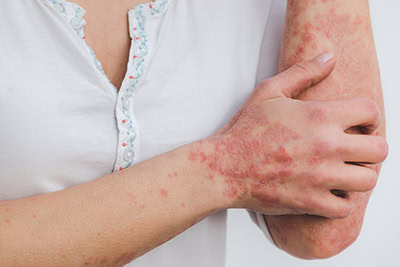
| Download this episode | Many people look forward to this time of year when they are able to trade the coats and long pants they wore all winter for shorts and swimsuits. Not everyone, however, enjoys wearing summer outfits due to a nagging skin disease known as psoriasis. According to the National Psoriasis Foundation, more than 8 million Americans suffer from this autoimmune disease. Psoriasis causes itchy or sore patches of thick, red skin with silvery scales to appear on the elbows, knees, scalp, back, face, palms and feet, although they can show up on other parts of the body. Psoriasis is a persistent, long-lasting, or chronic disease. People with this common disorder may have periods when their symptoms improve or go into remission alternating with times when the illness worsens. Psoriasis usually occurs in adults and sometimes runs in families, with about one in three people having a close relative who also has the condition. | Psoriasis is believed to be caused by genetics, the immune system, and the environment. Psoriasis plaques occur because the overactive immune system speeds up skin cell growth. Normal skin cells completely grow and fall off in a month. With psoriasis, skin cells do this in only three or four days. Instead of shedding, the skin cells pile up on the surface of the skin. Inflammation caused by psoriasis can impact other organs and tissues in the body. People with psoriasis may also experience related health conditions. One in three people with psoriasis may also develop psoriatic arthritis. While scientists do not know what exactly causes psoriasis, we do know that the immune system and genetics play major roles in its development. One thing we do know, psoriasis is not contagious. You cannot catch psoriasis from another person. Usually, something triggers psoriasis, causing the symptoms to appear or worsen. | The symptoms of the chronic disease psoriasis can vary from person to person but typically they include red patches of skin with silvery scales, itching or soreness and thickened or ridged nails. There are several types of psoriasis, the most common being plaque psoriasis, which can occur anywhere on the body, including the soft tissue inside the mouth. Psoriasis on the scalp appears as red, itchy areas with silvery-white scales while guttate psoriasis primarily affects people younger than 30 and is usually triggered by a bacterial infection such as strep throat. It’s marked by small, water-drop-shaped sores on the trunk, arms, legs and scalp. Inverse psoriasis affects the skin in the armpits, groin, under the breasts and around the genitals, causing smooth patches of red, inflamed skin. Most types of psoriasis go through cycles, flaring for a few weeks or months, then subsiding for a time or even going into complete remission. | Psoriatic arthritis is a type of arthritis that can affect people who have psoriasis. Psoriatic arthritis is a lifelong condition that causes deterioration, pain and stiffness in the joints. It can also lead to inflammatory eye conditions such as conjunctivitis. The symptoms range from mild to severe and although the disease usually isn’t as crippling as other forms of arthritis, it can cause stiffness and progressive joint damage that in the most serious cases may lead to permanent deformity. Medication can help prevent joint deformities and disability if used early. Nonsteroidal anti-inflammatory drugs or salicylates may be prescribed to reduce pain and inflammation of the joints. Particularly painful joints may be injected with steroid medications and in rare cases, surgery to repair or replace damaged joints is needed. Without treatment, permanent joint degeneration and destruction can occur. | Treatment of psoriatic arthritis depends on the pattern of symptoms and their severity. You may need to try different medications to find one that works, or use a combination of them. Milder forms of the disease may be treated by over-the-counter anti-inflammatory and pain medications, which can help treat pain and swelling, or by injections of corticosteroids, strong inflammation-fighting drugs, into the affected joints. Because they are potent drugs, your doctor will prescribe the lowest dose possible to achieve the desired benefit. More persistent or severe disease may be treated by disease-modifying anti-rheumatic drugs that suppress the immune system on a broad level and help to decrease signs and symptoms of the disease. If a joint has been seriously damaged by psoriatic arthritis, your health care professional may recommend surgery to replace it with an artificial joint made of metal and plastic.
Transcript
Cell growth
Transcript
Silvery scales
Transcript
Psoriatic arthritis
Transcript
Potent drugs
Transcript