View Larger Image
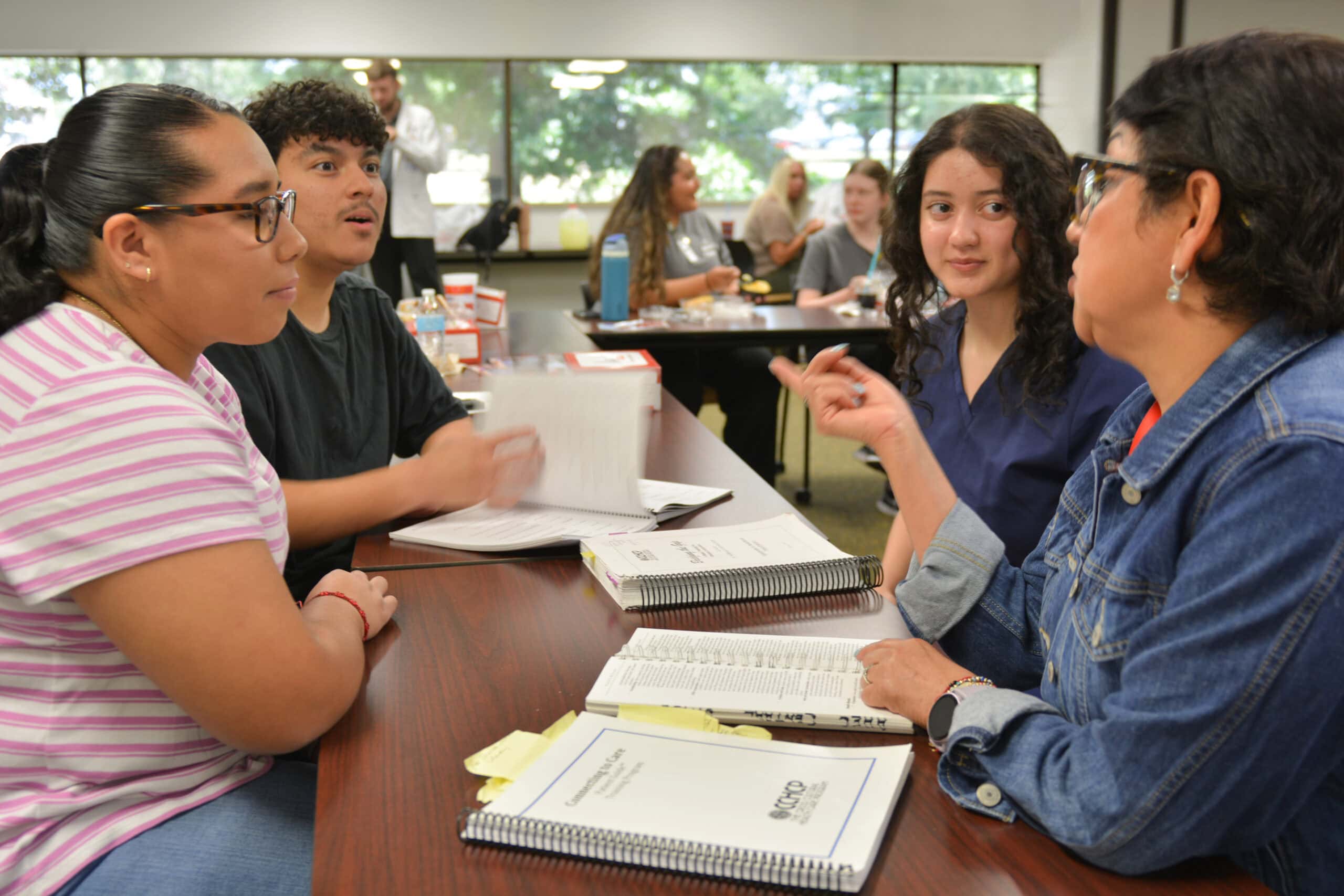
Ana Sanchez teaches students from "Beyond Communications," a simplified version of the one used by International Medical Interpreters Association.
Image by David Wise
UAMS Northwest Regional Campus Helps Bilingual Students Bridge Healthcare Language Gap
| Ana Sanchez couldn’t summon the right words when she tried to explain what the English-speaking physician was telling her 62-year-old father, who is originally from Mexico.
He had recently had a heart attack but knew only basic English and leaned on his bilingual daughter to help him understand his prognosis and treatment. Sanchez quickly realized her ability to speak Spanish did not automatically transfer to medical conversations.
This was 25 years ago, when the only certified medical interpreter in Northwest Arkansas was Nellie Cordova, said Sanchez, who noted that her surprising inability to interpret during her father’s consultation blossomed into an opportunity when she met Cordova. She took Cordova’s medical interpreter class and was hooked.
“It was so beneficial for me. And I thought, ‘How beneficial could it be for many bilingual people or workers in the hospital?’ because it’s not easy just to be bilingual and interpret. There are so many things that go into it, things that we’re allowed and not allowed to do at the hospital with patients,” said Sanchez.
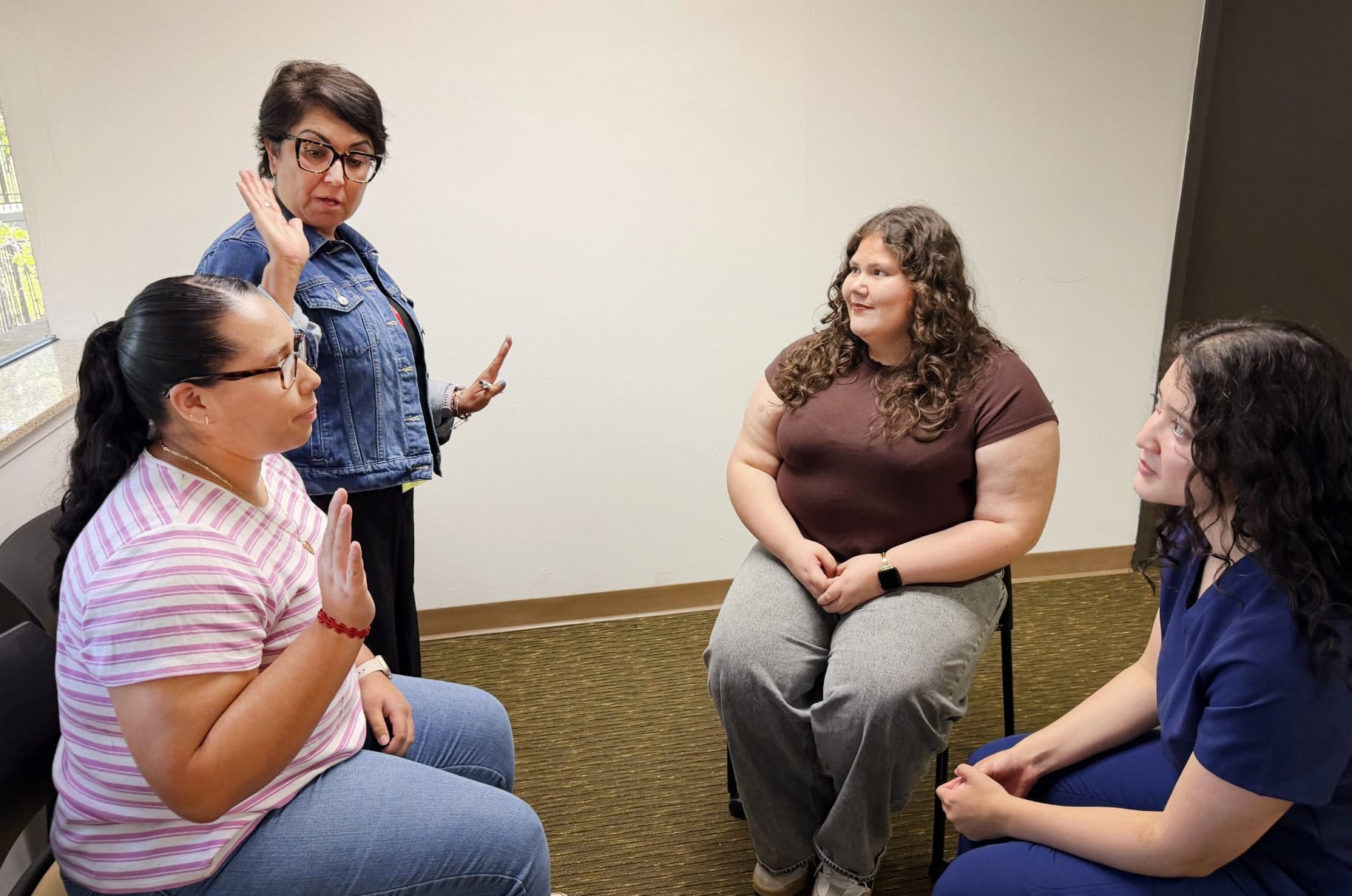
Ana Sanchez illustrates how to interrupt a conversation correctly.David Wise
Sanchez was hired in 2008 as an outreach coordinator for the University of Arkansas for Medical Sciences (UAMS) Northwest Regional Campus in Fayetteville. Since then, her role has expanded to education coordinator, where she plans student programs, supports aspiring medical professionals and coordinates events while building a healthcare workforce pipeline that will serve rural Arkansans. Much of her work is with high school students interested in healthcare, so she wove her passion for medical interpreting with her connections to local high schools and crafted a 20-hour course for bilingual high school seniors. She’s still teaching the class 18 years later and offers the only medical interpretation class within the UAMS Regional Campus statewide system.
“The reason we started doing the training was to connect the students with the hospitals,” Sanchez said. “And we want some high school kids to be trained to go and interpret for their families. We wanted to give them a few tools to start.”
The number of certified medical interpreters lags far behind the national need, and Northwest Arkansas is no different. When Sanchez moved to Springdale in 2000, the U.S. Census Bureau showed the Hispanic population of Benton, Carroll and Washington counties was 10%. The most current counts show the number at 18.1%. Additionally, nearly 39% of the Hispanic residents in Washington County have limited English-speaking skills, according to 2023 estimates from the Association of Arkansas Development Organizations.
Good communication between providers and patients is essential in healthcare. Patients with limited English-speaking skills may misunderstand the advised treatment, which can have an adverse effect on their health. Even small miscommunications about medications or follow-up care can escalate to larger healthcare problems.
These heightened health needs mean Sanchez’s class is in high demand, drawing a steady stream of 25 students each spring. One of those students was Daniela Alvarado, who took the class while she was a senior at Springdale High School. She now teaches English and Spanish at a dual-language school in Tulsa, Oklahoma, and interprets for parents and students who need services. When Alvarado’s not working, she will interpret for her family.
Students must be 18 to interpret in a hospital, so Sanchez teaches the course during the spring semester when high school seniors are preparing to graduate. The students meet for one month, four hours each Saturday. Graduates earn a certificate of completion from Sanchez’s 20-hour course. They can become a certified medical interpreter with an additional 28 hours of training through the International Medical Interpreters Association.
Sanchez’s latest class wrapped up in March.
She uses a course text titled “Beyond Communications,” a simplified curriculum that she and her colleagues extracted from a larger version used by the International Medical Interpreters Association. The students are taught that the interpreter must interrupt the provider if a term isn’t understood or paint pictures for the patient if a similar word doesn’t exist in the patient’s native language. The course also teaches the students where to stand in the room and how to manage frustrated patients or physicians.
“We focus a lot on the code of ethics that every medical interpreter has to abide by, the values and the principles, the national standards. And, of course, oral practice is very important for the kids. The most important thing I want them to learn is that, when they make a mistake, how they can correct it,” said Sanchez.
For Alvarado, the class taught her skills that apply to many interpreting situations, even though she doesn’t officially interpret for patients.
“I think it helped because it gave me a little more of the technical aspect of interpreting: making eye contact, using terms they can understand but without having to miss any of the meaning between languages. It helped me become more confident with the interpretation process,” she said.
Sanchez will begin recruiting her 2027 group soon. After 18 years of teaching, she continues to find joy in teaching these young students.
“I love teaching this class. It is so important, and I hope it continues for a very long time.”