View Larger Image
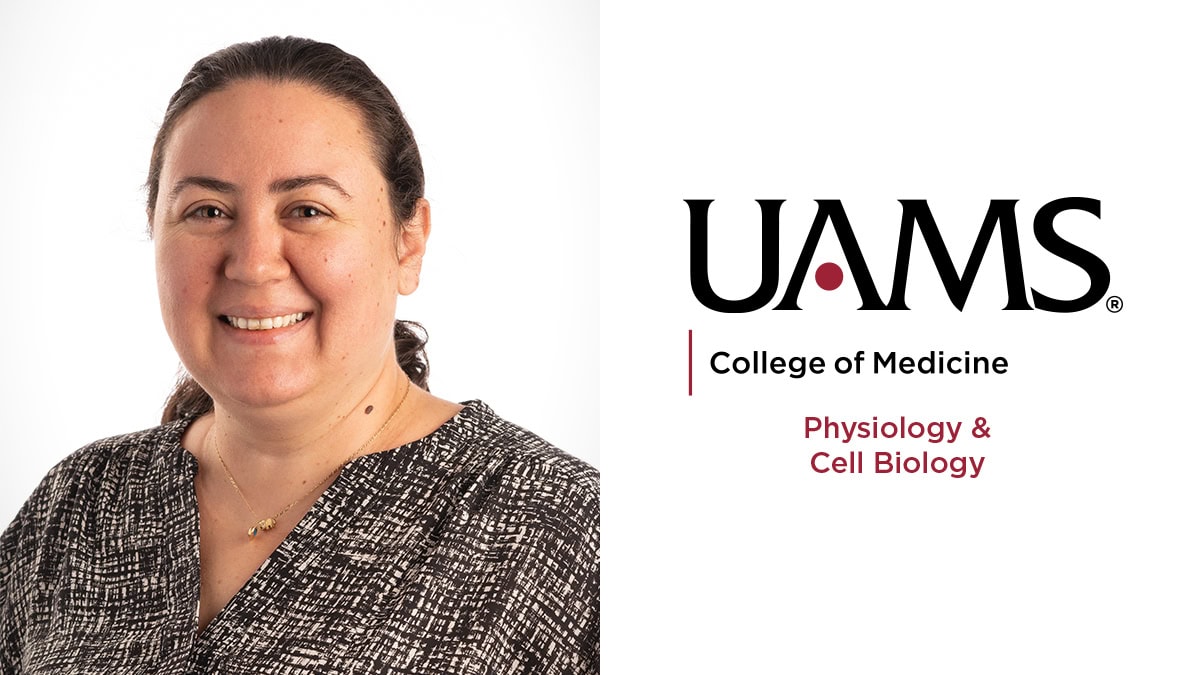
Melda Onal, Ph.D.
UAMS Receives $2.4 Million to Study Bone Loss in Aging and Brittle Bone Disease
| LITTLE ROCK — Thanks to a $2.4 million grant from the National Institute on Aging, researchers at the University of Arkansas for Medical Sciences (UAMS) are studying mechanisms that could be manipulated to improve bone formation and bone strength in aging populations and in people with brittle bone disease.
Melda Onal, Ph.D., an assistant professor in the UAMS College of Medicine Department of Physiology and Cell Biology, is the primary investigator for the project, which will receive the funding over five years from the division of the National Institutes of Health.
Onal said her laboratory focuses on autophagy, an intracellular recycling process that is critical for the survival and function of bone-forming cells. This process is thought to be inadequate in both aging and osteogenesis imperfecta (OI), a genetic disorder commonly known as brittle bone disease.
“The beauty of our skeleton is that it is a dynamic tissue that is constantly remodeled, with old bone being removed and new bone being formed throughout life,” said Onal, a member of the UAMS Center for Musculoskeletal Disease Research. “Our bones are constantly renewing themselves, even late in life. The reason people lose bone as they age is that the process becomes unbalanced — more bone is removed than replaced.
“One factor contributing to this imbalance is an age-related decline in bone formation,” she added. “We aim to identify the reasons why bone formation declines with age, so we can reverse those cellular processes and halt osteoporosis. We have evidence that during aging, autophagy (the recycling process) declines in bone-forming cells, likely reducing their survival and function.”
People with moderate to severe OI have very fragile bones that can break with little or no force. OI is caused by mutations in collagen type I — a major component of bone — or in enzymes involved in collagen processing. These mutations not only weaken the quality of the bone that is produced but also impair the function of bone-forming cells. OI mutations cause collagen to fold incorrectly and accumulate within bone-forming cells. This buildup is thought to impair the cells’ ability to make new bone.
Onal said that normally, “autophagy contributes to clear the misfolded collagen and recycles molecular building blocks, which help maintain cell survival and function. However, in OI, the amount of misfolded collagen overwhelms the cell’s recycling capacity.”
“The common denominator in aging and OI is the inadequacy of this recycling mechanism that cleans up damaged organelles and misfolded proteins in the cells,” she said.
So far, Onal said, “there have been no functional studies” to examine if inadequate autophagy causes the decrease in bone formation in these conditions, and “we’re the first ones to functionally test it,” using an advanced form of genome-editing technology called CRISPR activation technology.
“If successful, our studies will uncover whether autophagy insufficiency restrains bone formation in aging and OI and identify strategies to prevent or reverse it,” she noted.
She said the overarching goal is to figure out how to stimulate bone formation in elderly people and in people with brittle bone disease, so that both groups have more bone mass and fewer fractures.
Other UAMS Center for Musculoskeletal Disease Research contributors to this project include Maria Almedia Schuller, Ph.D, an expert in aging; Roy Morello, Ph.D., an expert in OI; and Intawat Nookanew, Ph.D., an expert in bioinformatics.
Research reported in this release was supported by the National Institute on Aging of the National Institutes of Health under Award Number R01AG094715. The content is solely the responsibility of the authors and does not necessarily represent the official views of the National Institutes of Health.
UAMS is the state’s only health sciences university, with colleges of Medicine, Nursing, Pharmacy, Health Professions and Public Health; a graduate school; a hospital; a main campus in Little Rock; a Northwest Arkansas regional campus in Fayetteville; a statewide network of regional campuses; and seven institutes: the Winthrop P. Rockefeller Cancer Institute, Jackson T. Stephens Spine & Neurosciences Institute, Harvey & Bernice Jones Eye Institute, Psychiatric Research Institute, Donald W. Reynolds Institute on Aging, Translational Research Institute, and the Institute for Community Health Innovation. UAMS includes UAMS Health, a statewide health system that encompasses all of UAMS’ clinical enterprise. UAMS is the only adult Level 1 trauma center in the state. UAMS has 3,553 students and 1,030 medical residents and fellows, and two dental residents. It is the state’s largest public employer with about 12,000 employees, including 1,200 physicians who provide care to patients at UAMS, its regional campuses, Arkansas Children’s, the VA Medical Center and Baptist Health. Visit www.uams.edu or uamshealth.com. Find us on Facebook, X (formerly Twitter), YouTube or Instagram.###