UAMS Neonatologists Strengthen Physician-Scientist Roles with Ph.D. Achievements
| Four neonatologists at the University of Arkansas for Medical Sciences (UAMS) have recently earned Doctor of Philosophy degrees, bolstering their ability to connect clinical care with research to improve outcomes for newborn Arkansans and their families.
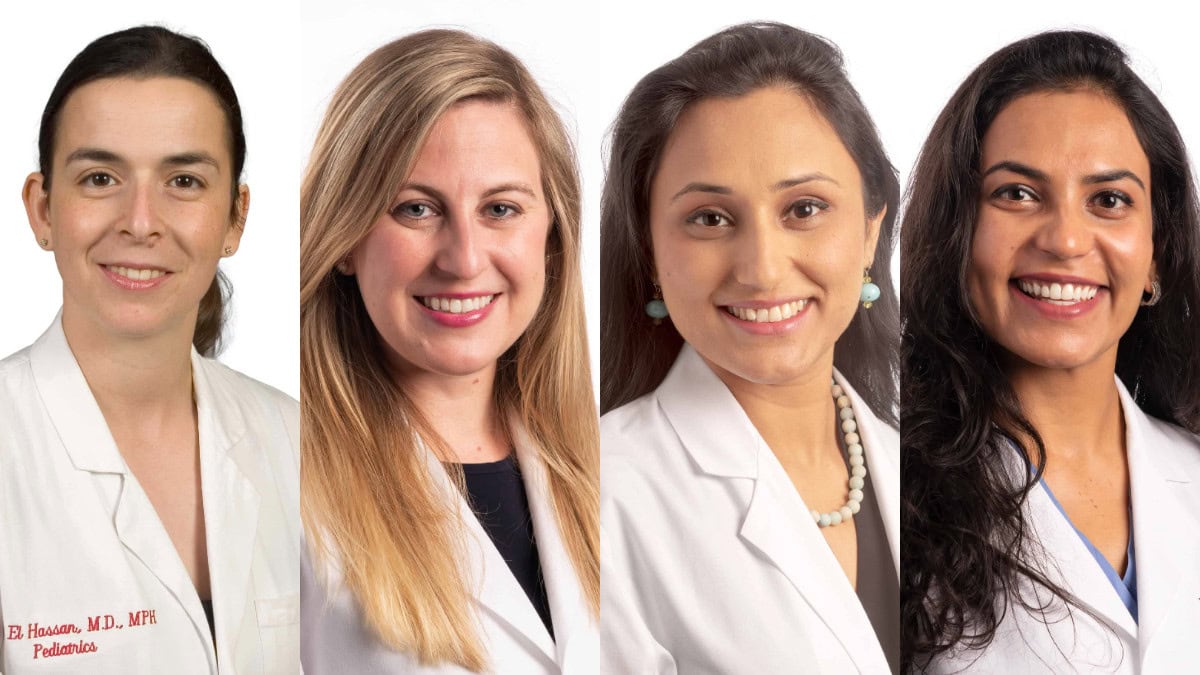
Nahed O. ElHassan, M.D., Ph.D., MPH-CI; Jennifer Rumpel, M.D., Ph.D.; Megha Sharma, M.D., Ph.D.; and Ankita Shukla, M.D., Ph.D., each pursued their advanced doctoral training while continuing their work in neonatology at Arkansas Children’s Hospital and UAMS.
The dual-degree accomplishment represents years of dedication to both patient care and research, said Ashley Ross, M.D., professor of pediatrics and section chief of neonatology.
“Completing a doctoral degree while maintaining a busy clinical practice, taking in-house calls, and balancing family responsibilities is an extraordinary accomplishment that reflects years of discipline and perseverance,” Ross said. “They have invested in developing the skills to become outstanding physician-scientists who will strengthen both our research mission and the care we provide to our patients.”
ElHassan earned her Ph.D. in Pharmaceutical Evaluation and Policy, while Rumpel, Sharma, and Shukla earned theirs through UAMS Graduate School’s Clinical and Translational Sciences (CTS) program.
A chief goal of clinical and translational research is improving patient care, Ross said. Ph.D. training gives physicians the tools to identify important clinical problems, design rigorous studies, analyze data, and generate evidence that can change practice.
“Physician-scientists have the unique advantage of seeing unanswered questions at the bedside and then pursuing research that leads to better care for future patients,” Ross said.
Looking Beyond the Bedside
ElHassan, a professor of pediatrics in the Division of Neonatology, said her decision to pursue a Ph.D. grew from a desire to improve clinical care for infants but also to pursue questions to seek answers for better care and outcomes at the population level.
Her research focuses on maternal exposures during pregnancy and their effects on neonatal and long-term childhood outcomes. She is particularly interested in linking large healthcare, pharmacy, public health, and other population-level databases to study those questions and follow children beyond the neonatal period.
“These large, real-world data sources provide opportunities to study relatively uncommon outcomes, identify disparities in care, and generate evidence that can inform clinical practice, healthcare delivery, and health policy affecting mothers, infants, and children,” she said.
ElHassan said her doctoral training strengthened her skills in epidemiology, pharmacoepidemiology, study design, data analysis, and evaluating medication exposures and health outcomes using real-world data.
“This training has changed how I approach clinical questions by giving me the tools to critically evaluate evidence and, importantly, to generate new evidence when important questions remain unanswered,” she said. “It allows me to bring together the perspective of a neonatologist caring for individual infants with that of a researcher examining outcomes across large populations, and to translate those findings into opportunities to improve clinical care, healthcare delivery, and policy for mothers and children.”
A Dissertation With Impact
Rumpel already had clinical training through caring for patients, but she wanted the tools to answer the questions that her patients and their conditions raised.
As a neonatologist caring for infants whose kidneys are still developing, Rumpel became frustrated that the criteria used to diagnose kidney injury in newborns were borrowed from adults.
“Every time I looked at a creatinine value, I wondered whether it actually meant what we assumed it did,” she said. “I started my research career with a K12 Mentored Research Career Development Scholar Awards Program from TRI, and it quickly became clear that if I wanted to build large datasets and predictive models that could change practice, I needed formal training in biostatistics, informatics, and data science. This Ph.D. gave me that foundation while I continued caring for patients.”
Rumpel’s research focuses on acute kidney injury in newborns — how it is detected, defined, and predicted in infants at highest risk. Her interest grew from caring for infants with severe brain and multi-organ injury from oxygen deprivation at birth, many of whom experienced severe kidney injury that put them at risk for death and chronic kidney disease. That experience led to her first study on urinary biomarkers in patients with neonatal encephalopathy and eventually building ADVANCE, a database of more than 26,000 infants from 10 children’s hospitals.
“My dissertation leveraged ADVANCE to show that a ‘normal’ creatinine depends entirely on an infant’s gestational age and day of life — the same value can be reassuring in one baby and alarming in another — and turned our findings into NeoKidneyCurve and NeoKidneyRisk, interactive online tools for clinicians,” she said.
Bridging Research and Practice
For Sharma, an associate professor of pediatrics in the Division of Neonatology, the path to her Ph.D. included experiences in laboratory-based research, clinical research, and implementation science.
Sharma wanted to forge her own research career by learning how to ask her own questions, design and conduct hypothesis-driven clinical research, and work directly with patients.
“I also recognized a gap in my own training,” she said. “I had several important clinical questions that I felt needed to be investigated, but I did not yet know how to study them rigorously or how to obtain the funding needed to pursue them. I realized that I needed a structured way to develop those skills and, ultimately, to help bridge the gap from science to research and from research to practice.”
Her Ph.D. has made her more thoughtful in approaching clinical problems and better equipped to develop an analytical and systematic approach to questions that arise at the bedside, said Sharma, whose research centers on improving outcomes for newborns with hypoxic lung disease.
“My Ph.D. has reinforced for me that some of the most impactful research questions come from identifying a true clinical need,” she said. “Being both a physician and an investigator allows me to see those needs firsthand and gives me the tools to try to address them. That has made me a better clinician, but also a more curious one.”
Turning Clinical Questions Into Research
Shukla, an associate professor of pediatrics in the Division of Neonatal-Perinatal Medicine, earned her Ph.D. in clinical and translational sciences in 2025. One of the reasons she pursued doctoral training was to strengthen her understanding of how rigorous clinical research is designed, conducted, and translated into meaningful improvements in patient care.
“As a physician, I was already able to identify important clinical questions, but I wanted the methodological and scientific training to investigate those questions systematically and ultimately develop evidence-based solutions,” Shukla said.
Her research focuses on improving outcomes for high-risk infants, particularly through understanding early brain development and identifying interventions that can improve long-term neurodevelopmental outcomes.
Her experience caring for critically ill newborns has reinforced the importance of looking beyond survival to consider how children develop and thrive over their lifetimes.
“The unanswered questions I encounter in clinical practice continue to shape and inspire my research,” she said.
Her Ph.D. has also changed how she approaches clinical problems by teaching her to thoroughly evaluate evidence, recognize knowledge gaps, and develop rigorous approaches to answering bedside questions.
“It allows me to bridge the roles of physician and scientist — using experiences with individual patients to generate research questions and then translating what we learn back into better care for future patients,” she said.
Educating the Next Generation of Physician-Scientists
Ross said the accomplishments of the four physicians also reflect the culture of the Section of Neonatology.
Faculty members supported one another by sharing clinical responsibilities, adjusting schedules when needed, and recognizing the importance of protected time for research and coursework. Mentors within the section, particularly Sherry Courtney, M.D., and Whit Hall, M.D., also provided guidance throughout the physicians’ training.
“We believe developing physician-scientists is essential to advancing neonatal care,” Ross said. “These graduates are an excellent example of what can be achieved when talented faculty are given the opportunity and support to pursue that goal.”