College of Public Health Alum Strives to Beautify Nashville
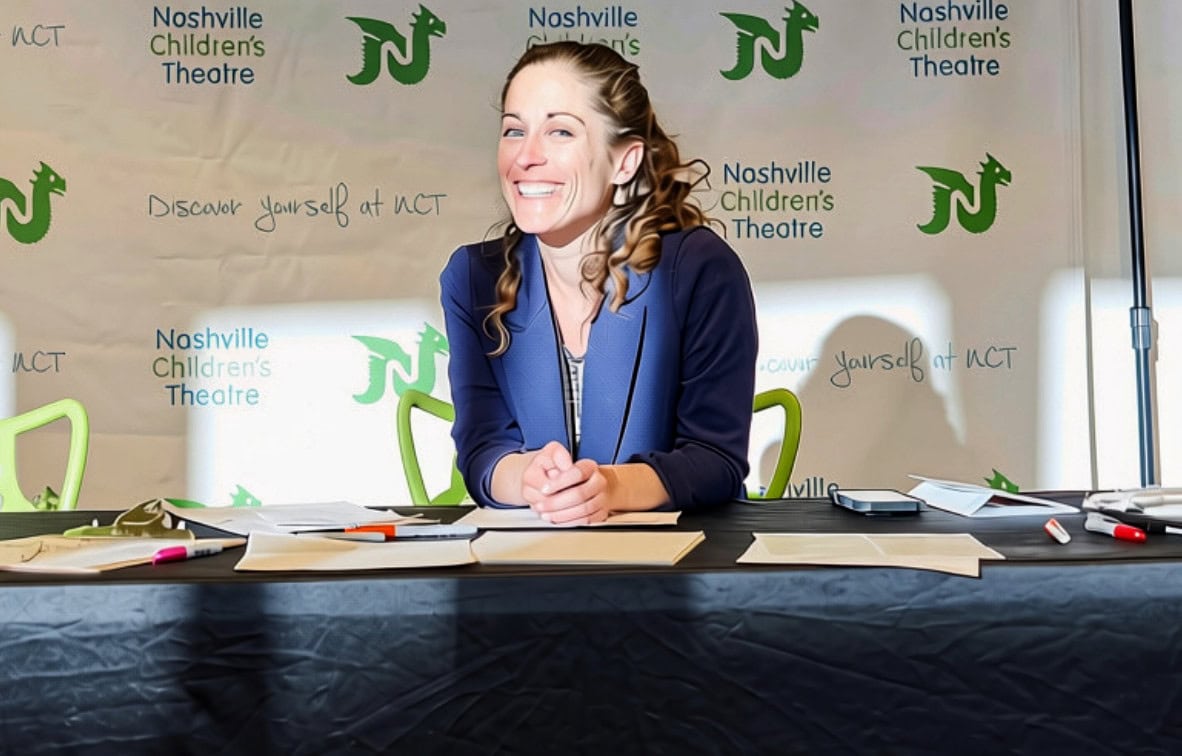
| Ashley Bachelder, MPH, MPS, enjoys her executive director duties for the Metro Nashville Arts Commission.
In that role, Bachelder oversees the work of the commission, which administers the city’s public art program and annual artist and organizational grantmaking programs.
“We see arts as a method for promoting cohesion in Nashville,” she said. “As part of the Nashville city government, our mission is to drive a vibrant and equitable community through the arts.
“Arts have been among the driving factors in Nashville’s exploding in population and becoming a destination city. The arts are important to telling the history and culture of Nashville.”
Bachelder — an alumna of the University of Arkansas for Medical Sciences (UAMS) Fay W. Boozman College of Public Health — said her work represents a way for community members to see public funds being used for public good.
“We use the arts to promote civic engagement,” she said. “I like the tangible impact of our work through the programming we support and the physical art we create throughout the city.
“Bringing resources into Nashville communities for art programming, that’s public health.”
Bachelder’s path to Nashville began in Athol, Massachusetts, a town of nearly 10,000 people 70 miles northwest of Boston. Bachelder is from a household comprised of her mom, dad and one sibling. Her parents both worked blue-collar, manual labor jobs.
She appreciated the small-town life and how the activities, especially for the youth, typically revolved around the local school. Though she has mostly fond memories of her childhood, Bachelder recalls being indirectly introduced to public health as she watched family members deal with hardships.
“Growing up, I remember access to healthcare being a significant situation,” she said. “As a teen, I can recall my grandfather passing away due to a lung disease that was linked to his occupation. He worked in a factory for many years and was around many occupational hazards. My mom working in retail, didn’t have quality health insurance, and there were occupational hazards at her job as well.”
The difficulties motivated Bachelder to work hard, especially academically. In 2005, she graduated from high school near the top of her class.
“I always planned to leave my hometown,” she said. “There just weren’t many opportunities. I wanted a different life. I saw college as a pathway for that.”
She chose to attend Southern New Hampshire University and major in psychology. Bachelder graduated from the school, located in Manchester, New Hampshire, in spring 2009.
After obtaining the bachelor’s degree, Bachelder relocated to Louisville, Kentucky, where she served a year in the AmeriCorps/VISTA program.
“I moved to Kentucky after having never lived in the South before,” she said. “I worked in different community programs that helped immigrants, refugees from all over the world.”
Bachelder said, to this day, her AmeriCorps term impacts how she views society and serves in the community. After a year out of school, Bachelder enrolled in the University of Arkansas Clinton School of Public Service. During her first semester at the school, she met other students who were in a concurrent master’s degree program with the College of Public Health.
“When learning about the college, it felt like something I wanted to be a part of,” she said.
She’d applied for the program. In 2010 she started the dual-degree collaboration. Bachelder embraced the Health Behavior and Health Education courses that focused on social determinants of health.
“At the Clinton School, we focused on program planning, program evaluation, public policy,” she said. “At UAMS the focus was community health. Through that education I became drawn to community-based public health. I enjoyed learning about action research, community-based participatory research, and how community partnerships make a big difference.”
“All of the terrible things happening in the world, I’m convinced it does not have to be this way,” Bachelder said. “I believe in the power of people working together to change things.”
The dual-degree education helped Bachelder find the career path she wanted to take. She remains grateful for the MPH program, the opportunities it presented, and the mentorship she received from public health professionals like Kate Stewart, M.D., MPH., and Creshelle Nash, M.D., MPH. In fact, during her final semester in the program, Bachelder was a research assistant for the UAMS Arkansas Center for Research Health and Society.
“I thought of public health from a narrow perspective, when I first started in the program,” Bachelder said. “But through the classes and program projects, I received the chance to see how public health is broad.
“Learning about the systems in play that shape our society. Learning about how things function in a different environment than where I grew up, was eye-opening.”
She’d eventually earn the dual-master’s degree in December 2012.
Bachelder would remain on staff with the college for a few more years working on research projects linked to community partnerships. In the process, she practiced the community research techniques she learned while in the MPH program.
“I got to continue the work that I started as a student,” she stated. “I got to learn a lot about evaluation of research grants, evaluating community programs, I got to work on community health worker models. I got to work on a lot of different exciting projects that were important to my professional development.”
In 2017, Bachelder moved to Nashville to work for Vanderbilt University Medical Center.
Since then, she’s deepened her commitment to community-based work as she has taken on different roles and become involved in various community efforts across Nashville. Her admiration for the community, Nashville’s diverse cultures, and residents is why Bachelder is passionate about helping to uplift Nashville via her role for the city’s art commission.
“Civic engagement has always been central to my career,” she said.
“Public health is broad, and the arts are important to human connection and human flourishing, especially during times of challenge and in a world of such great inequalities,” Bachelder stated. “Those are things that serve as protective factors for public health.”