UAMS Community Health Workers Use Gardening to Help Address Food Insecurities
| Sandra Cooper and Wonda Miller are using their careers to make a positive impact in their home communities.
Both women are community health workers for the University of Arkansas for Medical Sciences (UAMS) Fay W. Boozman College of Public Health’s Department of Health Behavior and Health Education. Cooper lives in Lee County while Miller resides in Phillips County.
A community health worker is a resident of a town or city who connects their fellow community members to social and health-related services.
“I want everyone to live as healthy as they can so they can be the best version of themselves,” Cooper said. “We’re in an area where we have high numbers of people who smoke and who deal with chronic diseases.”
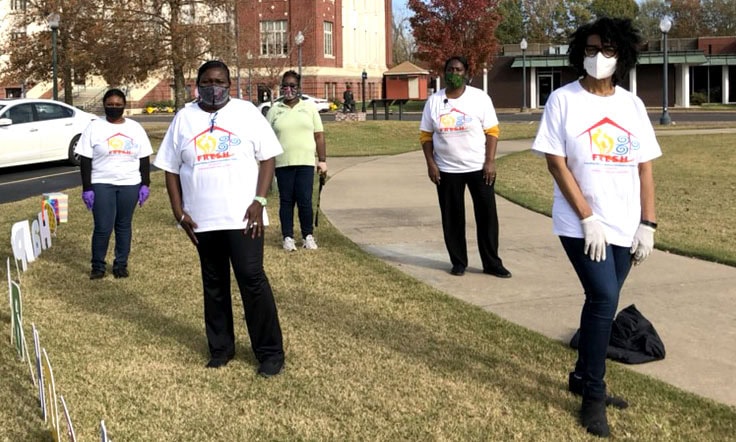
While conducting Families Rising to Enforce Smokefree Homes (FRESH) study as part of the Arkansas Center for Health Disparities, a disturbing trend was discovered. While recruiting residents of Lee and Phillips counties during the COVID-19 pandemic, the duo discovered that that many families did not have food.
“People were struggling to provide regular meals for their family,” Cooper said. “We had to address that issue in order to get the attention we wanted for our initial project.”
Miller agreed. “Some of these individuals don’t have ways to get healthy foods,” she said. “If they get fresh produce, they’ll cook it and enjoy it. Fresh produce that’s free is important. If they must pay for it, they may not get it.”
The mission to help people quit smoking and have food options became personal.
“We live in a region with limited resources,” Cooper said. “I grew up with these families. I know them, personally. Also, I’ve been on the other side as a single parent of three. There were times when I’ve asked for help. Maybe not with food to feed my family but with other resources, so this mission is personal.”
The number of people in need of food was impossible to ignore.
“Too often when I would visit with my participants about smoking, I’d learn they needed food in their home,” Miller said. “I then used my connections with my community partners to help them get food. They were always willing to work with us.
“Addressing hunger and food insecurity in the Delta is impactful.”
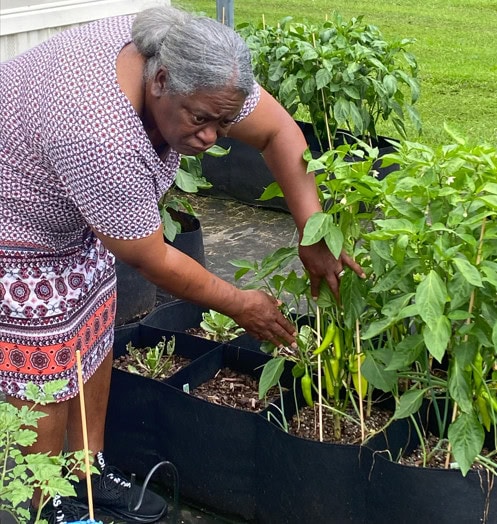
Wonda Miller, UAMS College of Public Health community health worker, checks the vegetables growing in a community garden located in Phillips County, Arkansas.
The constant request for food prompted Pebbles Fagan, Ph.D., MPH, professor in the College of Public Health, to meet with the workers to create a practical solution during the pandemic. The FRESH team came up with two ways to maintain the study while also addressing food insecurity.
First, they collaborated with the Arkansas Foodbank, local ministries, and nonprofits to increase the number of food pantries and food giveaways in the area.
“It takes partnerships to make things like a food giveaway a possibility,” said Fagan. “I remember the first time we gave food away, and there were over 200 cars lined up. That was humbling.”
Secondly, Fagan wrote a grant in 2021 to conduct a second study, FRESH Delivers, which is part of the National Institute on Minority Health and Health Disparities-funded Center for Research, Health and Society. This study at UAMS helps residents in rural Arkansas counties who smoke to quit using tobacco by addressing food insecurity. Participants are 21-75 years old. Among the chief goals is to help eliminate tobacco-caused cancer health disparities.
“Tobacco use is a big problem in Arkansas,” Fagan said. “But if people don’t have enough food to eat, they are less likely to quit smoking. We must look at social circumstances that people deal with to help us understand why people smoke. Food insecurities are as high as 25% in some rural counties. In those same counties, there’s a high prevalence of smoking.”
Fagan has worked with Cooper and Miller for nearly decade on these studies. Fagan commended their commitment to serving the people of east Arkansas professionally, and during their own personal time.
“They’re down-home, caring individuals,” Fagan said. “That’s one of the things I value about them.”
“They are the eyes and ears of our research team. They’re closest to the clients. They hear and see everything. When something happens and we need an explanation, they clearly explain what is happening.”
“We can’t ignore what’s happening with our citizens,” she added. “You can achieve your research mission. But the mission should always have an impact. We do our best to listen to what the community needs and respond to the shortcomings.”
Fagan also presented Cooper and Miller with the opportunity to go through training to become master gardeners so they could help grow beans, fruits and veggies to sustain regular food sources in each research county.
The ladies accepted the offer and went through the training.
In 2019, they met the requirements to earn master gardener status. They’re now both members of the Monroe/Phillips County Master Gardeners. In 2025, the committee got their 501(c)3 status organizing what is now “The Mustard Seed Community Garden,” where Cooper is a board member.
Miller already had a green thumb. But the course enhanced her knowledge of planting, managing plants, and harvesting food.
“I enjoyed the training,” Miller said. “I learned a lot of important methods for gardening and planning for gardening through doing the master gardener training.”
Meanwhile, Cooper was apprehensive about becoming a master gardener.
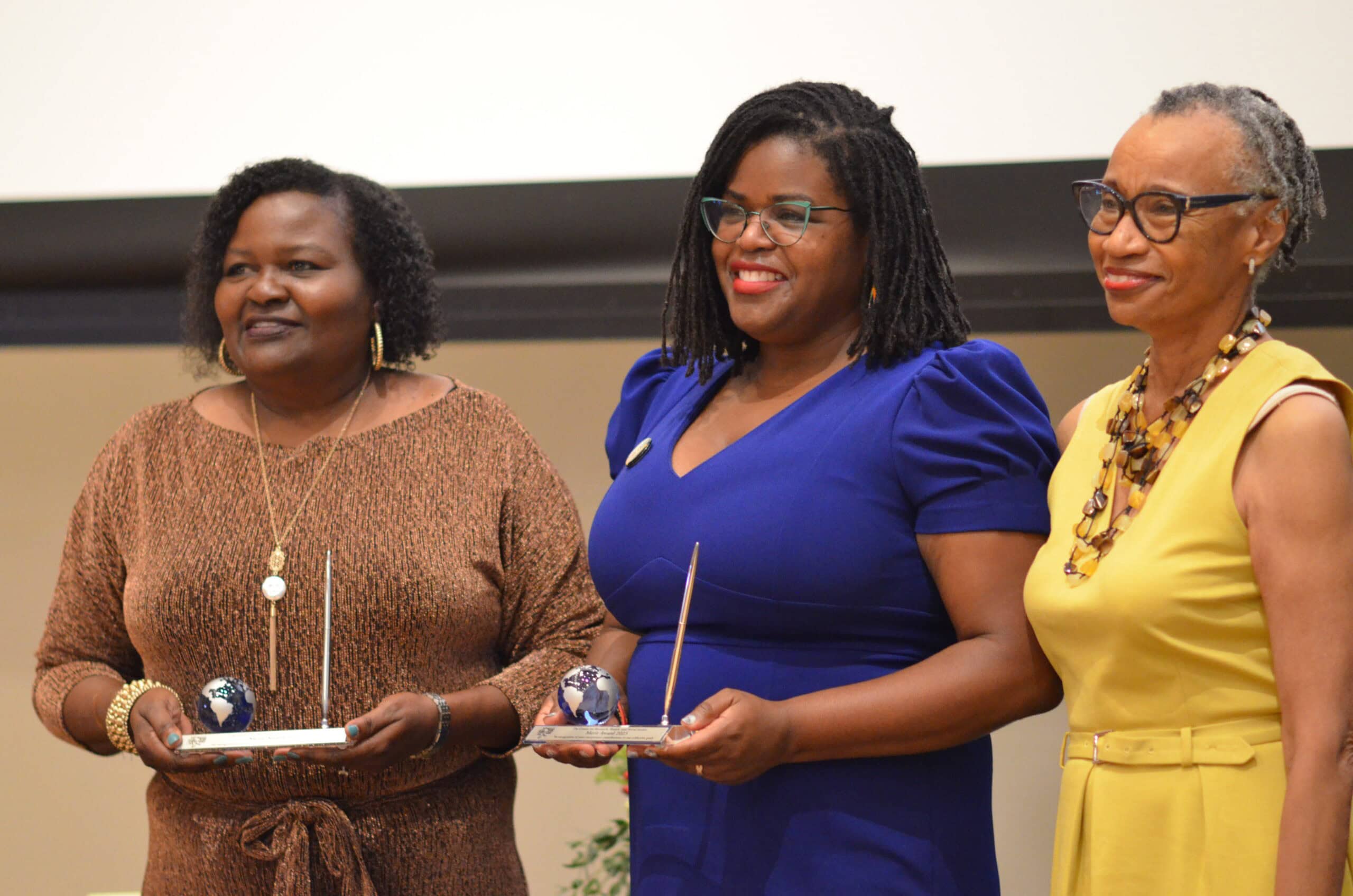
Sandra Cooper (left) poses for a photo after receiving special recognition during a UAMS Health Behavior and Health Education awards ceremony.
“I’m not an outdoors person,” she said with a heavy laugh. “I was nervous about playing in the dirt. But once I got into it, gardening really grew on me. Now I love it.
“I love reaping the harvest of a garden. I receive an emotional high when a fruit or vegetable blossoms and is ready for harvest.”
Once Miller and Cooper earned the certification, they opted to not only tend the gardens during traditional work hours — they took things to another level. They both volunteered their own time to work the gardens and help townspeople start personal gardens.
Cooper is now affiliated with numerous community gardens through partnerships with different churches and nonprofits.
“The people of our area were open to training on how to garden,” she said. “We don’t have access to a good amount of fruit and vegetable options.”
Miller said the trust they have built in the community factored heavily in residents being willing to garden and participate in the FRESH Delivers study.
“Once people realize they can trust you, they’ll tell you what’s really a burden in their life,” she said. “As community health workers, we pay attention and have a listening ear. We listen to the people. We don’t try to tell them what they should do. Often, we see their needs and try to fix the problem.
“We show our townspeople that they’re not alone. With us, they have a friend, a fellow member of the community, who will advocate for them.”
The willingness of Cooper and Miller to go beyond the call of duty has been vital to the success of FRESH Delivers and the garden projects.
“They’re the most passionate community health workers I’ve ever seen,” Fagan said. “They really care, a lot. I hope to forever have them on my research team. They take pride in their community and in helping their community.”