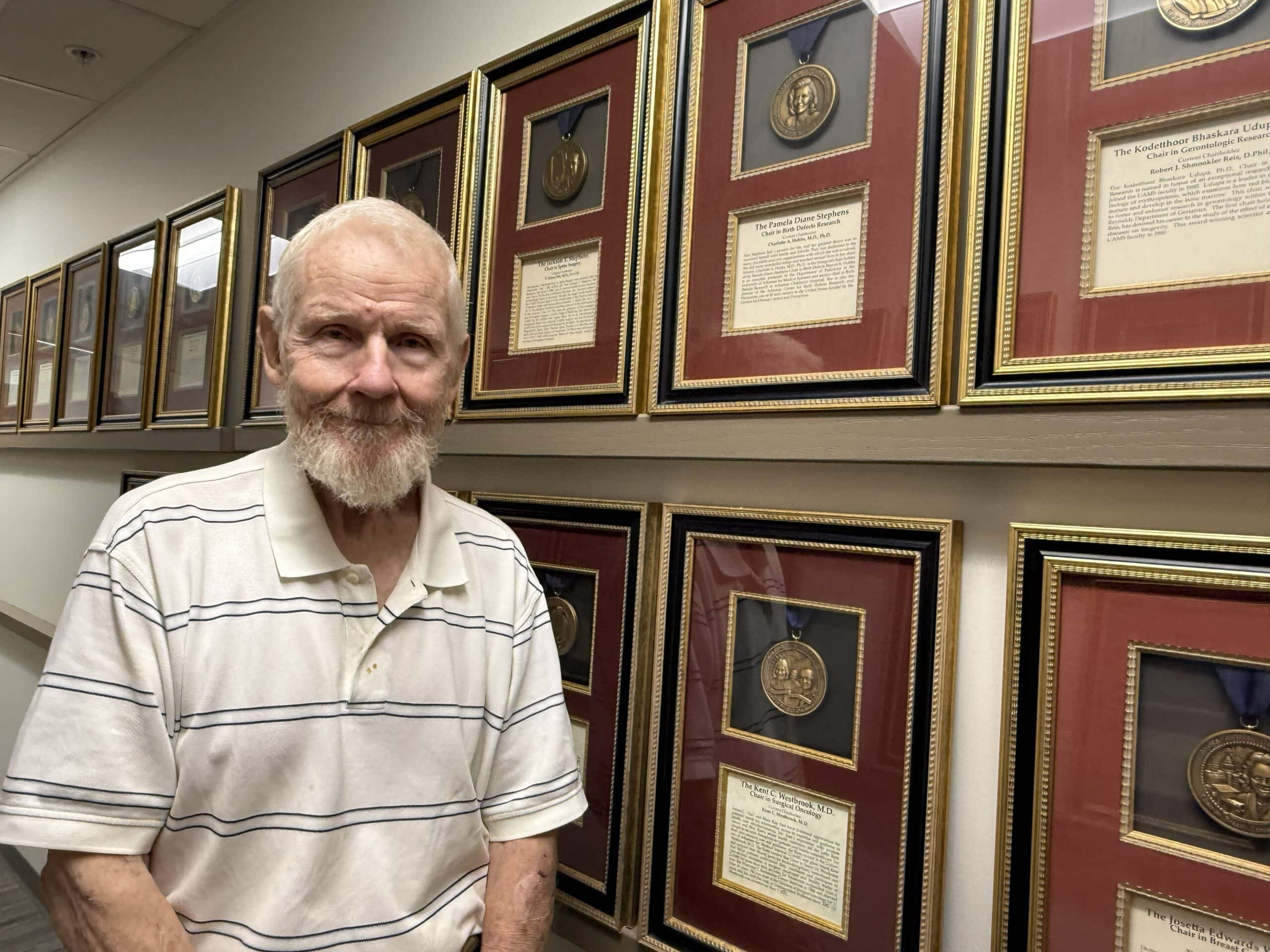
Former UAMS Employee Ron Tribell Bequeaths His Body to UAMS
| Oct. 9, 2026 | During his 34 years working at the University of Arkansas for Medical Sciences (UAMS), artist Ron Tribell’s work popped up in a lot of places: on the covers of American Family Physician, Contemporary Surgery and the Journal of Neurosurgery, in medical textbooks, on Christmas ornaments he designed for fundraisers, and on gold medallions he designed for endowed chairs and professorships — to name just a few.
Now, 26 years after retiring from his job in Media Services, where he was eventually assigned to work exclusively with the UAMS Department of Neurosurgery, Tribell has formally arranged to donate his body to UAMS.
At 84, Tribell isn’t planning on leaving his earthly life just yet. He feels fine. But in August, he and one of his three sons, attorney J.P. Tribell, visited UAMS to officially bequeath his body to the Anatomical Gift Program, the only whole-body donation program in the Central Arkansas area, upon his death.
Celia McCaslin, program manager in the Division of Clinical Anatomy in the Department of Neuroscience, which administers the program, said 80 to 100 bodies are donated each year to the program, and UAMS uses about that same number for educational purposes, primarily by medical students and for medical research.
Glenn Pait, M.D., a neurosurgeon and director of the Jackson T. Stephens Spine & Neurosciences Institute, said Tribell’s commitment to continue educating neurosurgeons after his death will also live on through his detailed, anatomically correct medical illustrations. Pait said the department has held onto the elaborate, full-color drawings, and would like to have them professionally preserved and framed for display.
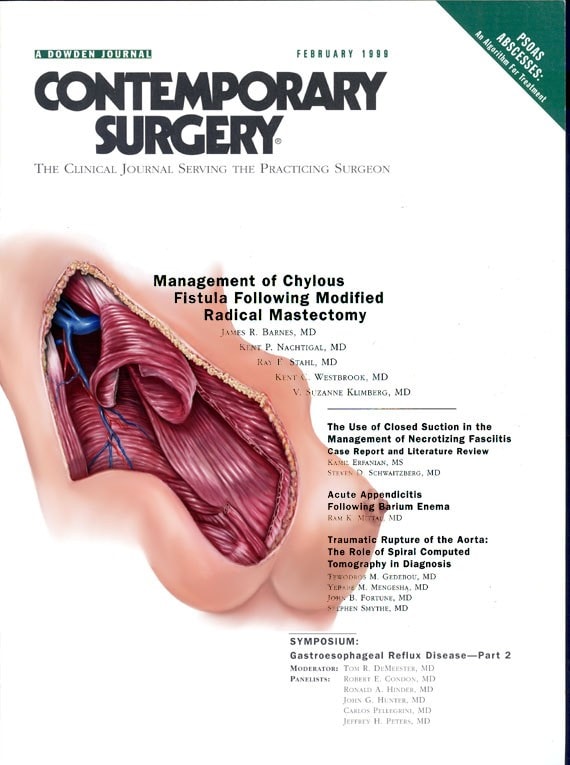
One of Tribell’s covers designed for Contemporary Surgery.
“They’re not only educational, but works of art,” Pait said. “He saw the beauty of what he was doing.”
“During his years at UAMS, Ron created lasting friendships with many members of our faculty and visiting professors,” McCaslin said. “The fact that they took the time to educate him on the human anatomy so that he could understand the functionality of each organ or appendage showed in his creations and art.”
In addition to Pait, among the UAMS neurosurgeons who regularly called upon Tribell to produce medical illustrations — sometimes to accompany their articles in medical journals and textbooks, and other times to educate students, residents and resident fellows — were the late M. Gazi Yaşargil, M.D., and Ossama Al-Mefty, M.D.
Yaşargil, a professor at UAMS for 10 years, was an internationally renowned neurosurgeon who was considered the father of microsurgery and was named “Man of the Century” by the Congress of Neurological Surgeons. Al-Mefty, also a renowned neurosurgeon, once headed the Department of Neurosurgery. He has called Tribell “a creative genius.”
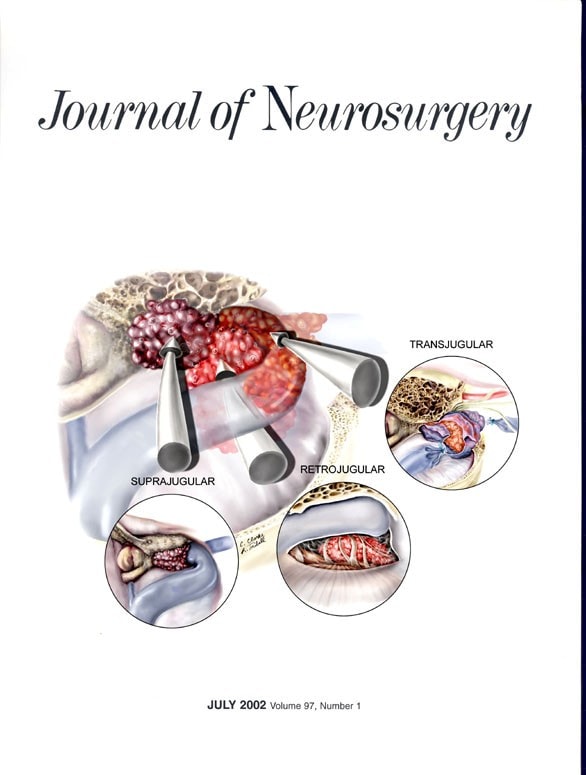
One of Tribell’s covers for the Journal of Neurosurgery.
Tribell, who lives on Greers Ferry Lake, still operates Axis Arts, a medical and legal illustration service that he founded in 1999, shortly before he retired in 2000. He said that when he joined UAMS in 1965 as an assistant to medical illustrator Jack Diner, he didn’t have a degree but was enrolled in the BFA program at the Arkansas Arts Center, now the Arkansas Museum of Fine Arts, until his enlistment in the National Guard forced him to drop out.
“I got a degree at the School of Hard Knocks,” he said.
That education included tutoring by Horace Marvin, M.D., who chaired the UAMS Department of Anatomy from 1958-1967, then served as associate dean for Academic Affairs before retiring in 1985. Tribell said he learned a lot from Marvin, but nevertheless, Al-Mefty and Yaşargil occasionally made him redo his anatomical drawings until they deemed them perfect. He said Al-Mefty even joked about how a good drawing required at least 100 revisions.
Tribell said he also learned about anatomy — and in the process developed great respect for people who donate their bodies — by accompanying neurosurgeons as they practiced their skills on cadavers in training laboratories at UAMS and in St. Louis.
“I was always very respectful in honoring the gifts they gave,” Tribell said of the donors. “I see that as a unique opportunity and honor to continue giving beyond one’s spiritual life. I even think there should be a little prayer said” after a cadaver is removed from a cooler for use in a classroom or research laboratory.
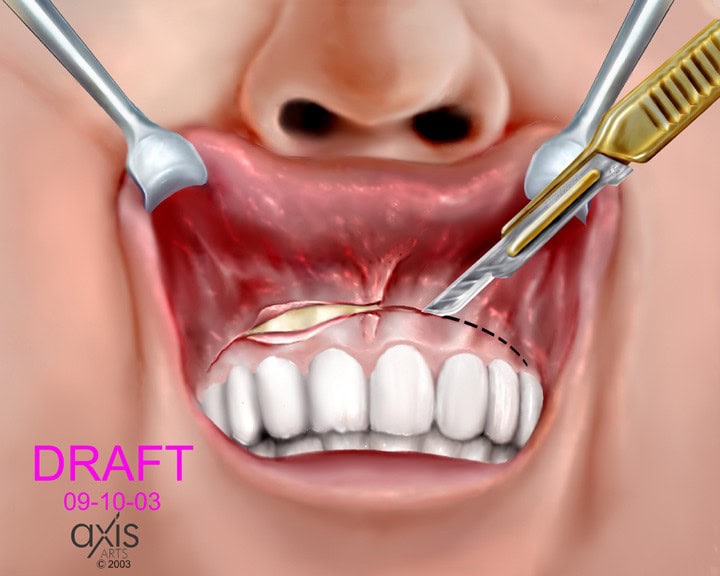
Another of Tribell’s medical illustrations.
He remembered seeing a poster of a casket with the words “Buried Treasure,” on the office wall of the late Patrick W. Tank, Ph.D., former president of the Anatomical Gift Program at UAMS, and thinking how profound it was.
“I said, ‘Why not? It is definitely painless and everybody wins with a gift to medical education and research,” he said, adding that he has often thought about how “wasteful” it is to just bury a body.
“When I worked with neurosurgery, it was a constant on my mind,” Tribell said. “I have really prayed about this, and I feel so good about doing this.”
“Donors become the first patients our medical students have,” McCaslin said, “and the relationship the students have with their donors is one of respect and gratitude. I have attended many memorial ceremonies held by the M1 classes over the years that honor the donors. The donors who so selflessly give their bodies to medical education are the greatest teachers our students will ever have.”
Tribell said that when he first began working at UAMS, he produced black and white pen and ink illustrations. The “carbon dust” technique was used when varying tones were needed. It took time for computers to produce sharp images before Tribell switched to design by computer, which he said was a “tremendous” change.
The UAMS medical illustration office that Tribell took over after Diner’s departure was eventually combined with other offices, including medical photography, instructional television and printing, until it eventually became known as Media Services.
Tribell’s duties also evolved, stretching beyond medical illustrations to include designing materials for fundraising campaigns and commemorating special occasions. He designed and produced large medical exhibits, the biggest of which was the UAMS Centennial exhibit in the foyer of the ED II building to commemorate the institution’s 100 years of teaching, serving, and researching. The Arkansas Gazette said it “might well have been put together by one of Madison Avenue’s top-rated ad agencies.”
He remembers designing the gold-plated medallions that are presented during investiture ceremonies to acknowledge endowments of at least $1 million for chairs and professorships — the bronze versions of which are permanently displayed on the walls of the UAMS College of Medicine.
Tribell said he enjoyed meeting with donors families to gain insights allowing him to design personal additions to each medallion, such as a war planes to commemorate the life of a World War II bomber or a pair of high-heeled shoes to commemorate an endowed gift from an heir of Dillard’s department store.
He also designed Christmas ornaments to raise funds for children with special needs and oversaw the design of promotional campaigns. He is especially proud of using his creativity to design materials for a major capital campaign — Invest in Life — that raised more than $65 million for UAMS in five years.
When blood bank donations slowed to just a trickle, Tribell designed and produced a “Banking in Good Health” campaign that resulted in a steady stream of blood donors.
When I. Dodd Wilson, then-dean of the UAMS College of Medicine, asked Tribell to write an invitation to the roasting of Gilbert S. “Gil” Campbell, M.D., Ph.D., chair of the Department of Surgery, Tribell designed a Cream of Surgery Soup label that he affixed to donated cans and mailed to the invitees.
In a published tribute to Tribell upon his retirement, his employees described him as having a unique ability to “see an assignment through a client’s eyes” and said he was instrumental in helping them develop their own artistic and production skills.
McCaslin said UAMS is grateful to Tribell and others who arrange to donate their bodies to medical education. She cited a quote from Albert Schweitzer, a German philosopher and physician who died in 1965: “At times, our own light may dim, only to be reignited by a spark from another individual. Each of us has ample reason to reflect with profound gratitude upon those who have ignited the flame within us.”
For more information on making a gift to the UAMS Anatomical Gift Program, call McCaslin at 501-686-7019.