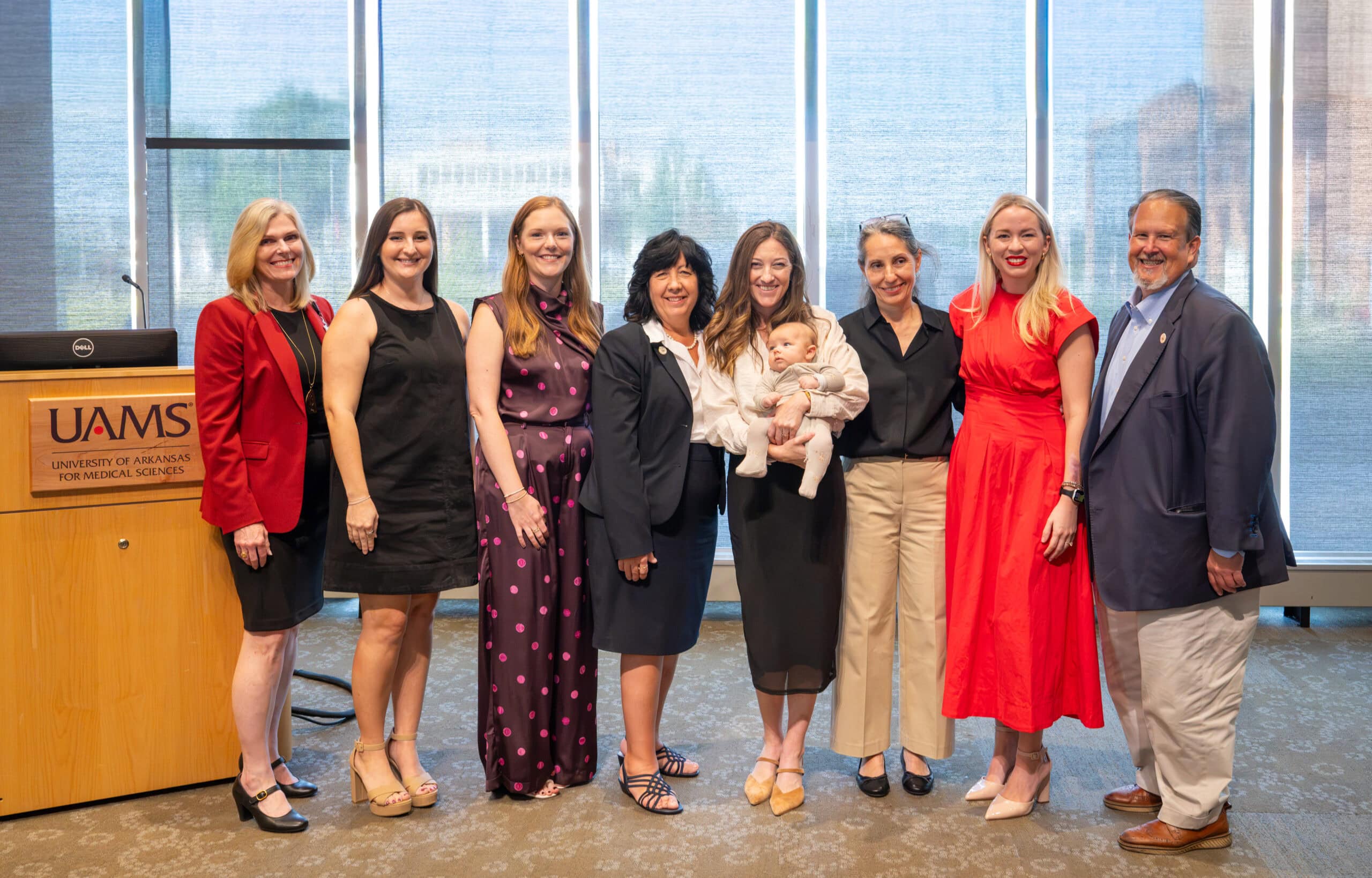
UAMS College of Nursing Welcomes Inaugural Cohort of State’s First Nurse-Midwifery Program
| The University of Arkansas for Medical Sciences (UAMS) College of Nursing this fall is pleased to welcome the inaugural cohort of its Nurse-Midwifery Program, the first of its kind in the state.
The master’s-level degree program will help aspiring nurse-midwives reach the workforce after 2½ years of graduate training.
Their first year consists of core courses that lay the foundation for their nurse-midwifery education. The students will then complete their training by working alongside certified nurse-midwives, as well as advanced practice registered nurses and physicians, at clinical placement sites in the state.
The program’s creation is part of a statewide effort to reduce Arkansas’ rates of maternal and infant mortality, which rank among the highest in the nation. A 2026 report from the March of Dimes found that 44% of Arkansas counties are maternity care deserts, with no obstetric clinicians to provide care for expecting mothers.
The Nurse-Midwifery Program admitted five students into its initial cohort, with many of them hailing from rural areas that face a shortage of options in women’s and maternal care. The hybrid program allows students to complete much of their coursework virtually while continuing to live in those areas.
Samantha Crouch, DNP, CNM, assistant professor in the UAMS College of Nursing and director of the Nurse-Midwifery Program, said nurse-midwives can play an important role in expanding access within rural communities.
“Graduates from this first cohort will have the ability to return home, establish their clinical practices, and mentor those who enroll in the program in the years to come,” she said. “Our students are very excited about the opportunity to serve as leaders in establishing nurse-midwifery as an accessible care option for women in Arkansas.”
Certified nurse-midwives (CNMs) are advanced practice clinicians who assist not only in labor and delivery but also provide primary and reproductive healthcare from adolescence through menopause and beyond. In Arkansas, nurse-midwives provide services at UAMS as well as in private practices, specialty clinics, federally qualified health centers, and home birth practices.
Sidney Foust, RN, a student in the program, began her career in labor and delivery at National Park Medical Center in Hot Springs, which announced plans earlier this year to close the unit. She said the loss of that unit — as well as others across the state — means that many women will have to travel farther for care, navigate additional barriers, and worry about what will happen if they encounter difficulties during pregnancy.
“Experiencing these ongoing challenges firsthand has strengthened my commitment to becoming a certified nurse-midwife,” she said.
Dominique DuBois, Ph.D., CNM, assistant director of the Nurse-Midwifery Program, noted that recent obstetric-unit closures have left the state with only 30 hospitals that provide labor-and-delivery services.
“Distance is not just an inconvenience,” she said. “Evidence shows that complications such as preterm birth increase the farther the distance between home and a delivery unit.”
In September, the College of Nursing received funding through the Arkansas Rural Health Transformation Program for an initiative to strengthen the rural nursing workforce, including nurse-midwifery. Funds will be used to mentor and assist rural nurses who want to apply for the Nurse-Midwifery Program, as well as to provide scholarships for nurse-midwifery students.
The Arkansas Legislature in recent years has moved to expand access to midwifery care, granting full-practice rights to nurse-midwives and allocating state funding for the UAMS Nurse-Midwifery Program.
State Rep. Mary Bentley, a former nurse who was the lead sponsor of Arkansas Act 607 of 2021, the legislation that granted full-practice authority, said nurse-midwives are an important component of the state’s efforts to improve health outcomes for mothers and infants.
“UAMS is our leading medical education provider and the best place for our future certified nurse-midwives to become a part of the maternal healthcare team in Arkansas,” she said.
Bentley said it is vital that mothers across the state have the ability to choose the form of care that best meets their families’ needs. At legislative conferences across the country, she has learned about how other states have benefited from providing another option through nurse-midwifery care, she said.
“The data shows that states with a higher number of births delivered by certified nurse-midwives have lower maternal mortality and infant mortality rates than Arkansas does,” Bentley said. “Most of those states have a lower rate of cesarean sections, as well.”
Crouch said research has also shown that midwifery care is associated with shorter hospital stays, higher patient satisfaction, and lower healthcare costs.
Miranda Hays, a student in the Nurse-Midwifery Program, said her own positive experience with nurse-midwives inspired her decision to become one.Now a mother of three, Hays decided after her first pregnancy to transition from traditional obstetric care to a team led by nurse-midwives.
She said the nurse-midwives worked closely with her during pregnancy to ensure that her birthing preferences were heard. And while they ultimately did not participate in her deliveries, they did give her the knowledge and the confidence to ensure that her wishes were carried out, she said.
“They taught me that midwifery isn’t about replacing obstetricians,” Hays said. “It’s about recognizing when a pregnancy requires a different type of care and working collaboratively with obstetricians and maternal-fetal medicine specialists to ensure the safest possible outcomes, just as they did in my case.”
Hays said she hopes to one day establish women’s healthcare offices in Arkansas communities that currently lack options for maternity care.
“I want to give other women what my midwives gave me: a voice, a choice, and the confidence to advocate for themselves,” she said.
UAMS is the state’s only health sciences university, with colleges of Medicine, Nursing, Pharmacy, Health Professions and Public Health; a graduate school; a hospital; a main campus in Little Rock; a Northwest Arkansas regional campus in Fayetteville; a statewide network of regional campuses; and seven institutes: the Winthrop P. Rockefeller Cancer Institute, Jackson T. Stephens Spine & Neurosciences Institute, Harvey & Bernice Jones Eye Institute, Psychiatric Research Institute, Donald W. Reynolds Institute on Aging, Translational Research Institute, and the Institute for Community Health Innovation. UAMS includes UAMS Health, a statewide health system that encompasses all of UAMS’ clinical enterprise. UAMS is the only adult Level 1 trauma center in the state. UAMS has 3,553 students and 1,030 medical residents and fellows, and two dental residents. It is the state’s largest public employer with about 12,000 employees, including 1,200 physicians who provide care to patients at UAMS, its regional campuses, Arkansas Children’s, the VA Medical Center and Baptist Health. Visit www.uams.edu or uamshealth.com. Find us on Facebook, X (formerly Twitter), YouTube or Instagram.###