View Larger Image
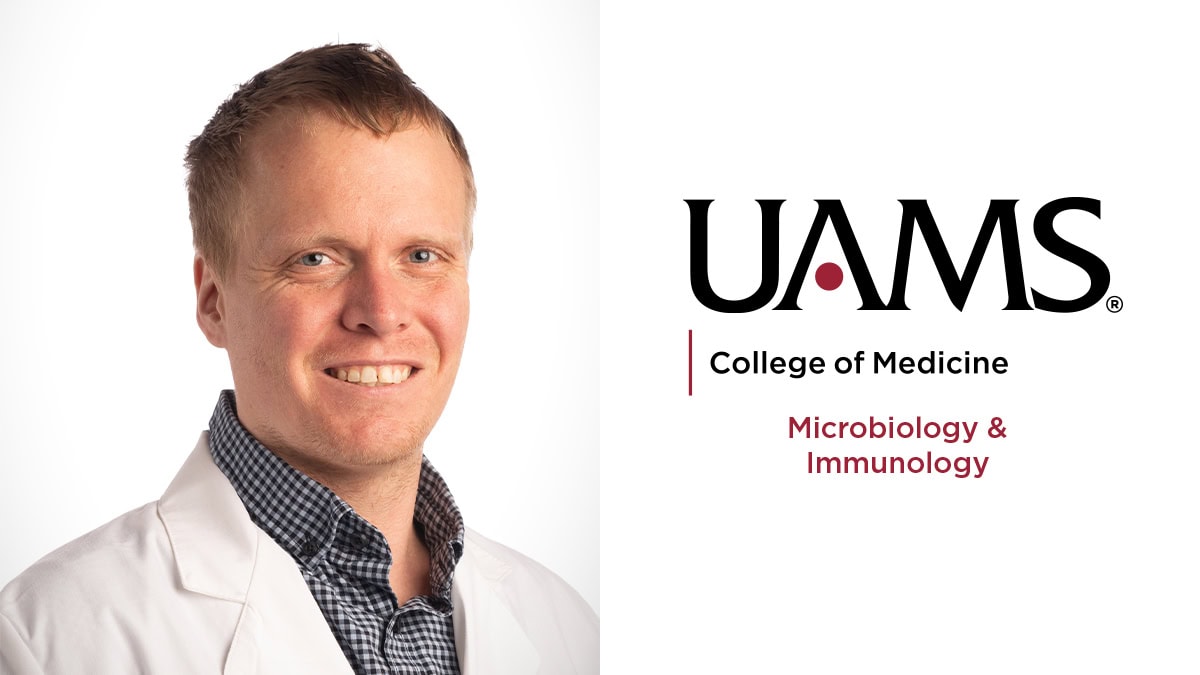
Clay Jackson-Litteken, Ph.D.
NIH Awards UAMS $2.2 Million to Study Ventilator-Assisted Pneumonia
| LITTLE ROCK — A researcher at the University of Arkansas for Medical Sciences (UAMS) has received a National Institutes of Health (NIH) Director’s New Innovator Award to support a study on ventilator-assisted pneumonia and ways to prevent it in a hospital setting.
“Ventilator-assisted pneumonia affects a significant proportion of people on ventilators,” said Clay Jackson-Litteken, Ph.D., an assistant professor in the Department of Microbiology and Immunology and the principal investigator for the five-year study. “Importantly, many of these infections are caused by antibiotic-resistant strains of bacteria, like Acinetobacter baumannii, that make cases difficult, and sometimes impossible, to treat with currently available therapies.”
New Innovator Awards support highly innovative research projects by new investigators in all areas of biomedical and behavioral research. They are given to researchers who propose bold and highly innovative projects that have the potential to produce a major impact on broad, important areas relevant to NIH’s mission.
“I am incredibly proud of what Clay has accomplished in his short time as an independent investigator,” said Jon S. Blevins, Ph.D., professor and chair of the department. “This award recognizes the creativity and impact of Clay’s research program and his innovative approach to understanding and combating hospital-acquired infections. I look forward to seeing the continued impact of his work on both scientific discovery and patient care.”
Jackson-Litteken said the study “will provide mechanisms for us to study bacterial interactions with the ventilator-associated pneumonia environment, helping us to develop new prevention and treatment strategies.”
When hospitals insert endotracheal tubing (ETT) to open a patient’s airway, the tubing scrapes the lining of the airway, causing inflammation and disrupting natural functions, such as the flow of mucous. The tubing can then be connected to a ventilator.
However, tubing creates an ideal breeding ground for infectious organisms, such as bacteria, to grow. Nearly half of all patients placed on ventilation develop an infection this way, which is called ventilator-assisted pneumonia (VAP).
“We do not yet understand all of the factors unique to ETT and ventilation that allow for these infections,” Jackson-Litteken said. “This issue is critical because VAP contributes significantly to patient mortality and often involves pathogens that are particularly difficult to treat with standard antibiotics.”
He and his team of researchers plan to develop accurate models of VAP caused by Acinetobacter baumannii, one of the pathogens that is resistant to standard treatments. Then, using cutting-edge microbiology techniques, they will observe key drivers of the pneumonia that develops. They plan to assess the ability of various tubing treatments to prevent pneumonia from developing.
“By revealing how pathogens such as A. baumannii interact with the ETT environment to drive serious infections, this research will improve our understanding of how ventilator-assisted pneumonia develops in patients,” Jackson-Litteken said. “This could inform treatments that decrease the incidence of ventilator-assisted pneumonia, thereby improving the health of patients who require ventilation.”
The project is called, “Harnessing innovative platforms to study and prevent Acinetobacter ventilator-associated pneumonia.”
The grant is for $2,228,534 and is supported by the National Institute of Allergy and Infectious Diseases of the National Institutes of Health under Award Number DP2A1200953. The content is solely the responsibility of the authors and doesn’t necessarily represent the official views of the National Institutes of Health.
UAMS is the state’s only health sciences university, with colleges of Medicine, Nursing, Pharmacy, Health Professions and Public Health; a graduate school; hospitals in Little Rock and Bryant; an orthopaedic hospital; a main campus in Little Rock; a Northwest Arkansas regional campus in Fayetteville; a statewide network of regional campuses; and seven institutes: the Winthrop P. Rockefeller Cancer Institute, Jackson T. Stephens Spine & Neurosciences Institute, Harvey & Bernice Jones Eye Institute, Psychiatric Research Institute, Donald W. Reynolds Institute on Aging, Translational Research Institute, and the Institute for Community Health Innovation. UAMS includes UAMS Health, a statewide health system that encompasses all of UAMS’ clinical enterprise, including affiliated hospitals in Pine Bluff, Helena-West Helena, Mena, and Warren. UAMS is the only adult Level 1 trauma center in the state. UAMS has 3,813 students and 1,030 medical residents and fellows, and two dental residents. It is the state’s largest public employer with about 12,000 employees, including 1,200 physicians who provide care to patients at UAMS, its regional campuses, Arkansas Children’s, the VA Medical Center and Baptist Health. Visit www.uams.edu or uamshealth.com. Find us on Facebook, X (formerly Twitter), YouTube or Instagram.###