OT Doctoral Graduate Builds a Movement, One Bench at a Time
| Becky DeClerk, OTD, OTR/L, a recent graduate of the UAMS/UA Doctor of Occupational Therapy program, is a believer in the adage that if you walk a mile in another person’s shoes, you gain a deeper understanding of what they are going through. So, when she decided to learn more about transportation issues for her capstone project, she rode buses. Then she built benches.
When DeClerk started her capstone project in the OT program, she wasn’t planning to end up building and hand-painting bus stop benches. She wasn’t planning to organize volunteers across four Northwest Arkansas cities either. But that’s exactly where her research project on accessible transportation led her. And today, 26 benches sit at bus stops across the region because of it.
Switching Gears
DeClerk spent the first two years of her doctoral program researching women’s health and urinary incontinence, and she was headed toward a capstone built around group therapy sessions in a hospital setting. Then, in her third year, a conversation with her clinical instructor at Encompass Health changed her direction entirely. A previous capstone student had studied transportation, and DeClerk, who admits she “had no interest in transportation” and no idea how it connected to occupational therapy, decided that was exactly the kind of challenge she wanted.
“I feel like if I wanted to, I could have gone out and done this project without really challenging myself,” DeClerk said of her original plan. Instead, she scrapped it and started from zero, building a new literature review around a subject she knew almost nothing about.
What she found surprised her. Transportation, she realized, touches nearly every occupational domain that matters to OT: work, socialization, leisure, and health management. Without a reliable way to get around, people can become isolated at home, a condition linked to anxiety, depression, and worse. There’s also a financial dimension that few people consider: owning a car can cost roughly $15,000 a year. That’s a substantial share of income for anyone living with a disability on a fixed income.
Learning to Ride
To understand the system she was studying, DeClerk didn’t just read about it. She lived it — biking and riding buses around Northwest Arkansas to get to meetings and go about everyday life, trying to understand what her options would be if she couldn’t drive.
What she noticed first was how hard the stops themselves were to find. The bus stops were often just small signs on the side of the road, with no shelter or seating to mark the spots. Waiting for the bus, she made a point of staying present and observing rather than reaching for her phone. Sitting in the dirt near the road, watching cars pass, she was surprised by what she felt.
“I know I’m very privileged in many ways,” she recalled thinking. “And I was like, why am I having this worthlessness feeling?” She realized it came from the setting itself — sitting on the ground, watching people look down at her. If a privileged, able-bodied graduate student felt that way, she reasoned, her neighbors who relied on public transit day in and day out, especially those who might be far less financially secure, were likely feeling it too.
From Idea to Instagram
DeClerk knew a project as large as building benches wouldn’t fit inside her capstone timeline. But the idea stuck, and after graduation she began connecting with others who cared about the issue. Many of them were from Fayetteville Strong, a local group of advocates for safer, more walkable, more bikeable streets. She calls herself “the herder of chickens” for the project: she didn’t build or paint every bench herself, but she organized the people who did.
The first round of benches came together as a woodworking workshop at DeClerk’s house, where her husband has a small woodworking setup. Participants paid $250 to learn basic woodworking skills and took home a finished bench at the end of the day. Each registration fee covered the materials for three benches, and almost every participant ended up donating their bench back to the project instead of keeping it. Her husband’s employer sponsored three more benches, and Ozark Regional Transit’s executive director funded two additional workshop spots. All told, the group built 27 benches that day; 26 went out to bus stops in Fayetteville, Springdale, Rogers, and Bentonville.
Reception from the cities varied. Rogers required a bit more paperwork but was, in DeClerk’s words, “extremely cooperative,” with a city worker even helping load and unload benches. Springdale and Fayetteville were especially welcoming. Fayetteville even went so far as to present DeClerk and Fayetteville Strong with an award for the project, and Mayor Molly Rawn has spoken publicly about the benches filling a gap while the city works on its own longer-term plan for permanent shelters and seating.
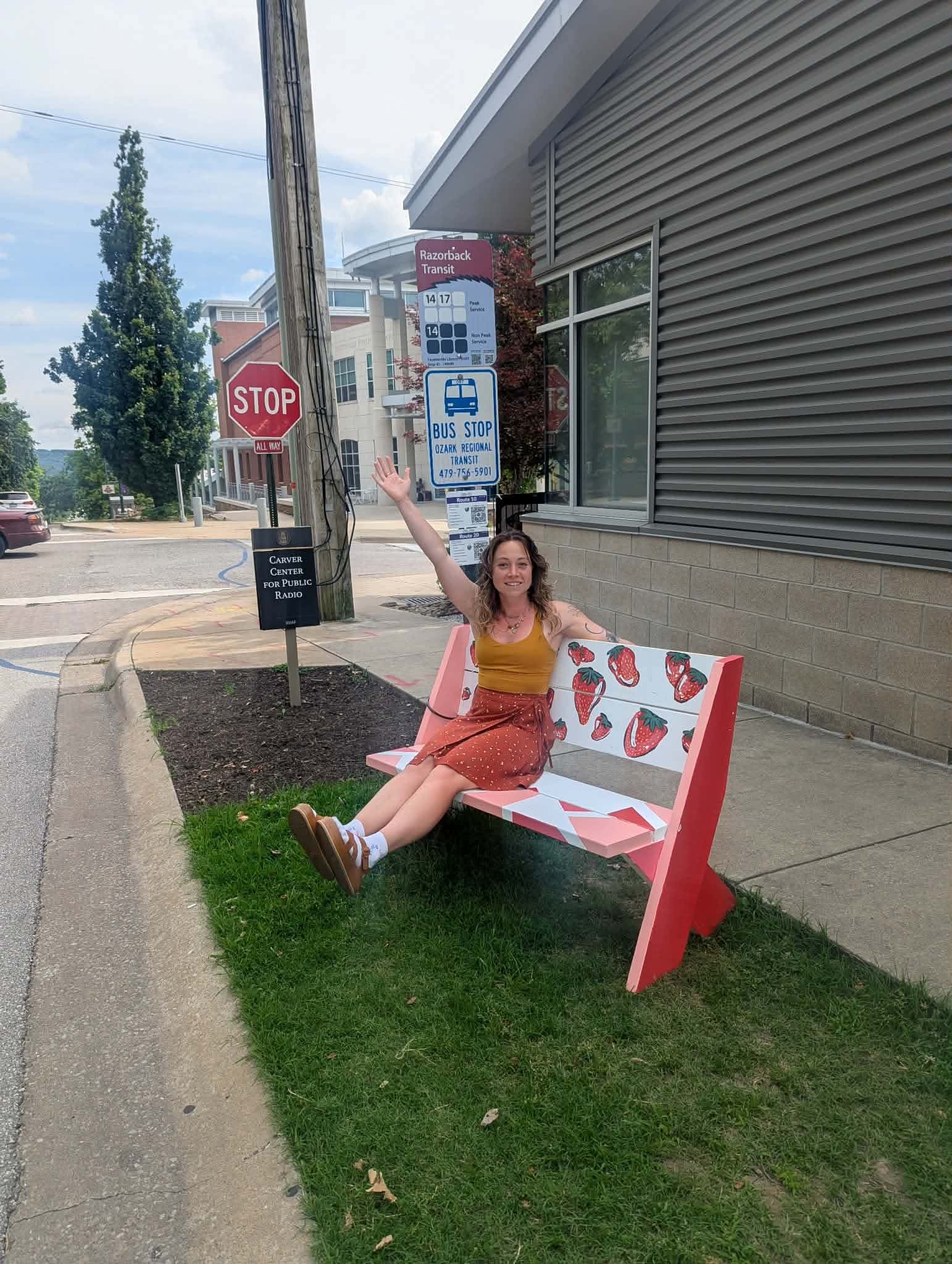
Each bench carries its own hand-painted design. One near KUAF in Fayetteville is covered in strawberries, a nod to the city’s annual festival. The final bench from this round is getting a different kind of treatment. Local artist Mike Abb, known for his role in integrating public art across the region’s biking trails, is wrapping it in vinyl featuring his signature design — a fitting tribute, DeClerk says, given how closely she believes biking and busing are linked in Northwest Arkansas’s culture.
“As an educator, nothing is more fulfilling than mentoring students as they bring their capstone projects to life,” said Kandy Salter, OTD, program director of the Doctor of Occupational Therapy program. “Becky’s project is a powerful example of community-centered occupational therapy and directly embodies our program’s mission to prepare future practitioners to be change agents, innovators, collaborators, advocates, stewards, and scholars. Her continued commitment to this initiative post-graduation is a testament to her dedication to making Northwest Arkansas more accessible for everyone. We are incredibly proud and inspired by the work she is doing.”
You can follow the project’s progress on Instagram at @nwabench.