UAMS Participating in Nationwide Study to Find Best Treatment for Life-Threatening Vascular Condition
| LITTLE ROCK — The University of Arkansas for Medical Sciences (UAMS) is one of 60 hospitals across the country participating in a clinical trial to determine the best treatment for type B aortic dissection — a life-threatening condition involving a tear in the wall of the aorta.
Funded by the National Heart, Lung, and Blood Institute, a part of the National Institutes of Health, the IMPROVE-AD (Improving Outcomes in Vascular DisEase-Aortic Dissection) study began in 2024 and is expected to last six or seven years, with enrollment continuing through mid-2028.
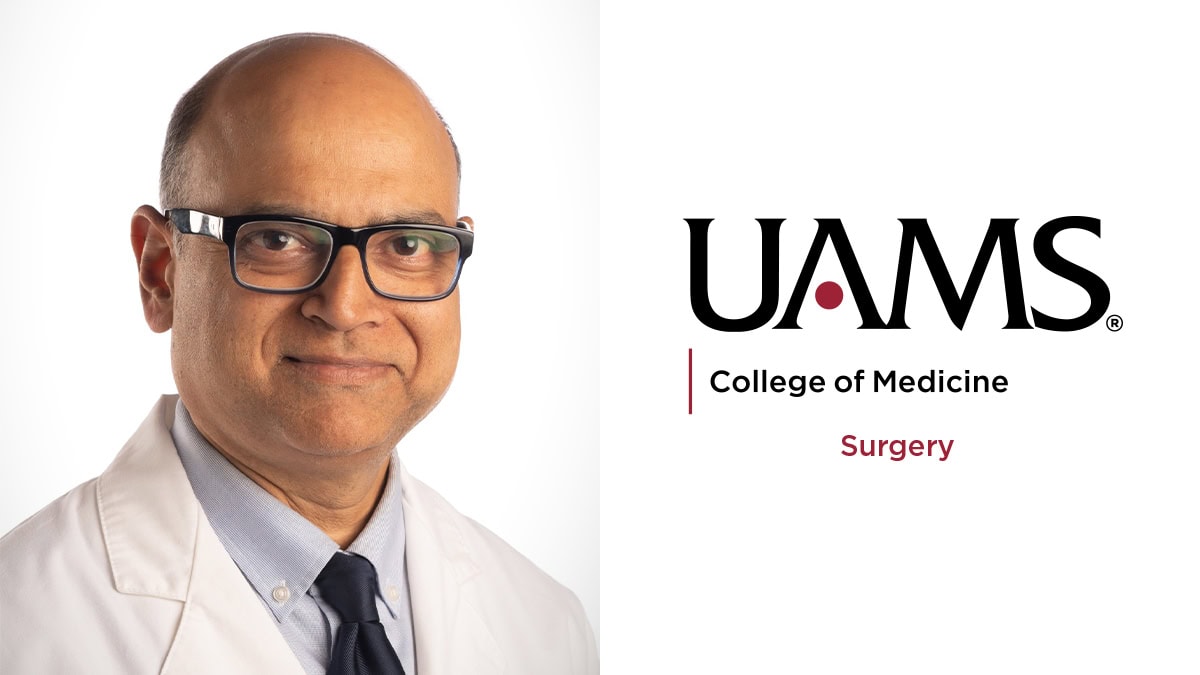
“We are excited to be part of this very important trial, which provides an opportunity for physicians to understand how to best treat this serious vascular health problem,” said Venkat Kalapatapu, M.D., the principal investigator for the UAMS arm of the study, which is based at Duke University in Durham, North Carolina.
Establishing UAMS as a study site was one of Kalapatapu’s priorities when he returned to UAMS in May as professor and chief of the Division of Vascular Surgery after 16 years at the University of Pennsylvania School of Medicine.
To qualify as a study site, an institution must be in an area where the disease is prevalent and have enough resources and staff to carry out the clinical trial.
The aorta is the body’s main artery, which carries blood from the heart to the rest of the body. When a tear occurs in the inner lining of the aorta, usually because of chronic high blood pressure, new blood flow channels are created in the middle layers, which begin to separate or “dissect.” This thwarts the normal flow of blood to a person’s internal organs.
Kalapatapu said patients often experience excruciating pain.
Type A aortic dissections are tears in the part of the aorta that is closest to the heart and the head, while type B aortic dissections start in the chest and extend to the lower part of the aorta, and into the abdomen. The type B dissections can be “uncomplicated,” meaning that the tear hasn’t significantly decreased blood flow to internal organs.
While complicated aortic dissections usually require urgent treatment, the uncomplicated ones — the focus of this study — are treated two ways: with medical management and light monitoring to control symptoms and prevent complications, or with medical management plus a minimally invasive procedure called a Thoracic Endovascular Aortic Repair (TEVAR)
TEVAR is performed while the patient is under general anesthesia and generally takes one to two hours. Through a small incision in the groin, the surgeon inserts a flexible catheter containing a collapsed fabric-covered metal tube (a stent) into a blood vessel. The surgeon then guides the catheter, using real-time imagery, to the tear in the aorta wall. Once in position, the stent expands, anchoring itself against the artery wall and creating a new channel to divert blood flow away from the weakened wall.
Researchers in the IMPROVE-AD study want to understand which treatment works best over a long period of time — about six years. They also hope to collect data on how the treatments affect women and diverse racial and ethnic groups, which are underrepresented in current data.
Kalapatapu said organizers hope to include about 1,100 participants nationwide. He said they will be randomly divided into two groups. Then, in consultation with their doctors, one group will be treated with TEVAR and medication, while the other will be treated with medication only — although patients in the medication-only group can receive a stent if it is medically indicated or they decide they want one.
Kalapatapu said most patients join the study after seeking treatment and learning they have had an aortic dissection. However, patients who have already started treatment at another hospital can switch to UAMS to participate in the study up to six weeks after experiencing the aortic dissection.
Anyone who is interested in participating in the study can call the clinic at 501-686-6176 and press #2.
UAMS is the state’s only health sciences university, with colleges of Medicine, Nursing, Pharmacy, Health Professions and Public Health; a graduate school; hospitals in Little Rock and Bryant; an orthopaedic hospital; a main campus in Little Rock; a Northwest Arkansas regional campus in Fayetteville; a statewide network of regional campuses; and seven institutes: the Winthrop P. Rockefeller Cancer Institute, Jackson T. Stephens Spine & Neurosciences Institute, Harvey & Bernice Jones Eye Institute, Psychiatric Research Institute, Donald W. Reynolds Institute on Aging, Translational Research Institute, and the Institute for Community Health Innovation. UAMS includes UAMS Health, a statewide health system that encompasses all of UAMS’ clinical enterprise, including affiliated hospitals in Pine Bluff, Helena-West Helena, Mena, and Warren. UAMS is the only adult Level 1 trauma center in the state. UAMS has 3,813 students and 1,030 medical residents and fellows, and two dental residents. It is the state’s largest public employer with about 12,000 employees, including 1,200 physicians who provide care to patients at UAMS, its regional campuses, Arkansas Children’s, the VA Medical Center and Baptist Health. Visit www.uams.edu or uamshealth.com. Find us on Facebook, X (formerly Twitter), YouTube or Instagram.###