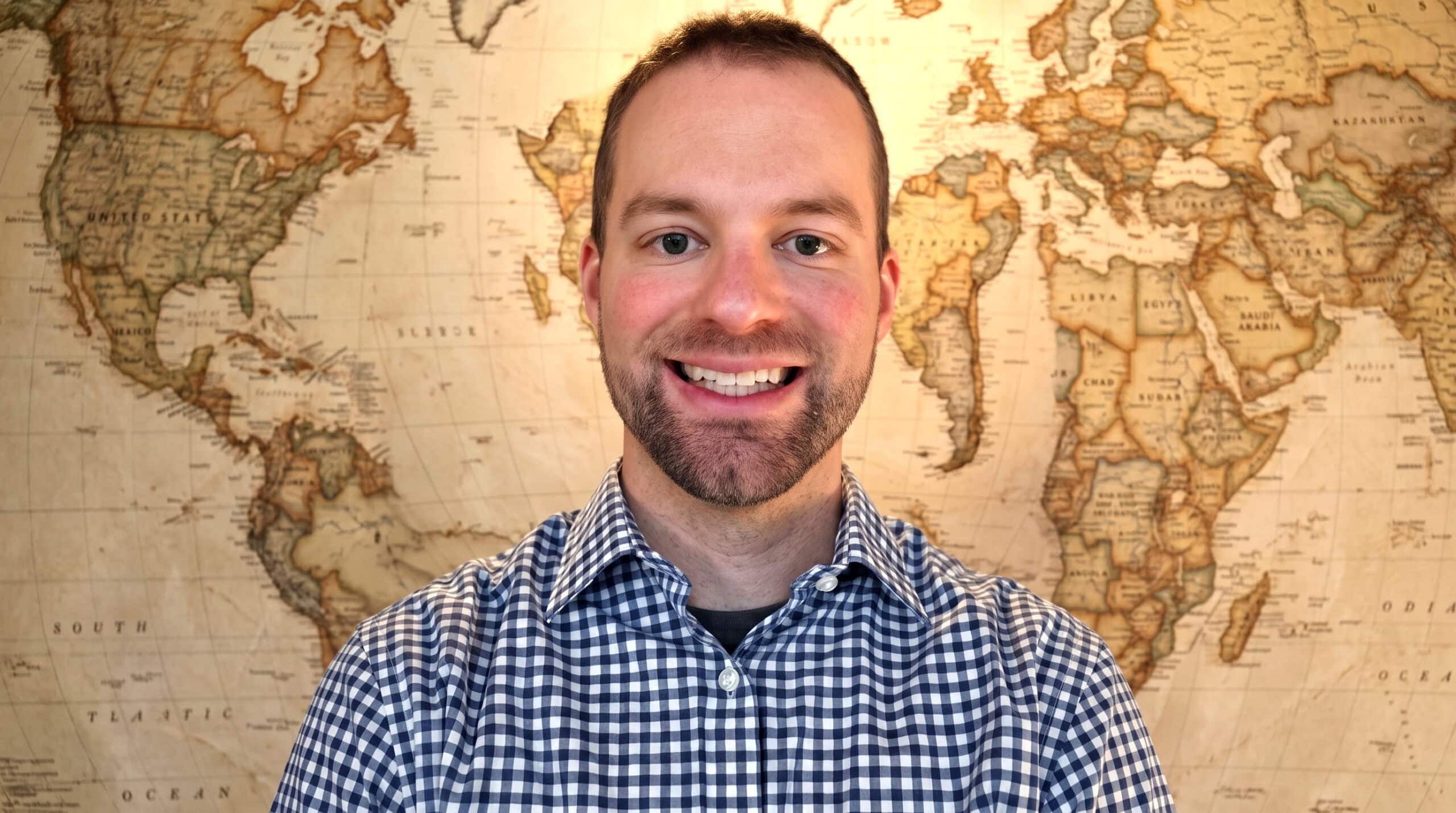
Bryan Mader, Dr.PH, Promotes Nutrition and Health Literacy in the Pacific Northwest
| Bryan Mader, Dr.PH, enjoys helping the residents of Washington state obtain pertinent health and nutrition information.
Mader, an assistant professor and public health nutrition specialist for the Washington State University Extension, specializes in making university research easily accessible for the general public.
The Arkansas native and alumnus of the University of Arkansas for Medical Sciences (UAMS) Fay W. Boozman College of Public Health believes that access to practical nutrition and health data is vital to improving communities.
“The decisions people make about food happen every single day,” Mader said. “Those decisions are shaped as much by access, information, and circumstance as by individual choice. Work that improves health literacy and closes gaps in nutrition access doesn’t just change individual behavior — it strengthens the health of entire communities, particularly in underserved and rural areas where those gaps are widest.”
Mader designs and evaluates nutrition and health literacy programs, develops curricula, and collaborates with organizations to lead community outreach projects.
“A central part of my role with WSU Extension is translating implementation science into practice — figuring out not just what works, but what works given the real geographic, financial and logistical constraints rural and underserved communities face,” Mader said. “That community-based, applied orientation is the heart of the land-grant extension model, and it’s a large part of why I find the work rewarding.”
Mader’s Arkansas-based education is the root of his success.
He earned a bachelor’s degree in psychology and anthropology from Arkansas Tech University in Russellville in May 2012.
By the time he graduated, Mader had an interest in public health, especially the various eating habits a person has.
“That curiosity quickly ran into a bigger, more practical question: why do entire communities struggle with diet-related disease at such different rates,” Mader said. “That question pulled me toward local food access and obesity prevention, and from there, toward public health as a field.
“That combination — the science of why we eat the way we do, and the systems-level work of changing what’s actually available to eat — is what made public health feel like the right career field.”
Aware of what he wanted to do professionally, Mader sought an elite public health education. The College of Public Health at UAMS provided what he was looking for.
“What drew me to the Boozman College of Public Health was the caliber and relevance of the work already happening there — particularly around obesity prevention and reduction,” he said. “Enrolling felt like an opportunity to train within an institution that was actively shaping the response to the problem I most wanted to address. That alignment between my interests and the college’s focus made the decision an easy one.”
Mader entered the school’s Master of Public Health program in 2012 and graduated in 2014. He then enrolled in the college’s Doctor of Public Health in Public Health Leadership program in 2015, completing that program in 2019.
Mader expressed gratitude for the mentorship he received from faculty members throughout his master and doctorate education. He also praised the opportunities he received to see public health in action — at the state health department and in the field.
“The experiential learning opportunities provided insight for me to explore the continuum of public health and public health practice, ultimately focusing on community-based work,” he said.
The doctoral program proved instrumental in teaching Mader what to inquire about when striving to examine the cause of a situation.
“The program pushed me to move past individual-level explanations for health outcomes and start asking systems-level questions instead: why do certain communities carry a heavier burden of diet-related disease, and what would it actually take to change that,” Mader said. “Between the coursework and the applied, practice-oriented nature of the Dr.PH, I left with both the analytical grounding and the practical skills to do the kind of work I do now.”
Mader mentioned three reasons why any person who has an interest in public health should attend the school.
“First, the applied orientation — the college doesn’t treat public health as just a purely academic exercise,” he said. “The work connects to real, active community and research initiatives. Second, the breadth of focus areas, which means students can pursue a genuine area of interest — rather than a generic public health track. Third, the sense of purpose that comes from training in a state working through significant public health challenges. For anyone serious about turning public health interest into public health impact, that combination is hard to beat.”
The Pacific Northwest is much different than his native Arkansas. But Mader has adjusted to the culture of Washington. More importantly, he enjoys making a positive impact in his new home.
“It’s genuinely fulfilling,” he said. “You rarely get to watch the effect of your work unfold in real time — the impact tends to surface gradually, in things like a community’s health outcomes shifting over years, or a program’s ripple effects showing up well after the initial work takes place.”
“Finding satisfaction in that long, often invisible arc is part of what makes public health distinct,” Mader said. “Knowing that the work contributes to something larger and longer lasting than any single day’s tasks makes it feel worthwhile.”