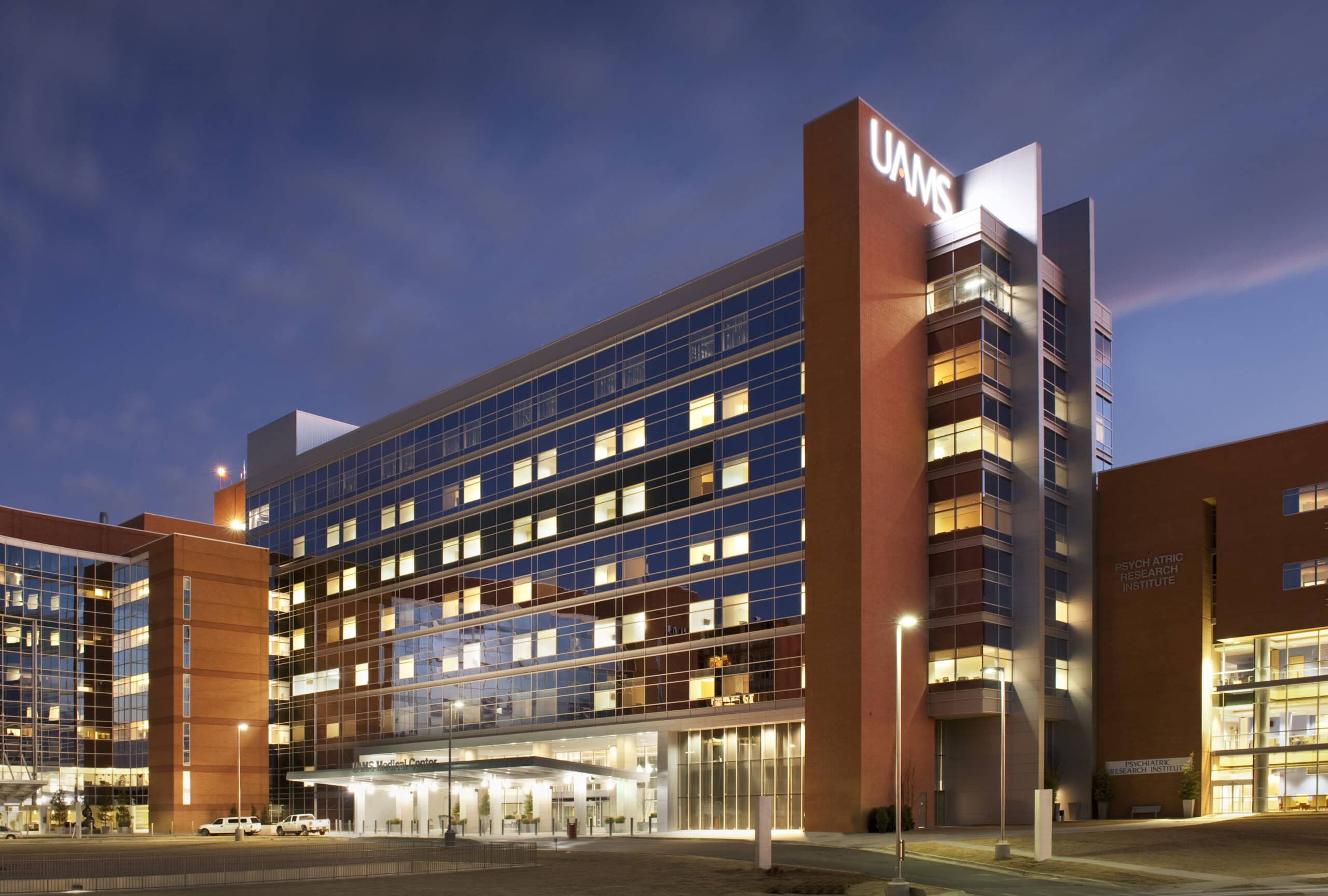
The Year in Review: UAMS Steadily Progresses in All Areas while Seeking a New Chancellor
| Every year brings change, and in 2025, a significant change in the leadership of the University of Arkansas for Medical Sciences (UAMS) came in the middle of the year when Cam Patterson, M.D., MBA, stepped down as chancellor after seven years in the role.
He announced his resignation in June, and it became effective July 10. To serve as interim chancellor, the University of Arkansas (UA) System selected C. Lowry Barnes, M.D., professor and chair of the Department of Orthopaedic Surgery and Rehabilitation and founding director of The Orthopaedic and Spine Hospital at UAMS.
UA System President Jay B. Silveria on Dec. 4 announced the selection of four finalists in the search for the next university chancellor. Earlier this month, each of them in turn visited UAMS’ Little Rock and Northwest Arkansas campuses, gave presentations, and met with faculty, staff and students.
Autumn brought a bountiful harvest in fundraising. In September, the Winthrop P. Rockefeller Cancer Institute raised a record-shattering $2.8 million at its annual Gala for Life black-tie event. The university set another new record, raising more than $1.3 million during its one-day Day of Giving on Oct. 8.
That fundraising success showed that despite the transition to new leadership, the university was not about to slip into pause mode. Just as it did before June, UAMS continued to provide patient care, educate students and innovate in research areas, continuing to attract research grant funding despite new challenges at the national level.
Patient Care
The UAMS Institute for Community Health Innovation announced in January it will train 80 doulas over the next year through a comprehensive program administered with partners including Ujima Maternity Network and Birthing Beyond.
In February, the Arkansas Perinatal Quality Collaborative — a partnership between UAMS, the Arkansas Department of Health and 34 birthing hospitals — launched an initiative to rapidly address a congenital syphilis problem. Throughout the year, UAMS’ Arkansas Center for Women & Infants’ Health rolled out several initiatives — postpartum alert bracelets, mother and infant supply kits, and a Proactive Postpartum Call Center — in an effort to reduce maternal and infant mortality rates statewide. Expanding on this commitment to maternal care, UAMS received a federal grant of nearly $4 million in October to reduce maternity-associated health problems and deaths in Ashley and Union counties.
UAMS achieved several surgical firsts in early 2025. In February, the university was designated the state’s only Center of Excellence for AMS 700 Inflatable Penile Prosthesis implantation for erectile dysfunction. That same month, the spine team celebrated completing more than 500 robotic spine surgeries, a milestone reached just four and a half years after the first procedure. UAMS also became the first Arkansas provider of NanoKnife technology for localized prostate cancer.
Innovation continued through the spring and summer. Surgeons performed the first transplantation in Arkansas of NRTX-1001 interneuron cell therapy into a patient with non-lesional epilepsy as part of an FDA-approved clinical trial. In August, UAMS performed the state’s first minimally invasive treatment for severe tricuspid regurgitation, offering hope to patients unable to undergo open-heart surgery. On Sept. 25, a clinical team including a urologist, physician assistant and medical student performed the first surgical procedure, a vasectomy, at the UAMS 12th Street Health & Wellness Center.
Supported by a $2.5 million grant from the Arkansas State Legislature, UAMS began expanding residency programs in south Arkansas in June. The university hosted its first Multiple Sclerosis Symposium that month to discuss the neurological disease.
On April 7, the university launched UAMS Health OrthoNow, a walk-in clinic for orthopaedic patients 12 and older. Also that month, bariatric surgery was added to the options at the UAMS Health Medical and Surgical Weight Management Clinic.
Expansion efforts continued into the fall. A July partnership between the Winthrop P. Rockefeller Cancer Institute and Arcare aims to improve colorectal cancer screening rates in seven rural counties. In September, UAMS and the ALS Association celebrated the opening of a multidisciplinary clinic for amyotrophic lateral sclerosis at the Northwest Regional Campus in Fayetteville.
In August, UAMS was rated among the top 10% nationally for cancer care and orthopaedic care by U.S. News & World Report in its 2025-2026 Best Hospitals ranking. UAMS also received five-star ratings for its treatment of heart failure, pneumonia and sepsis from Healthgrades, placing UAMS among the top 10% of hospitals nationwide for exceptional clinical performance in cardiac, pulmonary and critical care areas.
In another major recognition of quality, the kidney and liver transplant programs were honored in September with the John M. Eisenberg Award for Local Achievement in Patient Safety and Quality.
Education
In February, the Fay W. Boozman College of Public Health announced it would offer an Environmental Health Sciences doctoral program beginning in the fall 2025 semester, teaching students how the environment impacts human health.
April brought national recognition and regional expansion. The colleges of Medicine, Nursing, Health Professions and Public Health ranked among the top programs in U.S. News & World Report’s Best Graduate Schools for 2025. Simultaneously, UAMS and Washington Regional Medical Center received initial accreditation to establish neurology and emergency medicine residency programs in Northwest Arkansas.
Leadership updates followed in late spring. In May, UAMS announced that Sarah Jane Rhoads, Ph.D., DNP, a native Arkansan and former faculty member, would return as the next dean of the College of Nursing on Sept. 1. The university hired Brian W. Jones, DHSc, in June as the next vice chancellor for Regional Campuses. Starting Aug. 1, Jones replaced Richard Turnage, M.D., who retired after a distinguished career as a surgeon, educator and administrator, including more than 15 years in UAMS leadership.
Also in June, participants in the Institute for Community Health Innovation’s doula training program began receiving college credit through a continued partnership with the University of Arkansas Hope-Texarkana.
A $75,000 grant from the American Board of Family Medicine Foundation was received in July to help develop an educational collaborative aimed at improving and unifying family medicine residency programs across Arkansas.
In September, the College of Nursing received preaccreditation status to establish the state’s first nurse-midwifery program, set to launch in fall 2026.
A multiyear $1.5 million grant from the National Cancer Institute in November will support UAMS as it creates a new graduate-level certificate program focused on the commercialization of cancer-related technologies.
Philanthropic support came in March when Cathy Cole and Denton Seilhan pledged $1 million to the university. This gift established the Cathy Cole Seilhan and Denton Seilhan Endowed Chair for Child and Family Resilience in the College of Medicine’s Department of Family and Preventive Medicine. Gifts totaling more than $2.1 million in June funded the creation of the Jeanne Wei, M.D., Ph.D., Distinguished Chair for Leadership in Geriatric Medicine, an endowed fund in the Donald W. Reynolds Institute on Aging.
Research
In January, Eric Peterson, Ph.D., became president of BioVentures LLC at UAMS, a position he had held on an interim basis since March 2024.
The Winthrop P. Rockefeller Cancer Institute saw significant grant funding and academic publication throughout the year. In March, Ping-Ching Hsu, Ph.D., a researcher in the Cancer Institute, received a $1.9 million grant from the National Institute of Environmental Health Sciences to study the role of environmental exposures in the development of early onset breast cancer in Arkansas women.
Scientific progress continued in April when a team led by Tudor Moldoveanu, Ph.D., uncovered novel insights into apoptosis, the body’s fundamental process of programmed cell death. These findings were published April 4 in the high-impact journal Molecular Cell.
In August, new findings regarding a stealthy virus linked to cancer led to two grants totaling $3.42 million from the National Institutes of Health. By September, UAMS received a five-year, nearly $5.8 million grant from the National Institutes of Health to continue research into the often-overlooked side effects of cancer therapies, including radiation and chemotherapy.
UAMS researcher Nakita Lovelady, Ph.D., MPH, received $3.8 million from the NIH in October to lead a three-year trial reducing risky firearm behaviors among assault survivors.
The UAMS Institute for Community Health Innovation drove major initiatives in maternal health. In March, researchers found that excessive gestational weight gain is linked to an increase in cesarean sections, according to a study published in the American Journal of Obstetrics and Gynecology.
Researchers also determined that digital health care, such as virtual doctor’s appointments, could fill gaps in care services for postpartum mothers and help doctors identify critical needs earlier. To further support these efforts, the institute will expand research for maternal health in Arkansas by establishing the Maternal and Reproductive Community Health Excellence (MaRCH) research center, funded through an $11.7 million grant from the National Institutes of Health Centers of Biomedical Research Excellence.
Two cancer-related research grants bookended 2025, one in January and a second in December. Craig Forest, Ph.D., led a research team that found that a viral protein helps a cancer-associated herpesvirus evade the immune system, earning a five-year, $2.9 million NIH grant in January for further research. More recently, the NIH awarded a five-year, $10.5 million grant to UAMS to develop biomarkers for all human diseases including cancer.
During its annual meeting in September at UAMS, the Arkansas Biosciences Institute announced it had achieved a major milestone with ABI-supported researchers securing more than $1 billion in research funding from outside Arkansas since its creation in 2000.
In other significant research, Yong-Moon “Mark” Park, M.D., Ph.D., led a study that investigated whether physical activity could lengthen life expectancy for patients with dementia.