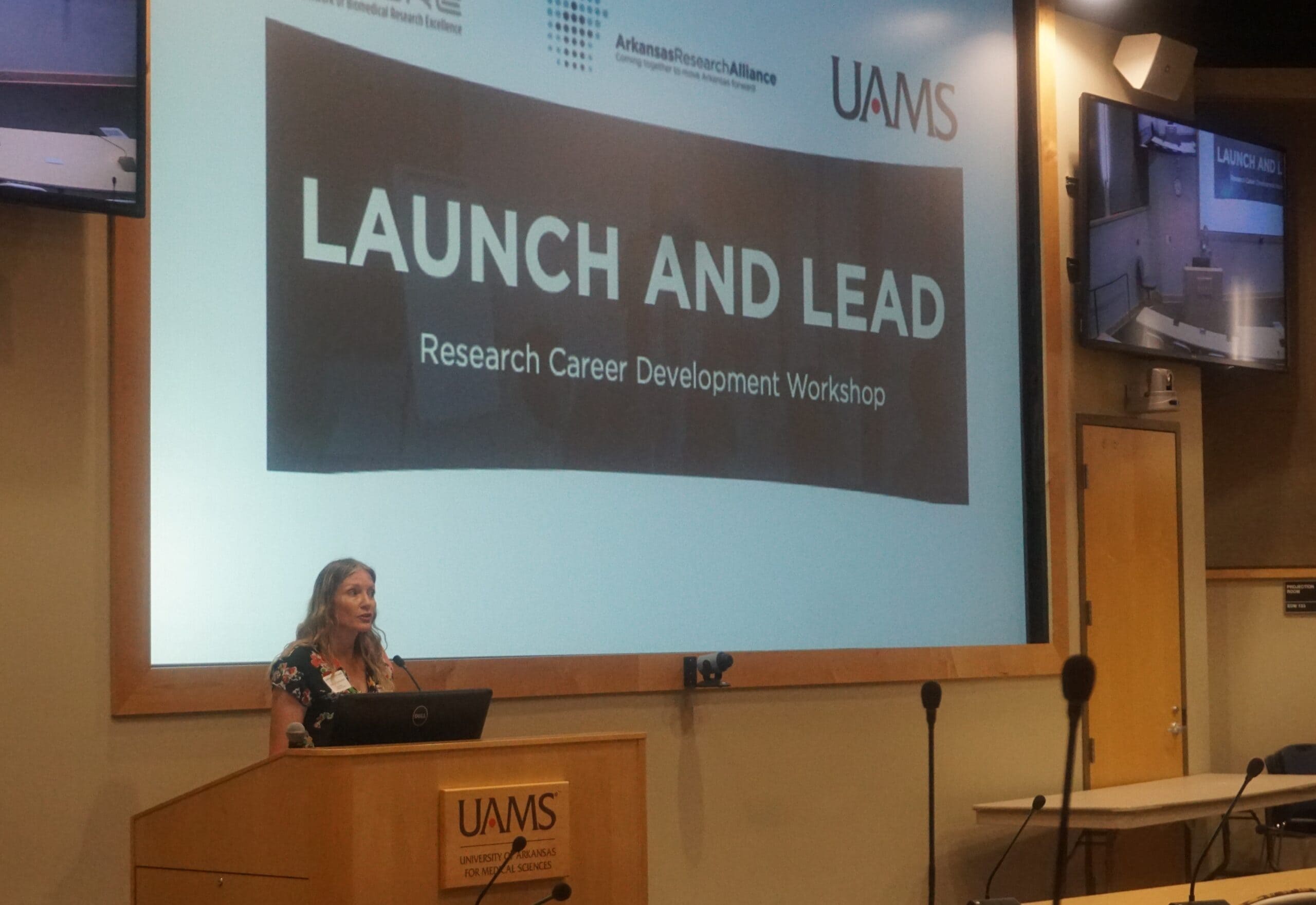
Workshop Helps Arkansas Researchers Build Skills Beyond the Laboratory
| Students, faculty, and research staff from across Arkansas recently gathered at the University of Arkansas for Medical Sciences (UAMS) for the inaugural Launch and Lead: Research Career Development Workshop, a one-day event designed to strengthen their skills, build relationships, and help them make an impact beyond the lab.
Hosted by UAMS’ IDeA Network of Biomedical Research Excellence (INBRE) program, in partnership with the Arkansas Research Alliance, the June 24 workshop drew nearly 70 attendees from 12 institutions across the state, including faculty members, professional research staff, and undergraduate and graduate students.
“The vision behind Launch and Lead is to provide students, trainees, faculty, and researchers at every career stage with the tools, skills, and relationships needed to facilitate their work making an impact beyond the lab and in the community, particularly for primary undergraduate institutions in Arkansas,” said Samantha Kendrick, Ph.D., associate professor in the UAMS College of Medicine Department of Biochemistry and Molecular Biology and the AR INBRE liaison for primary undergraduate institution faculty.
The event featured three flexible session tracks focused on students, research writing, and career development. Participants could attend sessions across tracks based on their individual interests and career goals. Topics included entrepreneurship, laboratory management, career development, responsible artificial intelligence (AI) use in research, building biosketches, maximizing research and internship experiences, and crafting effective oral presentations.
Stefanie Leacock, Ph.D., assistant professor and director of research at the Lyon College School of Dental Medicine in Little Rock, attended sessions on research writing, communicating scientific messages, and responsible AI use.
Among the highlights, she said, were presentations covering new government grant submission requirements, responding to manuscript reviewers, and communicating the broader impact of research proposals.
“The Message Box session helped me break down how to communicate the big picture of a problem, solution, benefits, and potential impacts for a grant submission,” Leacock said.
She also appreciated guidance from Joe Faith, D.Eng., an assistant professor of computer science and artificial intelligence at Harding University, on responsible AI use in research, noting his advice to treat AI models like “a junior intern” that requires careful supervision.
Leacock said professional development opportunities such as Launch and Lead are essential because successful researchers need skills that extend beyond scientific expertise.
“INBRE workshops like this one, as well as the fall research conference, provide me with new perspectives, information about current projects in the state, and connection with other faculty,” she said. “At Lyon College School of Dental Medicine, we are only in our second year, so building our research program through shared knowledge, skills, and collaboration is extremely important to our mission of improving oral health in Arkansas.”
For undergraduate participants, the workshop also offered valuable guidance for future careers.
Jadyn Wilhite, a rising senior majoring in biochemistry and molecular biology for pre-medicine at Harding University, attended the student breakout session, networking lunch, and graduate and professional school fair.
“The workshop provided me with a set of realistic, tangible ways to convey my research effectively and emphasized the importance of building professional skills outside of the lab,” Wilhite said. “Understanding the importance of networking, professional communication, and long-term career planning will guide my future in biomedical research and medicine.”
A member of INBRE’s 10-week summer research program, Wilhite said a discussion on creating and delivering effective oral presentations was especially impactful.
“I feel better equipped to communicate difficult scientific topics to all audiences, a skill set that will allow me to deliver challenging outcomes to patients from all backgrounds,” he said.
Kendrick said the workshop helps address an important need by providing expertise and resources that many institutions cannot offer on their own while connecting researchers across Arkansas.
“Workshops like this are incredibly important because while the laboratory is where we learn specialized techniques and perform experiments, there are other aspects needed for being a successful researcher,” Kendrick said. “Building effective communication skills to disseminate our discoveries, leveraging emerging tools like AI to enhance our research, and understanding entrepreneurship opportunities to translate our work into practical real-world solutions are also critical. Likewise, understanding what funding opportunities and shared core facilities are available provides resources for continued growth in our research.”